How to choose your first rabbit: the criteria that matter
Veterinary note — This article helps you choose an animal, not assess its health. Any rabbit with discharge, a soiled rear end, weight loss or unusual behaviour should be seen by a rabbit-savvy vet, before or immediately after adoption.
For a first rabbit, the profile that causes the fewest problems is an adult, already neutered, short-coated, medium-sized animal whose day-to-day behaviour the rescue or breeder can actually describe. And above all: the choice is made on your household’s constraints first, and on the animal you like second.
This page is about choosing the individual and the profile. Comparing rescues, breeders and pet shops stays in should you adopt or buy a rabbit, the age-by-age comparison in the best age to adopt a rabbit, and the question of sex in male or female rabbit.
Three questions to settle before looking at a single rabbit
A bad first rabbit is, in the vast majority of cases, a well-chosen rabbit in a household that was not.
- Where exactly will it live? Not “in the living room”, but how much floor space, in which room, on what surface. The benchmarks for space and flooring are in what size enclosure for a rabbit; if you live in a flat, what that imposes on the choice of animal is set out in which rabbit suits apartment living.
- How many hours out of the pen, and when? The floor is 3 to 4 hours a day, at the times a rabbit is actually active — see how many hours of exercise does a rabbit need. If those hours do not exist in your week, no rabbit profile will compensate.
- Who is looking after it in eight years? Rabbits commonly live 8 to 12 years. It is an adult’s commitment, including when the animal is requested by a child, as are rabbits good pets for children sets out.
Once those three answers are written down, choosing the animal becomes far simpler — and far quicker. They rule out certain sizes and coat types on their own: the detail is in the main domestic rabbit breeds.
The profile that makes the first six months easier
No profile guarantees an easy rabbit. Some simply avoid piling up unknowns at the moment when you are learning everything.
| Criterion | What makes life easier | What complicates it | Why |
|---|---|---|---|
| Age | Adult, fully grown | Newly weaned baby | The adult character is already readable |
| Neutering | Already done by the rescue | Still to arrange in the coming months | One appointment, one cost and one recovery fewer |
| Coat | Short or medium coat | Long, angora-type coat | Grooming becomes a daily job during a moult |
| Size | Medium build | Very large breed | Space, weight to lift, transport, bigger equipment |
| Litter habits | Tray already used where it lives | No training started | Several weeks of work saved |
| History | Behaviour described by the rescue | Unknown animal, no records | You choose on facts rather than an impression |
The most underrated line in that table is neutering already done. It removes the trickiest milestone of the first months and settles the behaviours tied to sexual maturity, covered in should you spay a female rabbit and should you neuter a male rabbit.
What a twenty-minute visit really tells you
A visit does not reveal a character, but it does give four usable pieces of information — provided you look at the right things.
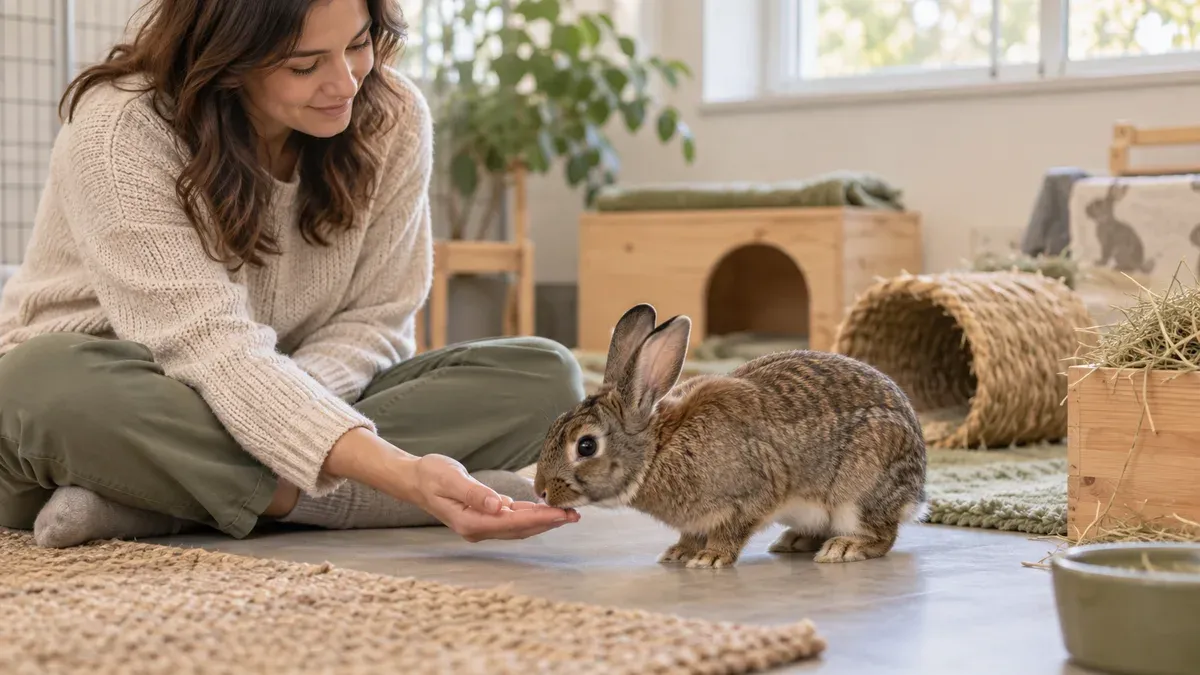
- The reaction to a hand placed on the floor. Crouch down, lay your hand flat, offer nothing. A rabbit that comes to sniff, or stays still and watches without bolting to the back of the pen, is showing useful baseline tolerance.
- Tolerance of care. Ask the person who looks after it how nail trims and ear checks go. That predicts your daily life better than a successful cuddle on the day.
- Activity level. A rabbit that explores, stands up on its hind legs and rearranges objects will need more space and enrichment than a settled one. Neither is a fault: it is a question of fit with your home.
- Litter habits already learned. A tray used most of the time saves several weeks, and is checked by looking at the pen rather than by asking.
And what a visit does not tell you: the reaction to travel, the behaviour three weeks later once the rabbit has relaxed, whether it will get on with another rabbit, tolerance of being picked up. On that last point the expectation is usually misplaced: most rabbits dislike being carried, including the most sociable ones, as my rabbit doesn’t like being picked up explains.
The criteria that are not criteria
- Colour and markings. They predict nothing about behaviour.
- The word “dwarf”. It describes a size, and is often used as a selling point. Hay, exercise and veterinary needs are identical to those of a bigger rabbit — what the label actually covers, and the few points where a small frame does change something, are set out in dwarf rabbits: adult size and real needs.
- Lop ears “because they look cuddly”. A lop’s temperament is not softer by design, and those ears need particular attention, as my rabbit keeps shaking its head sets out.
- “He came over to me.” A rabbit that approaches may be curious, used to visitors, or simply expecting food.
- A baby because it is small. Adult size arrives quickly, and a baby rabbit remains the most demanding option.
- Immediate availability. “He goes tomorrow” is not information about the animal; it is sales pressure.
Three profiles more demanding than they look
- The long-coated rabbit. Grooming is not optional: during a moult it becomes a daily job, and a neglected coat ends in tight mats that a professional has to cut out. What a moult actually demands is set out in rabbit moulting: normal or not.
- The large frame. An adult rabbit weighs anywhere from 1 to 7 kg depending on its lineage. A big rabbit means more floor space, a bigger tray, a carrier to match, and an animal that is harder to handle single-handed when care is needed.
- The unneutered rabbit approaching sexual maturity. It arrives at around 4 to 6 months and clearly changes behaviour — spraying, mounting, territorial aggression. That is not a problem in itself, but it is a decision to take in the first months, not a surprise to discover.
One rabbit, or two?
Rabbits are social animals, and living as a pair meets a need that people cannot substitute for. But adopting two strangers at once adds a major unknown to a first household. Two options hold up: adopt a bonded pair, whose social balance is already established, or start with one and arrange an introduction later. The decision criteria are gathered in can a rabbit live alone, and the method itself in how to introduce two rabbits.
The three facts to get about the individual you choose
For the specific animal you are taking home, three things genuinely change the first six months:
- The exact date of birth, and who checked the sex. Mis-sexing remains common and expensive; age governs when a rabbit may leave, as when is a rabbit weaned sets out.
- The exact current diet — type of hay, brand of pellets, vegetables given — to reproduce identically for the first few days, then change gradually following how to transition a rabbit’s diet.
- Neutering, microchipping and vaccination status, with the paperwork to match. Protocols and available vaccines vary by country: these benchmarks apply to the United Kingdom and Western Europe, and should be confirmed with a local rabbit-savvy vet (rabbit vaccination schedule).
How you obtain those facts depends on where you adopt: it is set out route by route in adopting a rabbit from a rescue, how to choose a rabbit breeder and buying a rabbit from a pet shop.
Where to go next
A concrete next step: before contacting anyone, write down your three answers — available space, realistic hours out of the pen, the person responsible — then call two rescues describing that framework rather than asking “what rabbits do you have”. A good rescue will steer you towards two or three compatible individuals on its own. Then set up before the arrival, using what accessories are truly essential for a rabbit and the budget in how much does a rabbit cost per month. Our other guides are gathered in the rabbit adoption section and on the rabbit species page.
Sources and references
Frequently asked questions
Is a baby rabbit easier to tame than an adult?
No, and the belief is remarkably persistent. A baby rabbit means going through sexual maturity, neutering, the end of growth and litter training, with no way to predict the adult character. An adult arrives with a temperament you can already read, and trust builds with an adult just as it does with a youngster, at a pace that depends mainly on the method you use.
Should I pick the rabbit that comes over to me in the pen?
It is a clue, not a criterion. A rabbit that approaches may be curious, used to visitors, or simply expecting food. A rabbit that keeps its distance may just be on alert in a busy room. What reads better is the reaction to a hand placed flat on the floor, how quickly the rabbit settles after a noise, and how it tolerates being handled for care.
Is a dwarf rabbit the best choice for a beginner?
Not necessarily. Dwarf describes a size, not a character or an easier animal to keep: exercise, hay and veterinary needs are identical. A medium-sized, calm, already-neutered rabbit is often simpler to live with than a very small, newly weaned one that is more fragile to handle.
Can I choose a rabbit from a photo, at a distance?
That is the one case where waiting is better. A photo says nothing about handling, the state of the eyes and nose, or the condition of the rear end. If travelling is impossible, ask for a video of the rabbit moving around its space and have the rescue or breeder describe precisely what they observe day to day.