Which rabbit should you choose for apartment living?
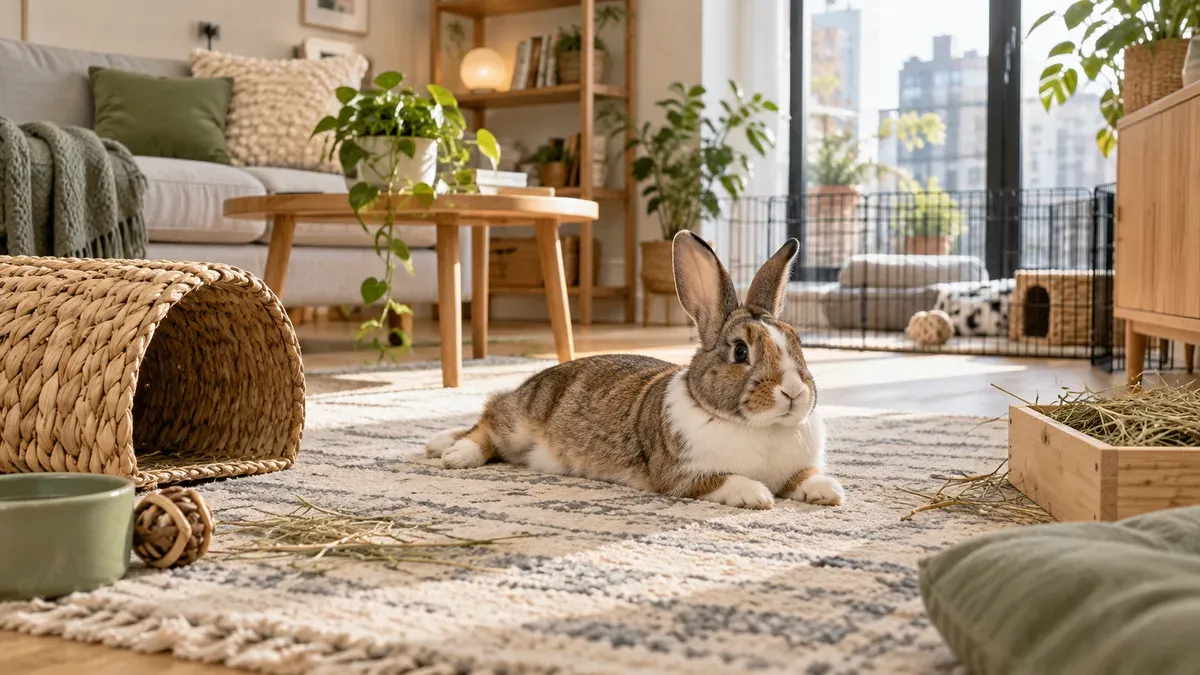
In a flat, the choice comes down to four things: the floor space genuinely available, what that floor is made of, the exercise hours your week actually contains, and tolerance for noise in both directions. The rest — colour, breed, lop ears — changes nothing about life in an enclosed home.
Put differently, you are not choosing “an apartment rabbit”: you are choosing a rabbit compatible with the apartment you have. This guide is about the animal; setting up the home itself is covered in keeping a rabbit in an apartment, and choosing the individual more broadly in how to choose your first rabbit.
Floor space decides, not the number of rooms
A well-organised studio suits a rabbit better than a large but cluttered flat. What counts is free, continuous floor space — a rabbit does not climb, it runs in straight lines and changes direction sharply.
The common markers are at least 2 m² of base space for a rabbit under 2 kg, plus 4 m² of free exercise, for a minimum of 3 to 4 hours a day. Since an adult rabbit weighs anywhere from 1 to 7 kg depending on the line, those figures rise with size. The detail is in what size enclosure for a rabbit, and the exercise hours in how many hours of exercise does a rabbit need.
Measure that space before looking at a single rabbit. If it does not exist, no size compensates: a small rabbit in an inadequate space is still a rabbit in an inadequate space.
Size: what a small format changes, and what it does not
| What size does change | What it does not change |
|---|---|
| The footprint of the tray, carrier and pen | Unlimited hay as the basis of the diet |
| How easy the rabbit is to lift for care | The 3 to 4 daily hours out of the pen |
| The gaps behind furniture you must block | The 8 to 12 year commitment |
| The base area to plan for | Vet costs, which do not scale with weight |
“Dwarf” is the most overrated apartment criterion: it describes a size, not ease of care, and it guarantees no adult weight. What the label actually covers is set out in dwarf rabbits: adult size and real needs.
Conversely, a large rabbit in a flat is not absurd: it simply needs more base area, a wider tray, a suitable carrier, and an adult able to handle it alone at the vet.
Noise, in both directions
This is what prospective adopters in flats anticipate least.
From the rabbit to the neighbours: rabbits do not call out, but they thump, dig against partition walls and push their bowls around, mostly at dawn and dusk when they are most active. These are impact noises, carried through the floor. Two fixes usually cover it: stand the pen on a thick rug, and keep it away from a shared wall or the head of a bed. What these behaviours mean is explained in why does my rabbit thump and why does my rabbit dig everywhere.
From the neighbours to the rabbit: a home crossed by sudden noise — building work, a shared stairwell, music — weighs on a prey animal. In that case, favour an adult already described as settled over a young rabbit whose reactivity is unknown, and plan an enclosed hiding place in the pen. The confidence-building method is in how to tame a fearful rabbit.
Three housing constraints that genuinely steer the choice
- Slippery flooring. Sealed wood, tiles and laminate make paws skid at every acceleration. An older, overweight or large rabbit is more exposed than a light young one. Suitable surfaces are compared in the best floor surface for rabbits.
- Heat on upper floors. Above 28 to 30 °C a rabbit is at risk: it cannot sweat. A top floor without air conditioning means planning for summer — see what temperature can rabbits tolerate and how to keep a rabbit cool in summer. In a home that heats up sharply, a long-coated or overweight rabbit is the least suitable profile.
- Cables and reachable furniture. In a flat, everything is within reach. A rabbit that chews is a normal rabbit: it is the room that adapts, as described in how to rabbit-proof a room. A very active, exploratory rabbit simply calls for more thorough proofing than a settled one.
One rabbit or two when you are out all day
Rabbits are social animals, and being out during the day is the norm in city living. A bonded pair keeps itself occupied and copes better with long stretches without people; in exchange they need more space, two water points and double the veterinary budget.
Two options work in a flat: adopt an already bonded pair, whose balance is established, or start with one and arrange a bonding later. The decision criteria are gathered in can a rabbit live alone, the method in how to introduce two rabbits. What to avoid: adopting two strangers on the same day and hoping they get along in a confined space.
The apartment criteria that are not criteria
- “It was calm in the pet shop.” A rabbit sitting still in a busy place is often an alert rabbit, not a settled one.
- “A cage takes up less room than a pen.” It takes up less floor and far more of the rabbit’s life: a 120 × 60 cm cage is only 0.72 m². The comparison is in rabbit cage or pen.
- “Rabbits get used to anything.” They adapt to an enclosed home, not to the absence of exercise or to excessive heat.
- “Lop ears mean a calmer rabbit.” Temperament cannot be read from ear type.
- “A long coat is just a look.” During a moult, brushing becomes daily and loose fur circulates in an enclosed space: see rabbit moulting: normal or not.
Matching the profile to your home
| Your situation | Profile to favour | Watch out for |
|---|---|---|
| Studio or one-bed, limited free floor | Adult, small to medium, already neutered and litter trained | Daily run across the whole room, not just around the pen |
| A dedicated room available | Any size, including large | Secure cables and skirting before arrival |
| Top floor, hot in summer | Short coat, healthy weight | A cooling plan ready before June |
| Older building, thin partition walls | Adult described as settled | Pen on a rug, away from shared walls |
| Out during the day | Bonded pair, or a single rabbit with enrichment | Double the space and the budget for a pair |
| Cat or dog already at home | Adult used to other animals, as described by the rescue | Separate spaces and gradual introductions |
Where to go next
One concrete next step: measure the free floor space in the room where the rabbit will live, count the exercise hours genuinely available in a typical week, then note how hot the flat gets at the height of summer. Those three figures written down are enough to frame the conversation with a rescue or a breeder, and they rule out unsuitable profiles by themselves. The routes to adoption and their respective checks are set out in adopting a rabbit from a rescue and how to choose a rabbit breeder, and the budget in how much does a rabbit cost per month. Our other markers are in the rabbit adoption section and on the rabbit species page.
Sources and references
Frequently asked questions
Should I pick a dwarf rabbit because the flat is small?
No, and it is the most common shortcut. Size changes how much room the equipment takes up, not the rabbit's needs: unlimited hay, 3 to 4 hours of daily exercise and veterinary care are identical. A medium-sized rabbit, calm and already neutered, often needs fewer adjustments in a small home than a very young rabbit bought for its advertised size.
Will a rabbit make noise for the neighbours in a block of flats?
Rabbits barely vocalise, but they thump, dig against partition walls and shove their bowls around, mostly at dawn and dusk when they are at their most active. The noise that travels is impact noise, not airborne noise. Standing the pen on a thick rug and moving it away from a shared wall or a bedroom solves most situations.
Is a flat with no balcony or outdoor space enough for a rabbit?
Yes, provided the exercise hours genuinely exist. An indoor rabbit needs neither a garden nor a balcony: it needs secured floor space, a non-slip surface and time outside the pen every day. A balcony is extra space, never a substitute for the daily run in the room.
Is it better to adopt a rabbit that is already litter trained for a small space?
It is a real advantage in a flat, where accidents are noticed immediately. A rabbit that is already neutered and uses its tray at the rescue saves you several weeks. One caveat: litter training learnt elsewhere often lapses for a few days after the move, while the rabbit marks its new territory, before returning on its own.