How to keep a rabbit cool in summer safely: methods that work
Veterinary warning — Rabbits tolerate heat very poorly and can suffer fatal heatstroke in under an hour. This article is about prevention; faced with a rabbit that is prostrate, breathing fast, with burning-hot ears, it is an emergency: call a vet without delay.
To keep a rabbit cool in summer without endangering it, rely on passive, gradual methods: a ceramic or marble tile kept cool, a frozen water bottle wrapped in cloth, a room with shutters closed and indirect ventilation. Conversely, never point a fan at it, don’t bathe it, and don’t use ice in direct contact. Rabbits don’t sweat: their comfort depends mainly on the actual room temperature, not gadgets.
Why heat is such a threat to rabbits
Rabbits don’t sweat and regulate temperature poorly. Their only tools — dilating the blood vessels in their ears and breathing faster — are quickly overwhelmed. Ideally, their living area stays around 18–20 °C. As the room warms beyond that, they need access to a cooler area; humidity, direct sun and poor airflow increase the risk. For season-specific monitoring, see our guide what temperature can rabbits tolerate.
The goal, then, isn’t to “cool” the animal in bursts, but to keep its room below the danger threshold and offer cool spots where it chooses to lie down itself.
The methods that genuinely work
Act on the room first
This is the most effective lever, before any accessory:
- close shutters, blinds and curtains during the day on the sunny side, to block radiant heat;
- air the room early morning and late evening, when the outside air is cooler, then close up again;
- avoid placing the enclosure facing a picture window or near a heat source;
- if you have air conditioning, set it gently (around 24–25 °C) with no direct airflow on the rabbit.
Offer cool spots
A rabbit can thermoregulate if it has the choice. Make available, without forcing it:
- a ceramic, granite or marble tile on the floor (you can chill it in the fridge for a few minutes): the rabbit lies belly-down against the cool;
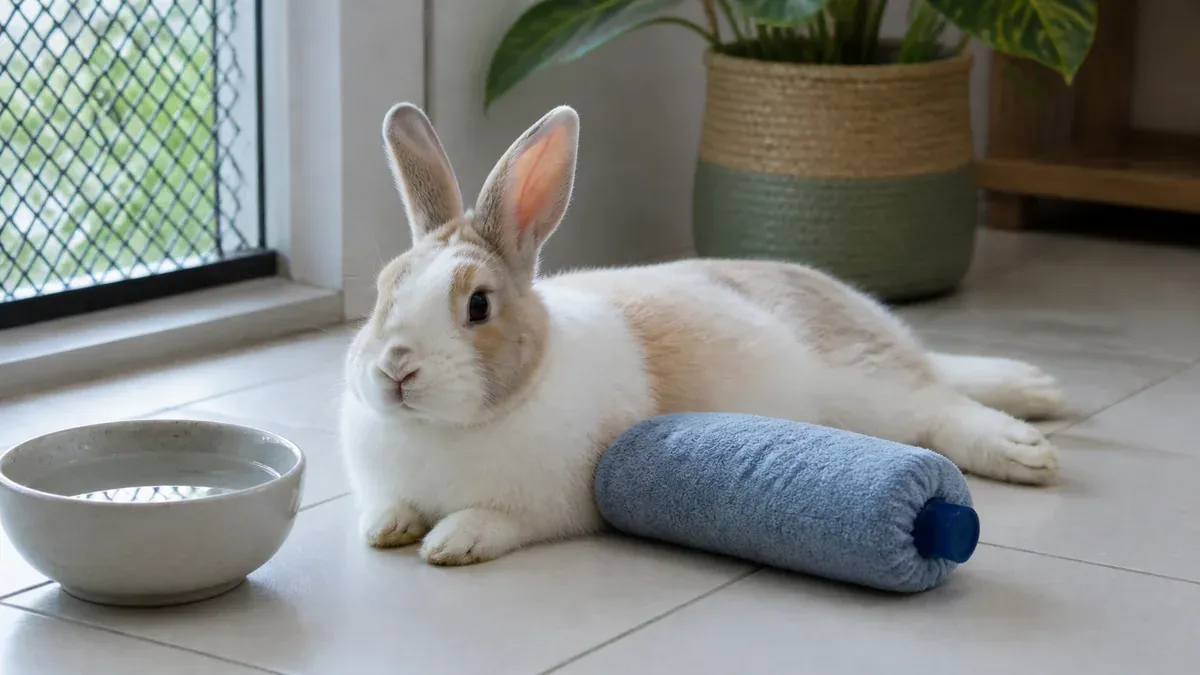
- a frozen water bottle wrapped in a thin cloth: it presses against it when needed. Always wrap it and replace it once thawed;
- a cooling mat made for pets, if it doesn’t nibble it.
Ventilate without blowing on the animal
A fan aimed at the wall moves the room’s air without bothering the rabbit. Another effective trick: point the fan at a frozen water bottle to spread slightly cooler air around. Never aim the flow directly at the rabbit.
Support hydration
In severe heat, a rabbit drinks more. Offer fresh, renewed water (a wide bowl keeps it cooler than a bottle), and lean on water-rich leafy greens, well washed, that hydrate gently. Dehydration quickly worsens heatstroke.
The mistakes you must never make
| To avoid | Why it’s dangerous |
|---|---|
| Bathing or wetting the whole rabbit | Thermal shock and intense stress, risk of collapse |
| Pointing a fan straight at it | Stress, dried mucous membranes, ineffective cooling |
| Putting ice in direct contact with the skin | Abrupt cooling, poorly tolerated |
| Leaving the enclosure in the sun “just for an hour” | The temperature climbs very fast, even in partial shade |
| Leaving the rabbit in a warm car or carrier | Fatal temperature rise within minutes |
Fundamentally, remember that abrupt cooling is as risky as the heat itself: aim for gradual cooling and letting the rabbit choose.
Special cases: balcony, outdoors, fragile rabbits
A rabbit on a balcony faces both direct sun and glare: shade it generously and bring it in during the hot hours — see how to make a balcony safe for a rabbit. A rabbit kept outdoors must have a permanent, cool shaded area; in a heatwave, shade isn’t enough and it must be brought in, as our guide on keeping a rabbit outdoors reminds you.
Some rabbits are more vulnerable and need extra vigilance: elderly rabbits, round-headed dwarf breeds, overweight rabbits, pregnant or nursing does, and sick animals. For them, start cooling measures before the room becomes uncomfortable.
Recognising the tip into an emergency
Cooling is prevention; it doesn’t replace emergency care. If, despite everything, your rabbit is breathing very fast, stays prostrate, has burning-hot ears, drools or stops responding, that is heatstroke: call a vet immediately and apply the first steps described in our dedicated guide rabbit heatstroke. Never immerse the rabbit.
Going further
Conversely, when the cold sets in the logic flips: see how to keep a rabbit warm in winter for an insulated shelter and suitable bedding.
Browse all our rabbit housing guides and the rabbit species page to adapt its environment to every season.
Veterinary source
Frequently asked questions
Can I point a fan at a rabbit?
Not directly. Airflow aimed at the rabbit stresses it and dries its mucous membranes, without really cooling it since it doesn't sweat. Point the fan at a wall to move the room's air, or aim it at a frozen water bottle to spread coolness nearby, without blowing on the animal.
Should I wet a rabbit when it's hot?
Never bathe it and don't wet it all over: the thermal shock and stress can be serious. In severe heat you can lightly dampen the tips of the ears with cool (not cold) water: the ears act as the rabbit's radiator. If there are signs of heatstroke, it's a veterinary emergency.
At what temperature is a rabbit too hot?
Ideally, keep the living area around 18–20 °C. As the room warms beyond that, provide access to a cooler area and watch the rabbit's behaviour, especially in humid conditions.
Is a frozen water bottle really useful?
Yes, it's one of the simplest and safest methods. Freeze a water bottle, wrap it in a thin cloth and set it in the enclosure: the rabbit lies against it when it needs to. Always wrap it to avoid direct contact and damp, and replace it once it has thawed.