Are air fresheners dangerous for rabbits? Sprays, plug-ins, candles
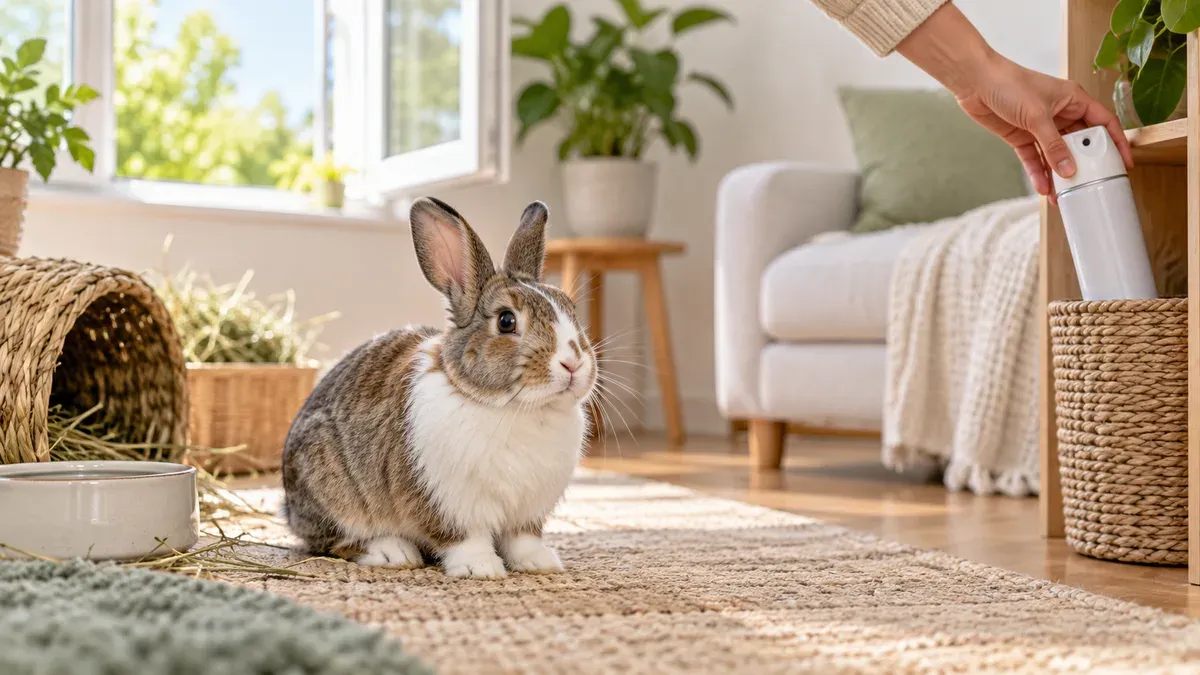
Veterinary warning — This article is about prevention and setup. Repeated sneezing, nasal discharge, weepy eyes or laboured breathing are never a matter of adjusting a household product: they need the opinion of a rabbit-savvy vet.
As a precaution, scented air fresheners have no place in a rabbit’s room: aerosol sprays, plug-in diffusers, essential oil diffusers, scented candles, incense, scented litter and “odour neutraliser” sprays for the tray. There is no validated exposure threshold for pet rabbits, and the veterinary references below do not rank every product. The aim is therefore to remove an avoidable respiratory exposure, not to claim that every fragrance causes poisoning.
And above all because they fix nothing: a masked smell is still a smell being produced. An ammonia smell is a reason to review tray size, litter depth and cleaning — a maintenance problem to correct rather than perfume (how to reduce rabbit litter odour).
Why a rabbit is far more exposed than you are
Four differences explain the gap in risk between owner and rabbit:
- It breathes through its nose, constantly. Rabbits are obligate nasal breathers: unlike you, they do not switch to mouth breathing when the air turns irritating. In this species, open-mouth breathing is a sign of distress, never a routine adjustment.
- It lives at floor level. Aerosol droplets and combustion particles come back down. They concentrate exactly where the rabbit sleeps, eats and grooms.
- It never leaves the room. You pass through the living room; it spends 24 hours a day there. Exposure that is “brief” for a human is continuous for the animal.
- It swallows whatever lands on it. Rabbits groom at length every day. Anything that settles on the coat ends up ingested — and rabbits cannot vomit.
There is one more thing owners rarely weigh: in a home, a rabbit’s air is also litter air. It is the combination of ammonia, fragrance and fine particles that matters, not the fragrance alone.
Product by product: what the problem is
| Product | What it does in the room | Verdict |
|---|---|---|
| Aerosol / room spray | Fine droplets in suspension, then settling on floor and coat | Avoid while the rabbit is present |
| Plug-in refill diffuser | Continuous release, no pause, usually at socket height so near the floor | Avoid |
| Essential oil diffuser or mister | Concentrated volatile compounds released continuously into a closed volume | Avoid, never in the rabbit’s room |
| Scented candle | Fragrance plus combustion particles, stale air in an unventilated room | Avoid |
| Incense, joss sticks | Dense smoke, large quantities of fine particles | Rule out |
| Scented litter | Fragrance in direct contact with nose and feet for hours a day | Avoid, choose unscented bedding |
| ”Neutraliser” spray for the tray | Sprayed exactly where the rabbit puts its head | Avoid |
| Scented fabric spray (rugs, sofa) | Deposits on the surfaces the rabbit chews and licks | Avoid, or keep out of its zone and only once fully dry |
| Pine / phenolic, ammonia-based cleaners, bleach | Respiratory irritants; bleach also reacts with urine | Rule out for the tray and its floor area |
| Ventilation, opening a window | Renews the air without adding anything to it | The right answer |
This ranking is not a measured toxicity scale: it is a common-sense order based on how long the exposure lasts and how close the product sits to the rabbit. Incense burned for ten minutes in an open room is not the same thing as a diffuser plugged in permanently thirty centimetres from a pen.
Essential oils deserve their own rule
They get a separate section because they are perceived as “natural, therefore harmless”. Three simple rules:
- Never on the rabbit, in any form — not on skin, not on fur, not as a collar, not as a home-made parasite treatment. Rabbits groom: whatever is put on them is swallowed within the hour.
- Never in the water or the food.
- No diffusing in its room, and certainly not continuously in a closed space.
Published data on sensitivity to essential oils largely concerns other companion species; there is no established exposure threshold for pet rabbits. That is precisely why caution applies: with no reference point, you do not continuously expose a small obligate nasal breather.
The smell you are masking has a cause
Before adding anything to the air, work through the five levers that actually solve the problem:
- A large, well-placed tray with hay at the edge (choosing the best litter tray).
- Absorbent, unscented bedding: the substrate comparison is set out in best bedding for rabbits.
- Regular cleaning, with diluted white vinegar followed by a clean-water rinse (how to clean a rabbit litter box).
- Real ventilation: ten minutes with a window open beats any fragrance, while avoiding a direct draught on the pen.
- Neutering or spaying, which noticeably reduces urine intensity and marking.
One point deserves attention: if the smell changes abruptly, becomes far stronger, or comes with puddles outside the tray, this is no longer a housekeeping question. Check the health side, starting with why is my rabbit peeing outside the litter box.
Signs of irritation to watch for
After an exposure, watch straight away for these signs:
- repeated sneezing, particularly right after the product is used;
- nasal discharge, even when clear;
- matted or crusty front paws — rabbits wipe their nose with them, which makes this a reliable clue;
- red or weepy eyes (conjunctivitis in rabbits);
- noisy, fast or open-mouth breathing: that one does not wait, it is an emergency (my rabbit is breathing fast).
Beware the commonest confusion: early on, irritation from a product and a respiratory infection produce very similar signs. Repeated or persistent sneezing, or any discharge, needs veterinary advice rather than a diagnosis at home (my rabbit sneezes, rabbit snuffles).
If you have already been using one
No need to panic, but follow a simple sequence:
- Stop the product and unplug or remove the diffuser from the room.
- Ventilate thoroughly, several times, without exposing the rabbit to a cold draught.
- Wipe with clean water everything it licks or chews: the floor of its area, the rim of the tray, bars, washable mats.
- Wash the textiles it lies on if the spray was applied to them.
- Watch and write down appetite, droppings, sneezing and the look of the nose.
- Call the vet if signs recur, persist or worsen, or appetite drops; laboured breathing is an emergency.
In a home where the air is hard to manage — open-plan kitchen, smoking, building work — the question to solve is where the pen sits, not which fragrance to use: the setup guidance is in keeping a rabbit in an apartment.
In summary
- Aerosols, diffusers, scented candles, incense, scented litter: keep them out of a rabbit’s room.
- Rabbits are more exposed because they breathe through the nose only, live at floor level, never leave the room and swallow what settles on their coat.
- Essential oils never go on a rabbit, never in its food, and are not diffused in its room.
- The real lever against smells is the tray, the bedding, the cleaning routine, ventilation and neutering.
- Persistent sneezing, discharge or laboured breathing: see a vet, do not just switch product.
Logical next step: walk through your home and remove anything releasing scent continuously at rabbit height, then work the odour levers in order instead of masking. To set up the rest of its space, browse our rabbit housing guides and the rabbit species page.
Veterinary sources and reference points
The sources below are used as veterinary or institutional reference points to frame this topic carefully: this article helps you remove an avoidable exposure, it does not let you diagnose a respiratory problem.
No numerical exposure threshold is given here, as none is established for pet rabbits: the recommendations rest on the precautionary principle and on the respiratory physiology of the species.
Sources used to frame these recommendations:
- RSPCA — Rabbit health and welfare
- VCA Hospitals — Rabbits: problems and diseases
- Merck Veterinary Manual — Noninfectious diseases of rabbits
Frequently asked questions
Is a 'natural' or aerosol-free air freshener safer for a rabbit?
Not necessarily. Labels like 'natural', 'organic' or 'propellant-free' describe how a product is made or released, not what its fragrance compounds do to a small herbivore's airways. A reed diffuser has no propellant and still releases scent continuously into the air the rabbit breathes. The only thing that genuinely improves a room's air is ventilation, not another product added to it.
Can I use a diffuser in a different room from the rabbit?
That is the only roughly acceptable setup, provided the room is genuinely separate, the door stays shut, and the rabbit never has access during free-roam time. In an open-plan flat or a studio the question does not arise: the air circulates and the rabbit is in it permanently. When in doubt, keep fragrance for times when the rabbit is out of the home.
Are white vinegar and bicarbonate of soda risky?
Diluted white vinegar can be used to descale an empty tray, provided it is rinsed with clean water and dried before the litter goes back. Do not add bicarbonate beneath the substrate: a rabbit can dig down to it, inhale it or ingest it. No cleaning product should remain wet or within licking reach.
My rabbit has been sneezing since I switched room sprays — what should I do?
Stop the product, ventilate thoroughly and wipe with clean water anything the rabbit licks or chews. Ask your vet for advice if sneezing recurs or persists, or if there is nasal discharge, weepy eyes or secretion-matted front paws. Laboured breathing is an emergency: irritation and infection cannot be distinguished by eye.