Rabbit in an apartment: complete setup guide
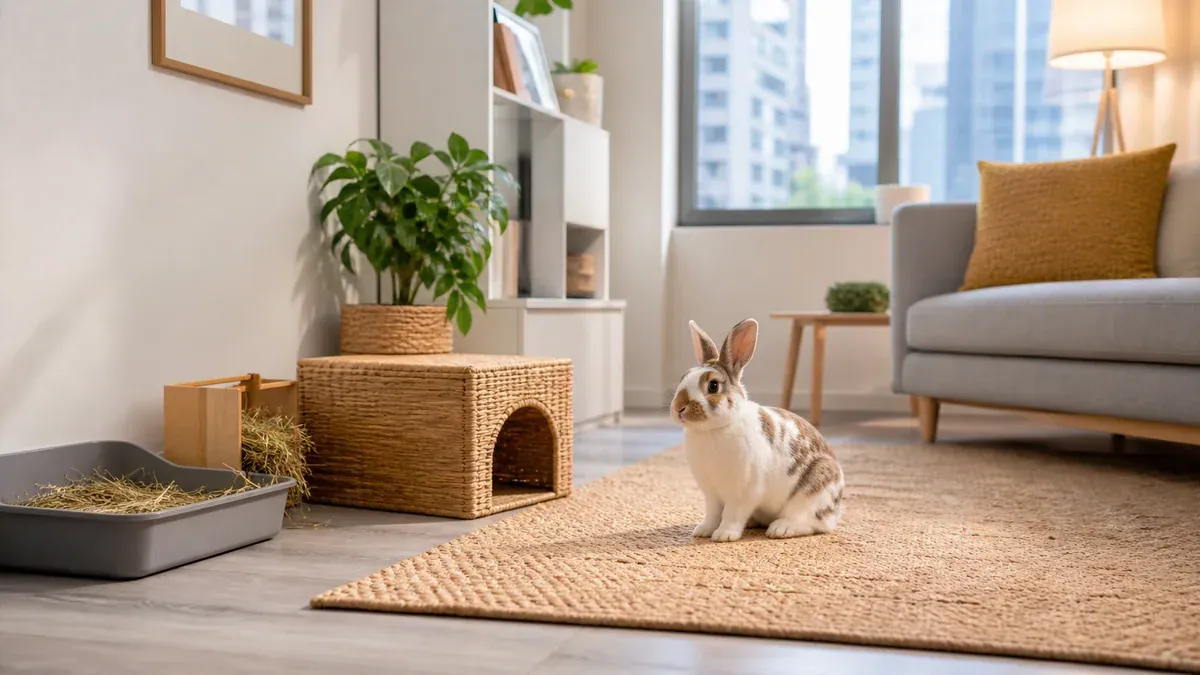
Rabbits and apartments are a perfectly workable combination — millions of people keep indoor rabbits in small to mid-size flats without issue. What makes it work is preparation, not square footage. Before you bring a rabbit home, four conditions need to be in place: enough daily exercise space, a properly rabbit-proofed environment, a consistent litter routine, and attention to the animal’s social needs. Get those right, and apartment life suits a rabbit just fine.
Space — the first requirement
The 4 m² minimum that welfare organisations recommend refers to the total space available for daily movement — not the floor area of a cage or pen. A rabbit that spends its day in a 60 cm × 90 cm hutch and gets fifteen minutes of run time is not meeting that threshold regardless of the hutch’s dimensions.
Free-roaming in a single room or across the full apartment is the ideal arrangement. The rabbit has constant access to space, interacts naturally with its environment, and gets exercise on its own schedule rather than waiting to be let out. If you use a pen or enclosure as a home base — for overnight, when you are away, or during the settling-in period — the pen itself should measure at least 2 m × 2 m. Smaller enclosures marketed as “rabbit cages” rarely meet that minimum. For a detailed comparison of pen and cage options, see the rabbit cage or pen guide, and for which room it should stand in, where to put a rabbit enclosure — in a flat the choice usually comes down to the living room or a bedroom, and it is not a neutral one. That same floor space is what frames the choice of animal if you have not adopted yet: which size, coat and temperament suit which home is set out in which rabbit suits apartment living.
Even in a free-roaming setup, aim for at least three hours of active time per day during which the rabbit is exploring rather than resting. When you are home all day, the practical goal is full-day access to the rabbit-proofed area. Rabbits are not passive animals — they investigate, rearrange, and cover distance throughout the day.
One important detail: the main movement area needs a non-slip surface. This matters more than most new owners expect and is covered in the flooring section below.
Rabbit-proofing the apartment — critical before arrival
A rabbit that free-roams will interact with everything at floor level. Rabbit-proofing is not optional and it needs to be done before the animal arrives, not after the first chewed cable or nibbled book.
Electrical cables
This is the highest-priority hazard. Any unprotected cable within reach will be chewed — not occasionally, but reliably. The risk is twofold: electrocution for the rabbit and a fire hazard for the apartment. Protect every cable with spiral plastic cable sleeves (sold in hardware and DIY stores) or rigid plastic tubing. Cables that cannot be sleeved should be routed behind furniture the rabbit physically cannot access. Do not rely on deterrent sprays — they are not consistently effective and not a substitute for physical protection.
Indoor plants
Many common houseplants are toxic to rabbits. The list includes pothos, dieffenbachia, philodendron, all lily varieties, aloe vera, and ivy. These plants should either be removed entirely from the rabbit’s accessible space or placed on high shelves or hanging fixtures the rabbit cannot reach. Before the rabbit arrives, walk through each room and check every plant against a reliable toxicity list. When in doubt, relocate the plant.
Objects at floor level
Newspapers, books, cardboard boxes, phone chargers, remote controls, shoes — anything left on the floor will be investigated and very likely chewed. Rabbits are not destructive out of spite; they explore with their mouths and have a strong instinct to gnaw. Store items at height, use closed storage boxes, and treat floor-level tidiness as a daily habit rather than a one-time step.
Hiding spots
Rabbits instinctively seek enclosed spaces: under sofas, behind the fridge, inside gaps between furniture and the wall. While a rabbit retreating to a safe spot is perfectly normal, some gaps are genuinely dangerous — a rabbit can wedge itself behind a fridge and overheat, or get trapped under certain sofa frames. Block problematic gaps with pieces of foam, rolled towels pushed firmly into place, or rearranged furniture. Give the rabbit one or two designated hideaways (a cardboard box with an entrance hole works well) so it has somewhere to retreat without going somewhere hazardous.
Flooring — a commonly overlooked problem
Smooth surfaces — polished tile, hardwood, laminate — are a genuine welfare issue for rabbits. A rabbit moving on slippery flooring cannot push off properly, loses traction mid-movement, and compensates by shuffling rather than hopping. Over time, repeated slipping causes strain injuries to the hindquarters and lower spine. In young rabbits or those that have slipped frequently, splay leg can develop.
The fix is straightforward: cover the main movement area with area rugs, jute mats, cork tiles, or interlocking foam tiles. The covering does not need to be expensive or continuous — what matters is that the rabbit has reliable traction in every part of the space it regularly uses. At an absolute minimum, place a non-slip mat directly under and around the litter tray, since this is the spot where the rabbit will be stopping and pivoting most often.
For guidance on litter tray substrate that also helps with traction and absorbency, the best bedding for rabbits guide covers the main options in detail.
Litter training in an apartment
Litter training is non-negotiable in an apartment context. An untrained rabbit will mark throughout its territory, which in an apartment means your furniture, carpets, and walls. The good news is that rabbits are naturally inclined to use one or two fixed spots — litter training mostly involves placing the tray where the rabbit already goes and reinforcing the habit.
The complete litter training guide walks through the process step by step. For day-to-day maintenance: clean the tray two to three times per week and scrub it with hot water and white vinegar when you do. Avoid ammonia-based or strongly scented cleaners — they tend to encourage re-marking rather than preventing it.
Hemp bedding and paper pellet litter are significantly more effective at absorbing odour than straw or wood shavings. Neutering makes a substantial practical difference here too: an intact rabbit produces far more territorial urine and droppings than a neutered one, and the odour is considerably stronger. If you are keeping a rabbit in an apartment and odour is a concern, neutering is one of the most effective measures available.
Noise and cohabitation
Rabbits are crepuscular, meaning they are most active at dawn and dusk. At 5 a.m., a rabbit that decides to rearrange its enclosure or thump repeatedly is a real consideration in an apartment — both for you and potentially for downstairs neighbours, since thumping transmits clearly through floors. Cushioned flooring in the rabbit’s area reduces the impact. Keeping the enclosure away from shared walls or thin floors can also help.
During the day, rabbits are easily startled by sudden loud sounds — a television at high volume, music with heavy bass, raised voices, or slamming doors. A rabbit living next to a speaker or underneath a wall-mounted television will be under repeated stress. Position the enclosure in the quietest part of the apartment rather than the main living area if your household is noisy.
Heat in apartments
Apartments — particularly upper floors with south-facing windows — can reach dangerous temperatures in summer. Rabbits are at risk of heatstroke above 28-30°C, and the danger is real. They cannot cool themselves the way dogs do and show distress signs (rapid breathing, prostration) only once the situation is already serious.
Practical measures: keep blinds closed on hot days, provide a cool ceramic tile the rabbit can lie on, and offer a frozen water bottle wrapped in a thin cloth as a cold contact surface. What to avoid: a fan blowing directly on the rabbit does not cool it effectively and causes stress. Sudden exposure to air conditioning at maximum output is equally problematic — if you use air conditioning, cool the room gradually rather than blasting it. The priority is preventing the room from overheating in the first place.
Living with other pets
Cats and dogs can coexist with a rabbit in an apartment, but the introduction must be gradual and supervised. In the first weeks, the rabbit should always have access to a safe retreat space — somewhere it can go that the cat or dog physically cannot follow. Cohabitation becomes safer once the rabbit has stopped fleeing from the other animal and the cat or dog has stopped fixating on it. Until that point — which can take several weeks — never leave them together unsupervised.
The size of the apartment matters here. A small studio with nowhere to retreat is harder to manage than a two-bedroom flat where the rabbit has a dedicated room. If space is limited, close doors to give each animal time away from the other, especially early on.
Needs that don’t change in an apartment
A few fundamentals remain constant regardless of living situation:
- Unlimited hay: hay must be available at all times and should make up around 80% of the diet. This does not change in an apartment.
- Social contact: rabbits are social animals. If you are out for most of the day, consider whether a single rabbit can thrive alone or whether a bonded pair would be more appropriate.
- Veterinary care: annual health checks, vaccination where relevant to your region, and neutering if not already done.
- Grooming: particularly during seasonal moults, when rabbits shed heavily and can ingest dangerous amounts of fur if not brushed regularly.
For a systematic room-by-room guide to securing cables, plants, flooring and escape zones before your rabbit’s first free-roam session, see our dedicated guide on how to rabbit-proof a room.
For managing indoor temperatures across the seasons — danger thresholds in summer and winter, and what to do during heat waves — see our article on what temperature rabbits can tolerate.
The thumping mentioned earlier can be audible to downstairs neighbours. To understand all the reasons a rabbit thumps and how to respond, read our article on why rabbits thump.
An apartment is not a compromise for a rabbit — it is simply a different environment that requires specific preparation. With the setup right from day one, a rabbit living in a flat has every opportunity for a healthy and active life. For a full overview of rabbit care requirements, visit the rabbit species page.
Frequently asked questions
Can a rabbit really be happy in an apartment?
Yes, provided it gets enough exercise space (minimum 4 m²), several hours of free time each day, a rabbit-proofed area, and its social needs are met. Rabbits adapt very well to apartment living when the right conditions are in place.
Does a rabbit in an apartment need a cage?
No, a cage is not compulsory. A rabbit can live free-roaming in one room or the full apartment, provided the space is rabbit-proofed. An open pen or a dedicated room is always better than a standard cage.
How do I control odours with an indoor rabbit?
The key is changing the litter tray two to three times per week and scrubbing it with hot water and white vinegar. A neutered rabbit produces significantly less smell than an intact one. Hemp or paper pellet bedding is far more effective at odour control than straw.
My rabbit chews cables — how do I stop this?
Electrical cables must be protected with spiral cable sleeves, rigid plastic tubing, or hidden behind furniture the rabbit cannot access. Any cable within reach of a free-roaming rabbit will eventually be chewed — this creates both an electrocution risk for the rabbit and a fire hazard. Never leave unprotected cables in the rabbit's area.