What size enclosure does a rabbit need? Dimensions and standards
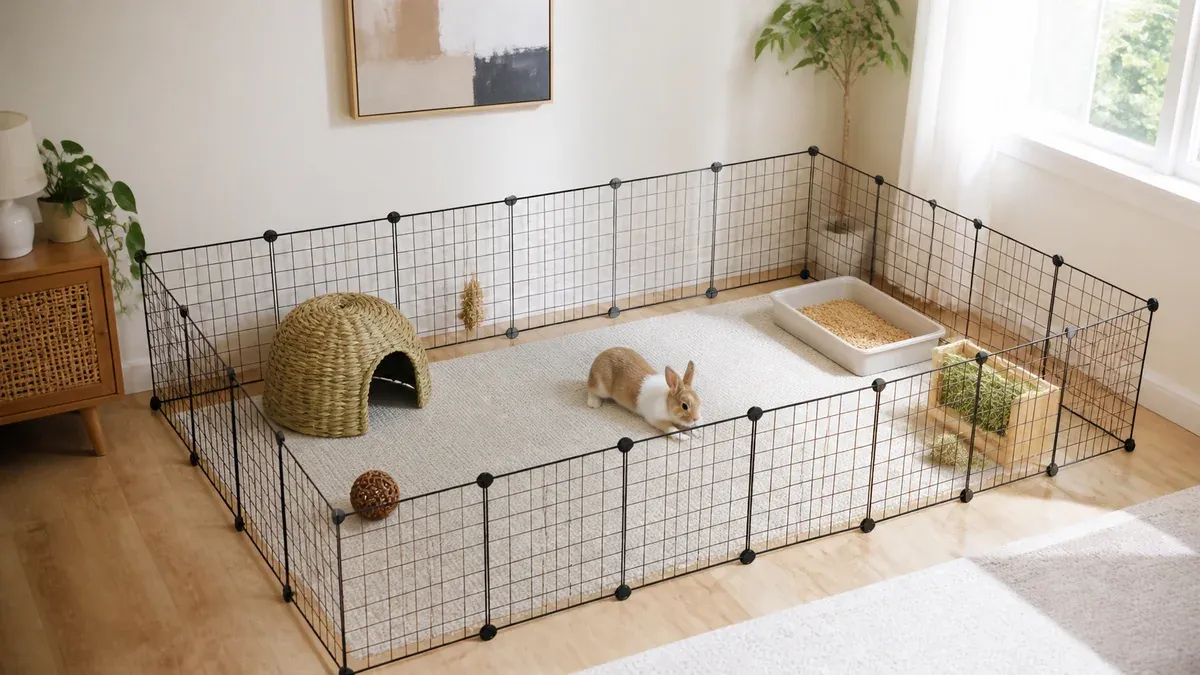
Why enclosure dimensions directly affect your rabbit’s health
A rabbit kept in too small a space develops measurable physical and behavioural problems: muscle atrophy, early osteoporosis, stereotypies (bar-chewing, repetitive circling), chronic anxiety and reduced hay intake. These consequences are not theoretical — they are documented by major veterinary associations and small-animal protection organizations across Europe.
Dimensions are therefore just as important as the type of setup you choose. For a full comparison of enclosures, pens and free-roaming options, see our article on rabbit cage or pen.
Recommended standards by body size
The figures below come from European animal welfare organizations (RWAF, PETA, ASPCA) and routine guidance from exotic-animal veterinarians.
Dwarf rabbit (under 2 kg)
| Criterion | Minimum | Recommended |
|---|---|---|
| Base living space | 2 m² | 3 m² or more |
| Daily free-roaming exercise | 4 m² / 3 h | 6 m² / 4–5 h |
| Open-top enclosure height | 80 cm | 90 cm |
| Covered enclosure height | 60 cm | 70 cm |
Medium rabbit (2 to 4 kg)
| Criterion | Minimum | Recommended |
|---|---|---|
| Base living space | 3 m² | 4 m² or more |
| Daily free-roaming exercise | 5 m² / 4 h | 8 m² / 4–5 h |
| Open-top enclosure height | 90 cm | 100 cm |
Large breed (over 4 kg)
| Criterion | Minimum | Recommended |
|---|---|---|
| Base living space | 4 m² | 6 m² or more |
| Daily free-roaming exercise | 6 m² / 4–5 h | Dedicated room |
| Open-top enclosure height | 100 cm | 120 cm |
For large breeds (the Flemish Giant, Continental Giant), a standalone enclosure is often impractical. A semi-dedicated room or rabbit-proofed apartment works much better.
How to calculate usable floor space
Usable floor space means the area actually available for movement. In practice, subtract:
- The space taken up by the litter tray
- The space taken up by the sleeping house or cardboard box
- The space taken up by the hay rack and water bowl
Practical example: a 2 m² pen containing a 50 × 40 cm litter tray, a 40 × 30 cm sleeping house and a hay rack leaves roughly 1.5 m² of clear movement space. That is insufficient for a resting adult dwarf rabbit. Always build in margin.
What pet-store cages actually represent
Most rabbit cages sold in pet shops measure between 60 × 40 cm and 100 × 50 cm — that is 0.24 m² to 0.5 m² of net floor space. These dimensions cover roughly 10 to 25 % of the recommended minimum space. They can be used for transport or brief isolation, but are not adequate as a permanent habitat.
For long-term setups, opt for a modular folding play pen or exercise pen. See our full guide on rabbit cage or pen.
Height: the dimension that is often overlooked
An adult rabbit needs to be able to stretch fully upright on its hind legs without being blocked by a lid or a panel. This posture is natural and necessary for healthy back and leg muscles. In practice:
- Dwarf rabbit: at least 60 cm internal height in a covered enclosure, 80 cm for an open-top pen.
- Medium or large rabbit: 80–100 cm minimum.
An enclosure that is too low forces a permanently hunched posture and leads to chronic back and lumbar strain. An open-topped pen that is too low has the opposite problem — the rabbit simply jumps out: height thresholds, bar spacing and the rest of the buying criteria are gathered in how to choose an indoor pen for a rabbit.
How enrichment and bedding affect space requirements
A well-furnished enclosure encourages movement and makes even a moderate space work harder. Useful items include:
- A tunnel or hide to promote exploration
- A raised platform (stable and non-slippery) to vary postures
- Chew items to keep the jaws and mind busy
For bedding criteria that contribute to comfort inside the enclosure, see our bedding guide for rabbits.
Litter training is easier with enough space
A rabbit with sufficient space will naturally select one corner for its toilet. A cramped space disrupts this learning and leads to accidents outside the tray. The full process is covered in our article on how to litter train a rabbit.
Going further
For how to fit those exercise hours into a working day, see how many hours of exercise does a rabbit need.
The rabbit species page covers the fundamental needs of the domestic rabbit and the key points to know before adoption.
Frequently asked questions
What is the minimum floor space for a dwarf rabbit?
A dwarf rabbit under 2 kg needs at least 2 m² of permanent base space, plus free-roaming exercise sessions covering 4 m² for 3 to 4 hours per day. Below these values, the risk of behavioural and musculoskeletal problems increases significantly.
Is a 120 × 60 cm pen big enough for a rabbit?
No. A 120 × 60 cm enclosure gives only 0.72 m², well below the 2 m² minimum. It can serve as overnight or short-absence containment, but must never be the sole living space.
How tall should a rabbit enclosure be?
At least 60 cm so the rabbit can stand fully upright on its hind legs without hitting the roof. For open-top enclosures, 80–90 cm prevents escape by jumping.
Does enclosure size change with the rabbit's breed?
Yes, proportionally to body size. The standard guidelines are: 2 m² for dwarf breeds (< 2 kg), 3 m² for medium breeds (2–4 kg), and 4 m² or more for large breeds (> 4 kg) such as Flemish Giants.