Rabbit cage or pen? What you really need to know
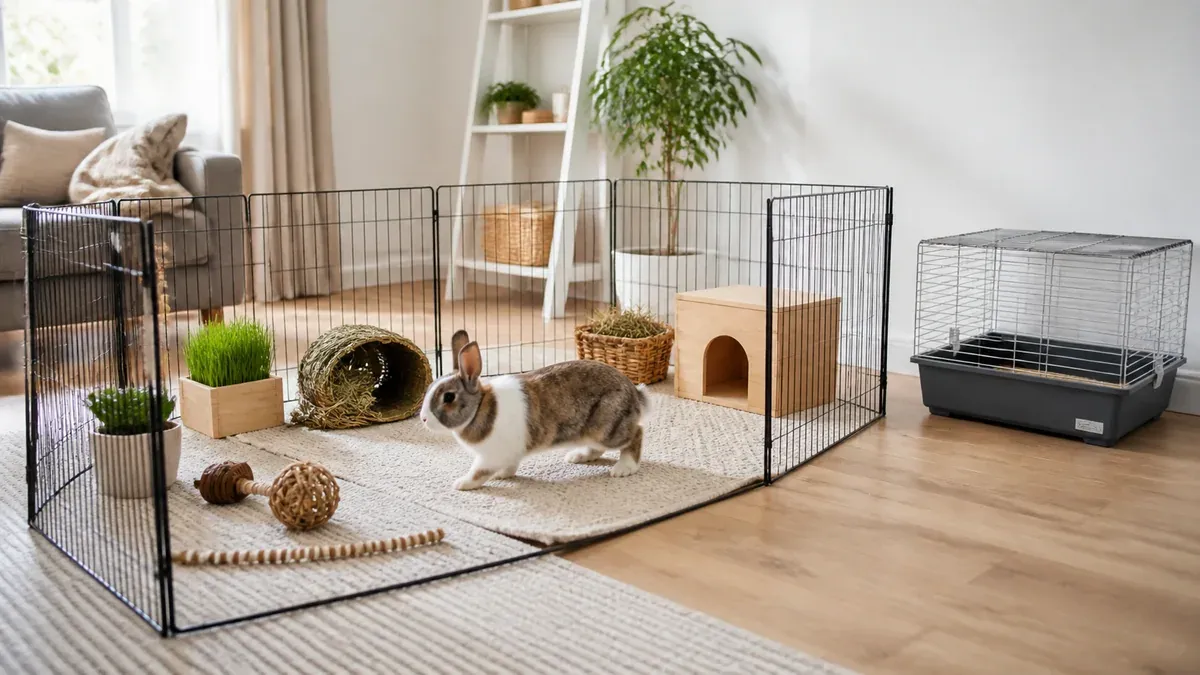
Why a standard cage is not enough
The typical pet-store rabbit cage — usually 60 × 40 to 80 × 50 cm — does not meet the real needs of a healthy rabbit. In the wild, rabbits can cover several kilometers a day. In captivity, they need to run, jump, stretch out fully and explore.
A rabbit confined to too small a space develops:
- Chronic stress and anxiety
- Stereotypies (compulsive bar-chewing, repetitive circling)
- Muscle weakness and risk of osteoporosis
- Reduced hay consumption
The question is therefore not “cage or pen” but “how to set up a space that is large enough and safe.”
The three main options
1. A floor-level play pen (recommended for beginners)
A foldable metal or wooden pen placed directly on the floor can serve as the main living area: allow at least 2 m² as a base space (4 m² is better), not counting the exercise area, on a non-slip floor. Choosing the model itself — panel height, bar spacing, stability, no wire base, door width — is covered in how to choose an indoor pen for a rabbit.
Add daily free-roaming sessions of at least 3–4 hours outside the pen; how to spread them across the day is covered in how many hours of exercise does a rabbit need.
2. A dedicated or semi-dedicated room
A room set aside for the rabbit is the best solution for its welfare. This involves:
- Securing all electrical cables (cable covers, conduit)
- Removing or protecting toxic plants
- Blocking gaps under furniture where the animal could get stuck
- Closing off access to balconies or elevated drops
The rabbit can have a litter corner, a hay rack and a sleeping area in the room and circulate freely the rest of the time.
3. Full free-roaming in the apartment
Possible in a properly rabbit-proofed home. The rabbit develops its territory, habits and personality most fully this way. Litter training is also usually easier (see our article on how to litter train a rabbit).
Prerequisites: secured cables, inaccessible dangerous zones, full household commitment. For the full set of requirements, the situations where it is better to wait, and a gradual method to get there, see our dedicated guide: can a rabbit live cage-free full time?
Minimum dimensions according to welfare guidelines
The figures below come from recommendations by major small-animal and exotic-pet protection organizations in Europe:
| Rabbit size | Base space | Minimum daily exercise |
|---|---|---|
| Dwarf (< 2 kg) | 2 m² | 4 m² over 3–4 h |
| Medium (2–4 kg) | 3 m² | 5 m² over 4 h |
| Large breed (> 4 kg) | 4 m² | 6 m² or more |
These are minimums. The more space available, the better the rabbit fares.
For a detailed breakdown of these dimensions by rabbit size, exact measurements and common mistakes, see our guide on what size enclosure a rabbit needs.
Setting up the living area
Whatever option you choose, the rabbit’s space must include:
- A litter tray with suitable bedding (see our bedding guide)
- A hay rack or permanent floor access to hay
- A sleeping corner: a small untreated wooden house or simply a cardboard box with an opening
- Enrichment items: tunnel, raised platform, chew toys
- A water bowl or elevated water bottle
Avoid slippery floors (bare tile): they stress rabbits and cause joint problems. A rug or cork tiles make good flooring. For a step-by-step guide to organising zones and adding enrichment, see our article on how to set up an indoor pen for a rabbit.
One thing is settled before the inside of the pen: which room it stands in, and where. A correctly sized pen placed in an empty room, against a radiator or on top of furniture does not produce the same result — the placement criteria are in where to put a rabbit enclosure.
Going further
The rabbit species page summarizes the general characteristics and fundamental needs of the domestic rabbit. For further guidance, see our complete guide to keeping a rabbit in an apartment or our overview of the benefits and risks of keeping a rabbit outdoors.
Frequently asked questions
What is the minimum recommended space for a dwarf rabbit?
The standard recommendation is 4 m² of exercise space per day for a dwarf rabbit. For larger breeds, allow 6 m² or more. This refers to total movement space over the course of a day, not the size of the cage or enclosure alone.
Can a rabbit live in a cage its whole life?
Not in a standard pet-store cage. Most of those cages are too small for the rabbit's locomotor and cognitive needs. A confined rabbit develops stress, stereotypies and musculoskeletal problems.
Are multi-level cages suitable for rabbits?
Not always. If ramps are too steep or platforms too small, the rabbit risks falls and joint injuries. A single-level pen with sufficient floor area is generally preferable.
Can a rabbit be allowed to roam freely in an apartment?
Yes, provided all electrical cables are secured, toxic plants removed, and dangerous areas (balconies, stairwells) blocked off. A rabbit with full access to a rabbit-proofed apartment thrives both physically and mentally.