How to litter train a rabbit: step-by-step method
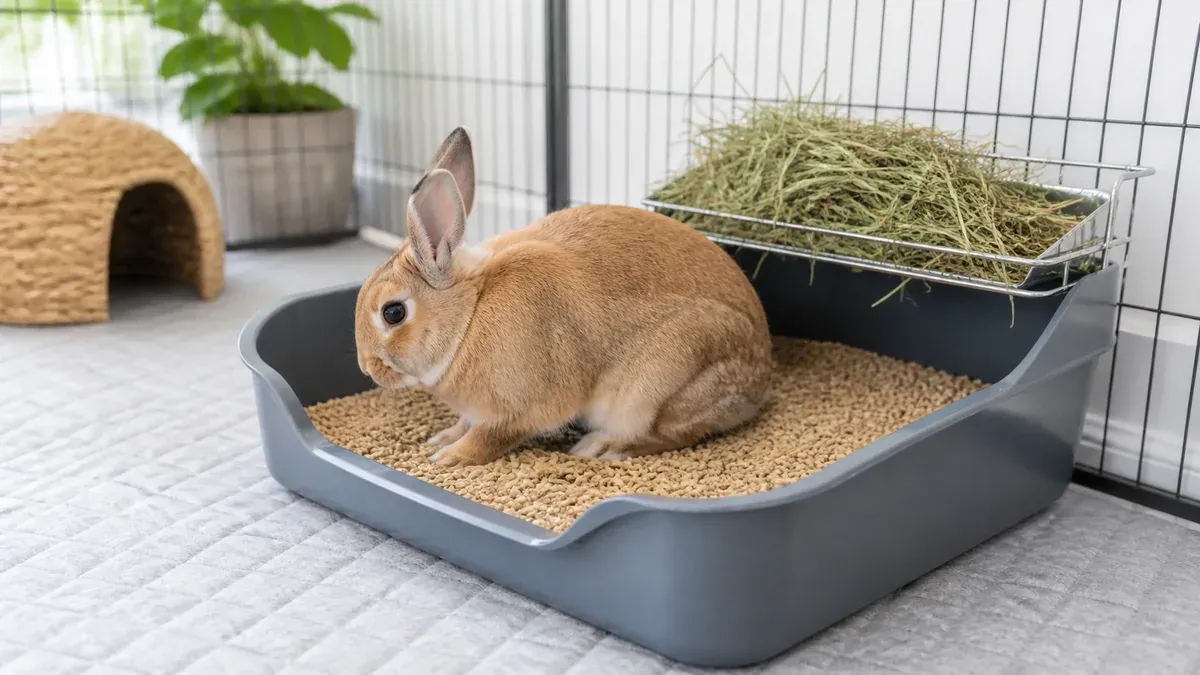
Rabbits are naturally clean animals
Rabbits naturally exhibit orderly behavior: in the wild, they designate specific areas for urination and defecation, which they identify by scent. In captivity, this tendency can be used to teach them to reliably use a litter tray.
Contrary to popular belief, litter training is not about commands or discipline — it is about making the tray more attractive than anywhere else in the rabbit’s space.
Understanding the two types of droppings
Before you start, you need to distinguish between two types of output:
Hard droppings (small, round, dry pellets): normal waste. A rabbit produces 200–300 per day. It is common for a few to be scattered outside the tray, particularly as territorial marking. This is not a training failure.
Cecotropes (soft, shiny, clustered droppings): not waste but food. The rabbit ingests them directly from the anus to complete its digestion. Finding large amounts on the floor often signals a diet that is too rich, or a mobility issue.
If cecotropes are frequently left on the floor, review our complete rabbit feeding guide to rebalance hay, vegetables and pellets.
Choosing the right tray
A poorly chosen tray is the leading cause of training failure. Key criteria:
- Size: the rabbit must be able to enter, turn around and crouch fully. For a dwarf rabbit, at least 40 × 30 cm. For a medium breed, 50 × 40 cm minimum.
- Rim height: 10–15 cm to limit scatter, with a lower notch on one side to allow easy entry.
- No grill: wire-bottom trays (often sold with cages) prevent the rabbit from digging in the bedding and reduce the tray’s appeal.
For bedding choice, see our guide on rabbit bedding.
Step-by-step training method
Step 1: limit the initial space
A rabbit given too much space right away has no idea where to go. Start by confining the rabbit to a small area (max 2 m²) containing the tray, hay and water. The rabbit will naturally gravitate toward the tray if it is well-positioned.
Step 2: place the tray in the right spot
The rabbit often picks a specific corner. Observe where it urinates the first few times and place the tray there. Add a few of the rabbit’s own droppings inside the tray: the familiar scent attracts it.
Step 3: link hay and tray
Place the hay rack directly above or beside the tray. Rabbits eat and toilet at the same time — it is an innate behavior. This association is the single most effective trick for fast training.
Step 4: correct without punishing
If the rabbit urinates outside the tray, do not punish it: this creates stress without teaching where to go. Pick up the dropping or blot up the urine, put it in the tray, and clean the soiled area with white vinegar (ammonia-based household cleaners attract the rabbit back to the same spot).
Step 5: gradually expand the space
Once the rabbit uses the tray consistently for 1–2 weeks, gradually increase its living area. If accidents occur in the new zone, temporarily shrink the space and repeat. To eventually reach full-time freedom across the whole home once this habit is solid, see our dedicated guide.
If your rabbit regresses or refuses the tray
Intact male rabbits
An unneutered male marks territory with urine sprays on walls, furniture and sometimes its owner. This behavior decreases significantly after castration. Litter training is still possible but consistent tray use for urine may be harder to achieve until the rabbit is neutered.
Adult rescue rabbits
An adult rabbit that was partially trained in its previous home may regress during the adjustment to a new environment. Restart training from scratch without impatience.
If, on the other hand, your rabbit was settled and reliably clean and suddenly starts urinating beside the box, this is not training to redo: rule out a medical cause first, then a hormonal one, before touching the setup. The three leads are sorted through in why is my rabbit peeing outside the litter box.
Females during pseudo-pregnancy
An unspayed doe can display cyclical marking behavior. Spaying resolves this permanently and brings numerous health benefits to the animal.
Going further
For more on organizing your rabbit’s living space, read our article on cages and pens. If you are wondering whether your rabbit needs a companion to thrive, read can a rabbit live alone?.
Frequently asked questions
At what age can a rabbit be litter trained?
From around 8–10 weeks, a rabbit can start using a tray. Litter training is usually achieved in 2–6 weeks depending on the individual, and is generally faster in neutered adult rabbits.
My rabbit drops pellets everywhere even with a tray. Is that normal?
Hard droppings (small round pellets) are often scattered around, especially in intact males: this is territorial marking. Only urine should consistently go into the tray. Soft droppings (cecotropes) are always ingested directly from the anus.
Does neutering help with litter training?
Yes, significantly. In males, castration reduces urine spraying and scattered droppings. In females, spaying decreases territorial behaviors linked to hormonal cycles. Litter training is often faster and more stable after neutering.
My rabbit always urinates in the same spot outside the tray. What should I do?
Place the litter tray exactly at that spot. Rabbits often choose their own corner: work with this instinct rather than against it. Clean the original spot with hot water and white vinegar to remove pheromones.