What do rabbits eat? A complete feeding guide
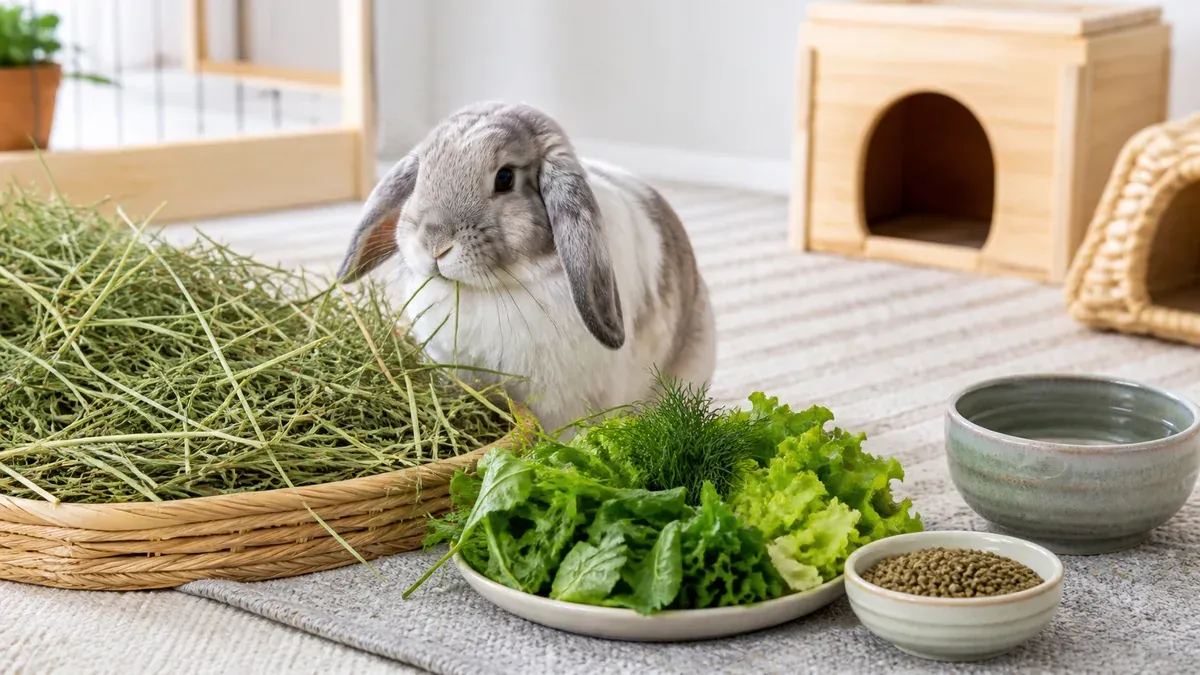
The three-pillar rule
A rabbit’s diet rests on three components that cannot replace one another:
- Hay (80–85% of the ration) — the absolute base, available at all times
- Fresh vegetables (10–15%) — varied leafy greens every day
- Pellets (~5%) — a measured nutritional supplement
Fresh water, renewed daily, is essential alongside all of this.
Hay: the non-negotiable base
Hay makes up the overwhelming majority of an adult rabbit’s diet. Its long fibers perform three vital functions: they wear down teeth (which grow continuously), stimulate gut motility, and keep the rabbit mentally occupied for several hours a day.
An adult rabbit weighing 1.5 kg should consume a volume roughly equal to its own body size in hay each day. In practice, hay is never rationed: the rack must always be topped up. For details on quantities and types, see our guide on daily hay amounts.
Recommended types:
- Timothy hay (1st or 2nd cut) for adults
- Meadow hay to vary palatability
- Alfalfa reserved for kits under 6 months
Alfalfa is commonly misunderstood — excellent for young rabbits but potentially problematic for adults in excess. Our complete guide to alfalfa for rabbits explains when it’s appropriate and when to avoid it.
Fresh vegetables: daily greens
Fresh vegetables supply water, vitamins and variety. They do not replace hay but round out the ration effectively.
Recommended daily amount: approximately 1–2 cups of fresh greens per kilogram of body weight per day.
Vegetables to give regularly:
- Basil, flat-leaf parsley, coriander
- Rocket, lamb’s lettuce, chicory/endive
- Outer leaves of savoy cabbage (not the stalk)
- Fennel, celery stalk
- Carrot tops, radish tops
Always wash vegetables and pat them dry before serving. Introduce each new vegetable separately to check digestive tolerance. For the complete list with amounts, see our article on vegetables for rabbits. For practical guidance on which greens to serve every day and how to rotate them, also see what greens to give a rabbit every day.
Pellets: a supplement, not a base
Despite what many first-time owners believe, pellets are only a nutritional top-up. Given in excess, they reduce hay consumption and promote obesity.
Recommended amounts:
- Kit (up to 6 months): pellets ad libitum — young rabbit feeding has specific rules, see what to feed a 2-month-old baby rabbit
- Young adult (6–12 months): 30–50 g per day
- Adult: 15–25 g per kg of body weight per day (roughly 25–35 g for a 1.5 kg rabbit)
- Senior (6+ years): adjust based on weight and vet advice
Choose pellets with at least 18% crude fiber and no puffed grains or added sugars. Reading the full label is covered in how to choose rabbit pellets; for the exact amounts by age and weight, see how many pellets to feed a rabbit.
Water: an underestimated need
An adult dwarf rabbit drinks between 50 and 150 ml of water per day depending on temperature and the water content of its vegetables. Provide fresh water in a ceramic bowl or a bottle, renewed every day.
In summer, increase the refresh frequency to prevent bacterial growth. For a full breakdown of quantities, bowl versus bottle, and warning signs, see our dedicated guide on rabbit water intake.
What to absolutely avoid
Some foods are toxic or strongly inadvisable for rabbits:
- Onion, garlic, shallot, leek (toxic)
- Rhubarb, avocado (toxic)
- Raw potato
- Corn kernels, legumes (peas, beans) in large amounts
- Sweets, sugar, dairy products
- Bread, crackers, chips
- Seed mixes and muesli: popular but harmful — they cause selective eating and gut flora imbalance. Read why seed mixes are bad for rabbits.
Commercial treats (honey sticks, coloured drops) are not toxic but strongly discouraged. For what you can safely offer as a reward, see our rabbit treats guide.
For the complete list of forbidden foods, see our article on foods rabbits cannot eat.
Summary table
| Component | Proportion | Frequency |
|---|---|---|
| Hay | 80–85% | Ad libitum, at all times |
| Fresh vegetables | 10–15% | 1–2 times per day |
| Pellets | ~5% | Once a day, measured portion |
| Fresh water | — | Renewed daily |
If you ever need to change your rabbit’s hay type or switch pellet brands, always do it gradually to protect gut flora: read how to transition a rabbit’s diet safely.
Two common greens questions: can rabbits eat fresh grass? (yes, with conditions) and can rabbits eat lettuce? (depends entirely on the variety — romaine yes, iceberg no).
These proportions do not depend on body size: a small rabbit eats less in absolute quantity, not in proportion. What the “dwarf” label actually covers, and what it does not change about daily needs, is set out in dwarf rabbits: adult size and real needs.
The rabbit species page covers the fundamental biological characteristics and nutritional needs of the domestic rabbit.
Frequently asked questions
Can rabbits eat fruit?
Yes, but only in very small amounts: one or two small bites per week at most. Fruit is high in sugar and can cause digestive imbalances if given too often.
Can you feed a rabbit on pellets alone?
No. Pellets alone do not cover the long-fiber needs that are essential for proper dental wear and gut motility. Hay must always make up the bulk of the diet.
How many times a day should I feed my rabbit?
Hay is available ad libitum at all times. Fresh vegetables are given once or twice a day. Pellets once a day in a measured portion.
From what age can a kit eat vegetables?
From around 12 weeks, introducing one vegetable at a time in a very small amount to monitor digestive tolerance.