How many pellets should you feed a rabbit?
The actual role of pellets in a rabbit’s diet
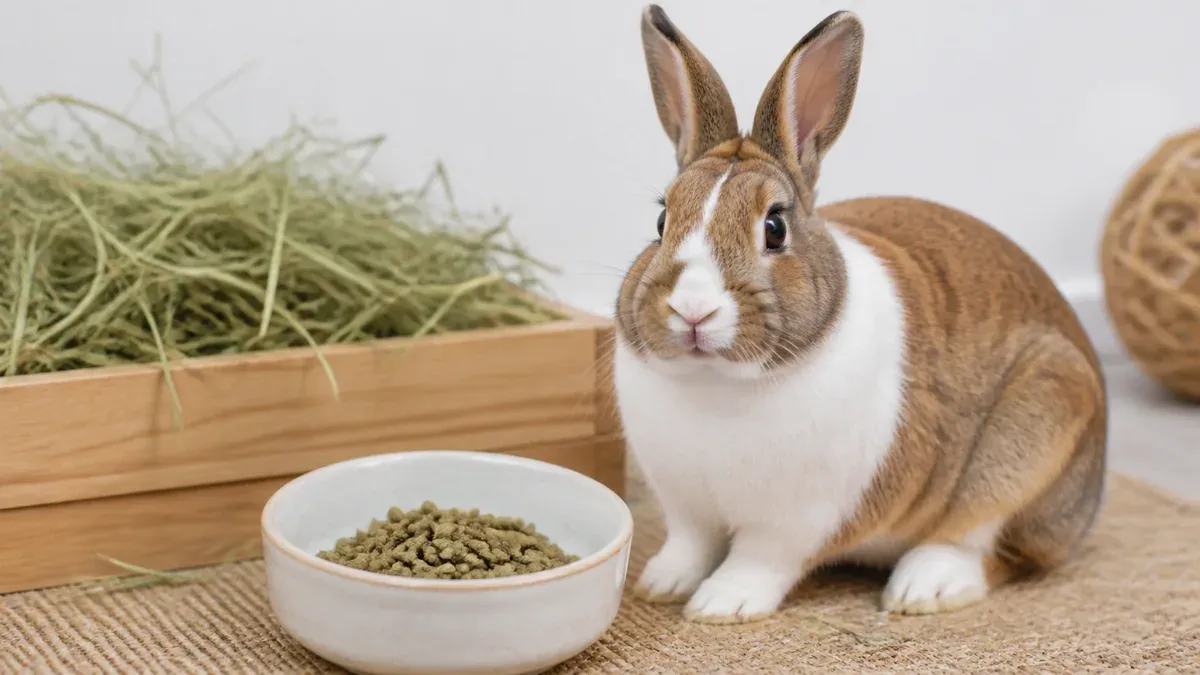
Pellets are frequently overvalued by first-time rabbit owners. They represent only about 5% of an adult rabbit’s total ration. Their role is to deliver a concentrated supply of nutrients (vitamins, minerals, amino acids) that hay and vegetables alone don’t always cover optimally.
Hay remains the central pillar of the diet. If your rabbit eats little hay because it is full of pellets, that is a warning sign. The daily hay quantity must always take priority.
Recommended quantities by age
Kit (0–6 months)
Pellets ad libitum, alongside alfalfa hay or an alfalfa + Timothy mix. Rapid growth justifies a higher protein and calorie intake.
Young adult (6–12 months)
Gradual transition: halve the pellets over 4–6 weeks, then stabilize at around 30–50 g per day depending on the rabbit’s size.
Adult (1–6 years)
The most common guideline is 15–25 g per kg of body weight per day:
| Rabbit weight | Pellets per day |
|---|---|
| 1 kg | 15–25 g |
| 1.5 kg (typical dwarf) | 22–37 g |
| 2 kg | 30–50 g |
| 3 kg | 45–75 g |
Weigh your rabbit regularly and adjust if it gains weight (reduce) or loses weight (increase slightly, but check health first).
Senior (6+ years)
Needs vary with health status and weight. A senior rabbit losing weight despite a good appetite should be seen by a vet. In the absence of pathology, maintain the same ration or increase it slightly.
Which product to serve: the verdict in two lines
A good pellet is uniform — identical nuggets, never a colourful mix — and declares at least 18% crude fibre, with hay as the first ingredient.
How to read the full label, which formula suits which age, what bag size to buy and which marketing claims to ignore are covered in how to choose rabbit pellets. This page stays on the amount.
Common mistakes
Giving too many pellets. This is the most widespread error. A rabbit well fed on hay and vegetables can go without pellets for a few days with no problem. The reverse is not true. If the weight has already crept up, taper the ration in stages rather than cutting it at once: the safe method is set out in my rabbit is getting fat.
Compensating a hay refusal with more pellets. If the rabbit ignores its hay, the answer is not to increase pellets but to change the type or freshness of the hay. See why a rabbit might refuse its hay.
Buying too big a bag. Pellets lose part of their vitamin content after opening: a bag should be finished within 6–8 weeks, which rules out bulk packs for a single rabbit. The bag-size arithmetic is set out in how to choose rabbit pellets.
Going further
If you need to switch pellet brands, always do it gradually over 3–4 weeks: read how to transition a rabbit’s diet safely.
For the specific pellet amounts needed during a kit’s first months, see what to feed a 2-month-old baby rabbit.
For an overview of a complete rabbit diet, see our full feeding guide.
Frequently asked questions
Can you give pellets ad libitum to an adult rabbit?
No. Unlimited pellets for an adult rabbit promote obesity and reduce hay consumption, leading to dental and digestive problems. Only kits under 6 months can benefit from unrestricted pellet access.
What is the difference between pellets and seed mixes?
Pellets (uniform nuggets) contain the same nutrients in every bite. Seed mixes let the rabbit select the most palatable (and usually the most sugary) pieces, which unbalances the ration. Seed mixes are strongly discouraged.
My rabbit refuses its pellets. Is that a problem?
If the rabbit is eating its normal amount of hay and greens and passing normal droppings, disinterest in pellets alone may not be urgent. Any broader fall in appetite or droppings warrants a prompt veterinary call; complete food refusal is an emergency.