Can a rabbit live cage-free full time? Requirements and steps
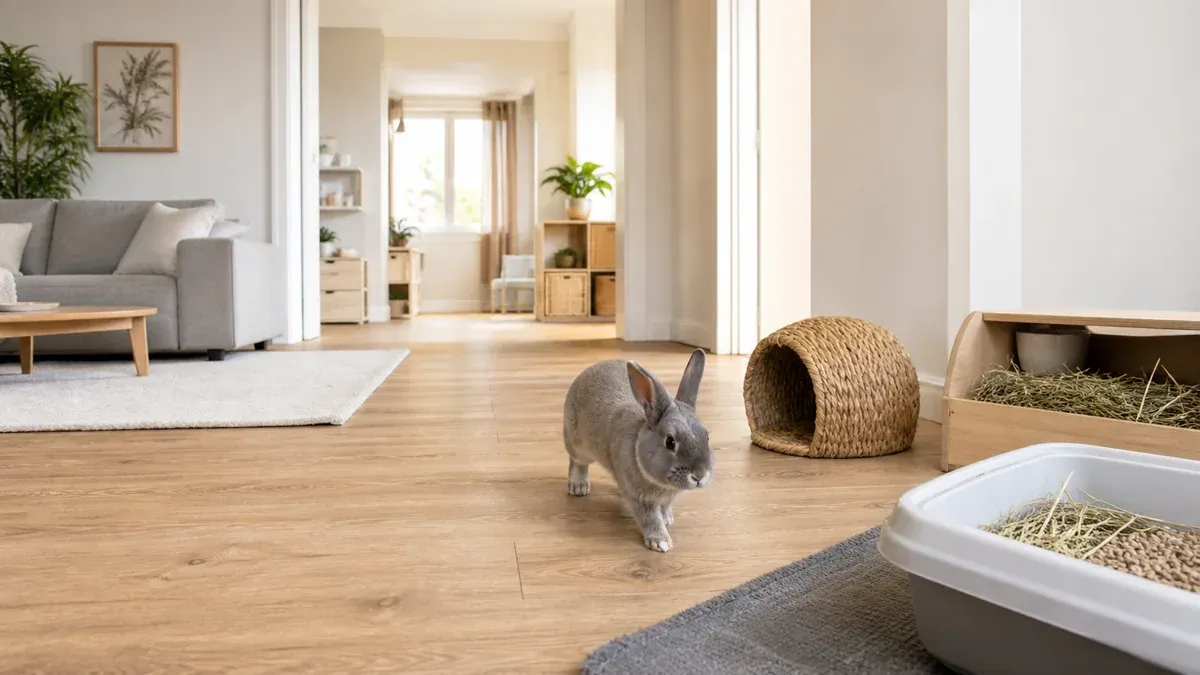
Yes, a rabbit can live cage-free full time in a home, with no closed cage or pen, provided the space is fully rabbit-proofed and the rabbit has been prepared for it gradually. It is not, however, the right option for every rabbit or at every stage of settling in. This guide covers the requirements, the situations where it is better to wait, and a method for getting there without stress or litter-training setbacks.
Full-time freedom, semi-free-roaming, or a pen: what’s the difference?
Full-time freedom means a rabbit has access to all — or nearly all — of the home at all times, with no mandatory return to a closed cage or pen. It differs from two related setups:
- A pen with supervised outings: the rabbit lives in a base space and gets several hours of supervised free-roaming per day. To compare living-space options, see our guide on rabbit cage or pen.
- Semi-free-roaming in a dedicated room: the rabbit moves freely in one or a few rabbit-proofed rooms, but not the whole home.
Full-time freedom is the natural endpoint of that progression, not a starting point.
The benefits of well-prepared full-time freedom
A rabbit that moves freely throughout the home:
- develops a rich, varied territory, which boosts physical and mental activity;
- often becomes more reliably litter trained, since it can pick its own habitual spots without the constraints of a cramped space;
- generally shows fewer frustration behaviours (compulsive chewing, restlessness) than a rabbit permanently confined to too small a space.
Requirements before moving to full-time freedom
Several conditions should be in place before considering full-time freedom:
- Solid litter training in a small space. The rabbit should be reliably using its tray for several weeks already. See our complete method for litter training a rabbit if that is not yet the case.
- The whole home rabbit-proofed, room by room. Cables protected, toxic plants removed, fall risks blocked off: see our guide on rabbit-proofing a room and apply the same rigour to every accessible room, not just the first one.
- A neutered or spayed rabbit. This greatly reduces urine marking and territorial behaviours that make litter training harder across a large space.
- Enough time settling into the household. A recently arrived rabbit needs time to get its bearings before facing such a large space.
When it is better to hold off on full-time freedom
Full-time freedom is not advisable in a few situations, at least temporarily:
- A recently adopted rabbit: it first needs to settle into a small, reassuring space.
- A young or unneutered rabbit: hormone-driven territorial marking and behavioural instability make litter training unreliable over a large area.
- An ongoing introduction of a second rabbit: bonding is best built in a controlled space first; opening up the whole home at the same time makes it harder to monitor both animals.
- A home shared with other pets not yet used to the rabbit: it is better to secure those interactions before opening up the full space.
In these cases, expanding one secured room at a time remains the best strategy, with full freedom coming later.
Should you still keep a “base” even with full-time freedom?
Yes, in most cases. Even a rabbit that can go anywhere benefits from having a fixed point: a sleeping house or shelter corner, a litter tray that stays in the same spot, a hay area that is always accessible. This base does not limit its freedom — it gives the rabbit a stable landmark, which is reassuring and keeps litter habits consistent.
A gradual method for expanding freedom
- First step: litter habits stabilised in a single secured room, while observing the rabbit’s preferences (chosen toileting corner, favourite resting spots).
- Second step: open a second secured room, keeping the first one permanently accessible so the rabbit keeps its bearings.
- Next steps: expand room by room, securing each new space before opening it — never after.
- Ongoing adjustment: if litter accidents repeat in one specific spot, temporarily place a tray there or restrict access for a few days before trying again.
The pace of this progression depends entirely on the individual rabbit: some manage it within a month, others need several months, and that is not a sign of a problem.
Going further
Before opening the whole home, return to the three guides that are directly useful for this decision: choosing between a cage and pen, stabilising litter training, then rabbit-proofing every accessible room.
Frequently asked questions
Does a full-time free-roaming rabbit still need a cage or pen?
Not a closed enclosure, but keeping an open 'base' (a sleeping house, a fixed litter tray, a hay corner) is still recommended. This base gives the rabbit a stable landmark and refuge even though it can go anywhere, and it also helps keep litter habits consistent.
How long does it take to go from a pen to full-time free-roaming?
Generally several weeks of gradual expansion once litter training is solid in a small space. More cautious or older rabbits may need longer; rabbits that are already well socialised often adapt faster.
Is full-time free-roaming right for every rabbit?
No. It is not advisable for a rabbit that was just adopted, a young unneutered rabbit, or during the introduction of a second rabbit. In these situations, it is better to progress step by step with a pen or a secured room before opening up the whole home.
What if my rabbit's litter habits slip once it has full access to the home?
Temporarily shrink the space back around the litter tray, then expand again more slowly. A one-off setback is not a permanent failure — it usually just means the expansion moved faster than that particular rabbit could handle.