How to rabbit-proof a room: complete room-by-room guide
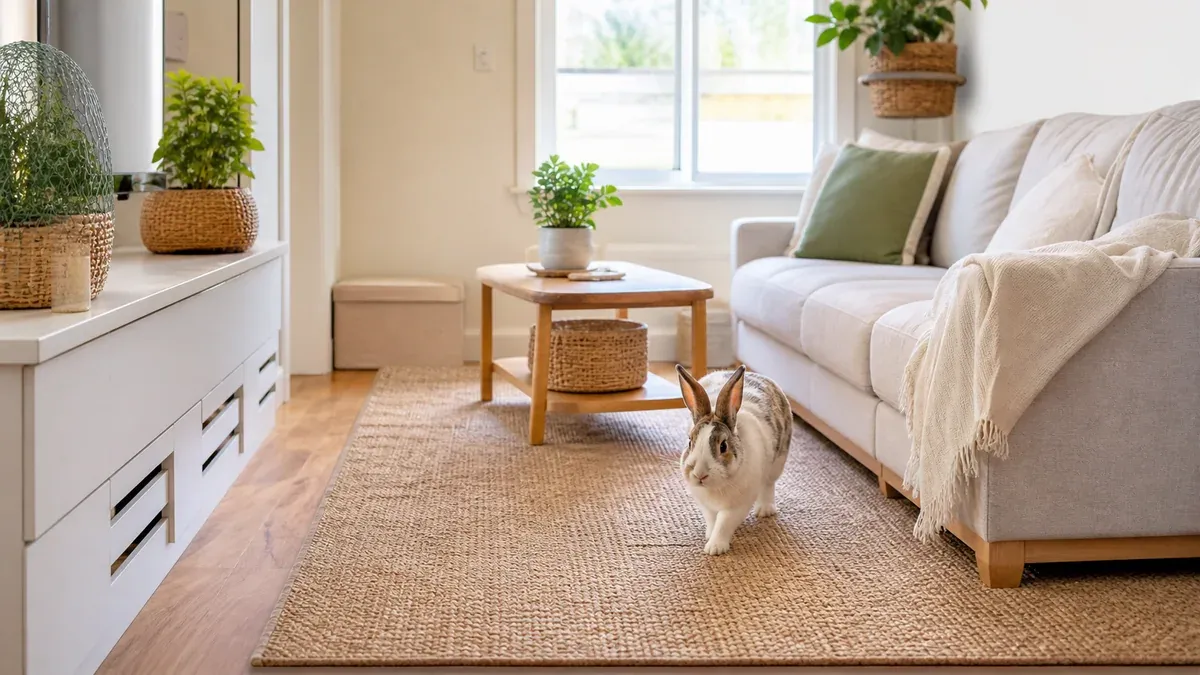
Allowing a rabbit to free roam is one of the best things you can do for its welfare — but only once the room is secured before that first session. A free-roaming rabbit explores everything, chews everything, and squeezes into every gap. Rabbit-proofing is not optional: it is the condition for freedom to remain safe for both the rabbit and your home. This guide gives you a systematic walkthrough of every hazard to address before opening the door. If you have just moved, redo this full walkthrough in the new home: see moving house with a rabbit.
Why rabbit-proofing is non-negotiable
Rabbits are prey animals whose natural behaviours include exploring, chewing (teeth grow continuously), digging, and squeezing into tight spaces for security. These behaviours cannot be suppressed — rabbits cannot be trained out of chewing a cable or gnawing a book. The only effective strategy is to make the environment inherently safe.
Rabbits vary in exploration intensity by age and personality, but the baseline level of proofing described here applies to all of them.
Electrical cables: danger number one
An electrical cable within a free-roaming rabbit’s reach will be chewed. This is not a question of luck or the individual rabbit’s character — it is a certainty within weeks. The consequences can be fatal (electrocution) and dangerous for the home (short circuit, fire).
What to do:
- Split loom tubing (spiral cable wrap, available at hardware stores or online): slides onto existing cables, resistant to chewing.
- Rigid PVC conduit: maximum protection for fixed multi-core cables.
- Hide behind furniture: push furniture flush against the wall to block access to cables running along the skirting board.
- Raise off the floor: move power strips, phone chargers, and charging cables above the level the rabbit can reach.
Priority cables to protect: TV and monitor power leads, computer cables, phone chargers, floor-level power strips, lamp cords.
Data cables (ethernet, HDMI) are also chewed — protect them even when not carrying mains voltage.
For detailed protection solutions by cable type and room, see our dedicated guide on protecting cables from rabbits.
Houseplants
Many common houseplants are toxic to rabbits, sometimes fatally so. The problem is that rabbits lack a reliable instinct to avoid them — a rabbit may nibble a toxic plant with no immediate sign before the poisoning develops.
Common toxic houseplants:
| Plant | Toxicity level |
|---|---|
| Lily (all varieties) | Very high |
| Dieffenbachia | High |
| Pothos | High |
| Philodendron | High |
| Aloe vera | Moderate to high |
| Ficus | Moderate |
| Ivy | Moderate |
| Azalea | High |
The simple rule: move all plants up high (shelves, windowsills out of reach) or remove them entirely from the rabbit’s free-roam area. When in doubt about a specific plant, check with a vet or toxicology database before exposing the rabbit to it. For the full list of species to remove first and what to do if one is eaten, see our dedicated guide on which houseplants are toxic to rabbits.
If your rabbit has eaten a plant and shows signs (drooling, convulsions, collapse, diarrhoea), seek emergency veterinary care.
Flooring: slipping and sore hocks
Polished wood flooring or tiles are slippery for rabbits. When a rabbit accelerates, brakes, or pivots, its paws slide out sideways. Over time, this causes musculoskeletal strain and promotes sore hocks (pododermatitis) — a painful inflammation of the foot pads common in rabbits kept on hard, slippery surfaces.
Solution: lay non-slip rugs, jute mats, cork tiles, or textile runners in the main movement area. These surfaces provide grip, are washable, and are generally appreciated by rabbits as resting areas.
At minimum, the zone where the litter tray, hay, and water are located must be non-slip. For litter selection, see our guide on the best bedding for rabbits. For a full guide on choosing the right floor surface throughout the living space, see our article on the best floor for rabbits.
Escape and entrapment zones
Rabbits instinctively squeeze into tight spaces — prey-animal behaviour for seeking safety. But these spaces can become dangerous traps:
Areas to block systematically:
- Under the sofa: raised only a few centimetres, this is often the first place a rabbit disappears. It can freeze inside and panic when you try to retrieve it.
- Under the refrigerator: very low, warm, and often impossible to access without moving the appliance
- Behind the washing machine or dishwasher: risk of crushing when the appliance vibrates or is moved
- Behind radiators: excessive heat, burn risk on heating elements
- Gaps between furniture and wall: if the space is too narrow for the rabbit to turn around, it will panic
How to block: thick cardboard panels held in place, custom-cut wooden boards, foam padding for small gaps. Under-door draught excluders also work for passage gaps under closed doors.
Objects at floor level
Any accessible floor-level object will be nibbled or chewed. This is not deliberate destruction — it is the normal behaviour of an exploring rabbit.
Tidy away or protect:
- Books, magazines, newspapers left on the floor
- Remote controls on low tables
- Shoes, fabric bags, clothing
- Soft plastic children’s toys
- Important papers and documents
- Wooden furniture legs and chair legs (unprotected wood will be chewed)
Clear plastic furniture leg protectors (available at hardware stores) can be fitted to the lower portions of at-risk furniture. If the rabbit keeps working at one particular spot, protection alone will not settle it: it also needs something it is allowed to chew in that same place, as explained in my rabbit destroys everything.
The kitchen: restrict access
The kitchen contains specific risks:
- Cleaning products in low cupboards: some can be nudged open by a curious rabbit
- Tight gaps behind built-in appliances
- Accessible food (bread, fruit) that falls outside a balanced rabbit diet
- Open bins
The simplest approach: block kitchen access with a gate or closed door when the rabbit is free-roaming.
The bathroom
- Medicines or toiletries within reach: toxic to rabbits
- Open toilet: a rabbit can fall in
- Cleaning products under the sink: must be blocked
Same principle: restrict access or secure all low storage areas.
Living with other pets
Two rules cover this: a cat or dog’s presence during free-roam sessions must be supervised, and the rabbit must always have a refuge inaccessible to other pets. Even a generally gentle animal can react to a fleeing rabbit.
The full setup — two-exit safe zones, which barriers actually work for a cat versus a dog, how to run introductions and the signs it is failing — is in keeping a rabbit with a cat or a dog.
For a full overview of managing a rabbit alongside other pets and organising apartment life, see our guide to keeping a rabbit in an apartment.
For general rabbit behaviour and natural instincts to keep in mind, visit the rabbit species page.
Frequently asked questions
My rabbit chews everything — is that normal?
Yes. Chewing is a natural, unstoppable behaviour in rabbits. Their teeth grow continuously and need to be worn down. A rabbit cannot distinguish between an electrical cable and a branch. The only effective strategy is physically protecting all sensitive objects — you cannot train a rabbit not to chew. Digging is equally instinctive: see our article on [why rabbits dig everywhere](/en/rabbit/behavior/why-does-my-rabbit-dig-everywhere/) to redirect it constructively.
Which houseplants are dangerous for a free-roaming rabbit?
Common toxic houseplants include pothos, dieffenbachia, philodendron, all types of lily, aloe vera, ficus, ivy, and azalea. When in doubt, move all plants out of reach — rabbits do not have a reliable instinct to avoid toxic plants.
How do I stop my rabbit from going under the furniture?
Block access with thick cardboard panels, foam padding, or by pushing furniture flush against the wall. Spaces under sofas, behind refrigerators, and behind washing machines are traps: a rabbit wedged inside may injure itself seriously trying to get out.
Should I rabbit-proof the whole house or just one room?
Start with one fully secured room for the first few weeks. Once you know your rabbit's habits and level of exploration, gradually extend access to other rooms. The kitchen (cleaning products, small gaps) and any room with unprotected cables should always have controlled access.