Moving house with a rabbit without stressing it
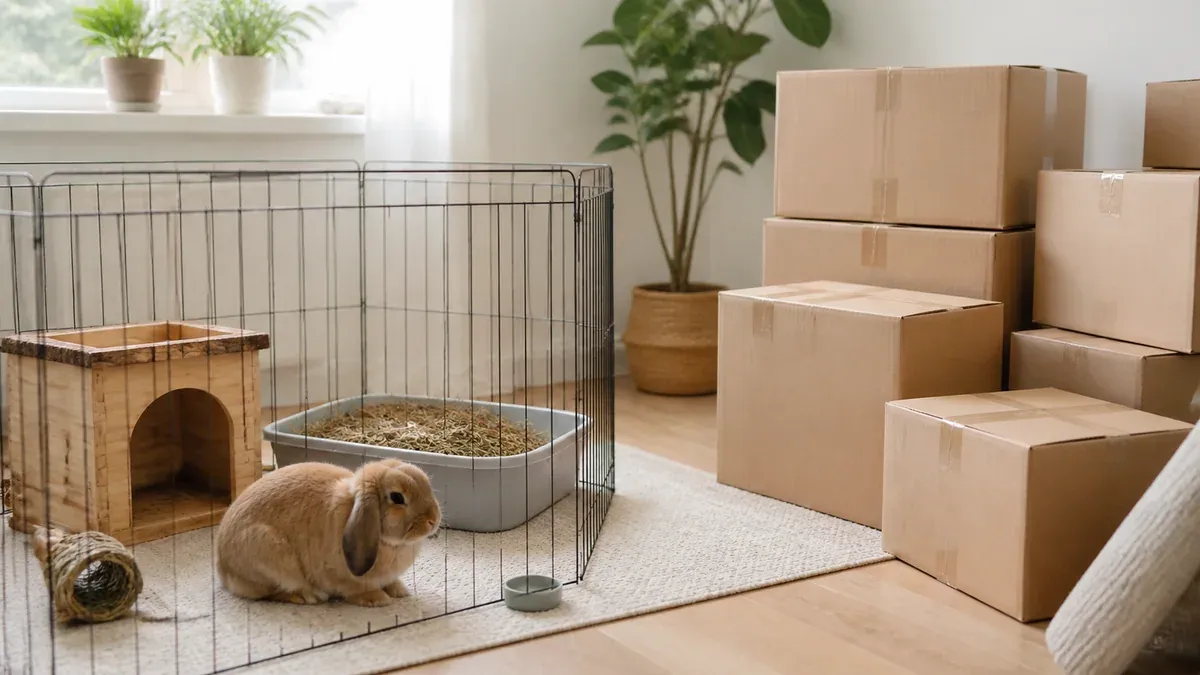
Moving house stresses a rabbit more than people expect, because it is a territorial animal attached to its landmarks, its smells and its space. The key to limiting that stress comes in three stages: prepare the transport, move the rabbit at the right moment, then quickly recreate a familiar, secured territory in the new home. This guide walks through those steps so the change goes as smoothly as possible.
Why moving unsettles a rabbit so much
Unlike a dog, a rabbit does not simply follow its human with enthusiasm: it experiences its environment as a territory mapped by its scents and habits. This trait is part of its nature, as the rabbit species profile explains. Losing all those landmarks at once — the litter box’s location, the smell of the walls, the hiding spots — is a real source of stress.
That stress is not just passing discomfort: in rabbits, intense tension can translate into a drop in appetite and a slowdown of the gut. That is why the goal is not merely to “transport” the animal, but to give it back a reassuring setting quickly.
Before the move: prepare without upheaval
- Keep its routine intact for as long as possible: same meal times, same food, same pen set up until the last moment.
- Prepare the transport in advance: bring out the carrier a few days ahead and leave it open near its space so it re-familiarises itself. The precise logistics of the trip are covered in our guide on how to transport a rabbit by car.
- Find a rabbit-savvy vet near the new home before you leave, so you are not searching in a hurry.
- Change nothing else at the same time: this is not the moment to alter its diet, its litter, or to attempt bonding with another rabbit.
Moving day: shield the rabbit from the chaos
Moving day concentrates every stress factor: noise, boxes, wide-open doors, strangers coming and going. Two possible strategies:
- Arrange care with someone for the day, and collect the rabbit once the bulk of the move is done.
- Isolate it in a closed, quiet room of the old home, with its litter, hay and water, transporting it last, just before you leave.
In both cases the rabbit travels in its secured carrier, never loose in the vehicle, and never in a cardboard box. A wide-open door during a move is the main escape risk: a frightened rabbit bolts straight outside.
On arrival: recreate a familiar territory
This is the step that makes all the difference. A reassured rabbit reclaims the space quickly; a rabbit released into a large unfamiliar home hides and becomes tense.
- Start small: settle it first into a single quiet room, with its pen, its litter (slightly used, for the scent), its hay, water and a hideout. It will expand its territory afterwards.
- Reuse its unwashed items: keeping its scent on the litter, a mat or its hideout recreates a familiar landmark far more effectively than a brand-new space.
- Secure the room before letting it explore: cables, plants, gaps. A new home is not “rabbit-proof” by default; redo the full walkthrough described in our guide on how to rabbit-proof a room.
- Let it come out at its own pace: do not force it from its hideout or pile on handling in the first days.
The first days: watch the right indicators
A rabbit coping well with the change keeps eating and passing droppings. Those are the two best signals to watch.
- A little more time spent hiding, some marking of the new territory (scattered droppings, chin rubbed on furniture) is normal and fades.
- On the other hand, a rabbit that stops touching its hay and passes no droppings is a potential emergency: stress may have slowed its gut, but another cause must be ruled out. See a rabbit-savvy vet without delay.
Above all, do not use the move as an occasion to change its diet: keeping exactly the same foods avoids adding a digestive upset to the stress of the change.
If your rabbit will not eat after the move
- Two already-bonded rabbits: move them together, in the same carrier if possible, so they reassure each other and do not lose their bond.
- An elderly, sick or recently operated rabbit: check with your rabbit-savvy vet before a long trip, and set up an easy-access floor-level resting spot on arrival.
- A long trip or a distant move: the same rules as for travel apply (heat, hay and water available throughout). Our guide on traveling with a rabbit covers organising a longer journey.
Going further
To organise the rabbit’s living space in its new home, browse all our rabbit housing guides.
Frequently asked questions
Should I arrange care for my rabbit on moving day?
Ideally yes. Moving day is the most stressful: boxes, noise, open doors, people coming and going. Leaving the rabbit with someone, or keeping it in a closed, quiet room of the old home and transporting it last, spares it the worst of the chaos and sharply reduces the risk of escape.
How long does a rabbit take to settle into a new home?
Most rabbits reclaim the space within a few days to two weeks. In the first days it may hide more, eat slightly less, or mark its new territory. As long as it keeps eating and passing droppings normally, give it time without forcing interaction.
My rabbit has stopped eating since the move — what should I do?
Stress can reduce appetite, but do not wait for an hourly threshold: call promptly if appetite or droppings fall. Complete refusal, especially with pain or collapse, is an emergency.
Should I clean everything before settling the rabbit into the new home?
On the contrary, keep a few unwashed items carrying its scent (slightly used litter, a mat, a hideout): they reassure by recreating a familiar territory. Clean cleaning-product residue off the floor, but do not strip away all its scent landmarks at once on the first day.