How to set up an indoor pen for a rabbit
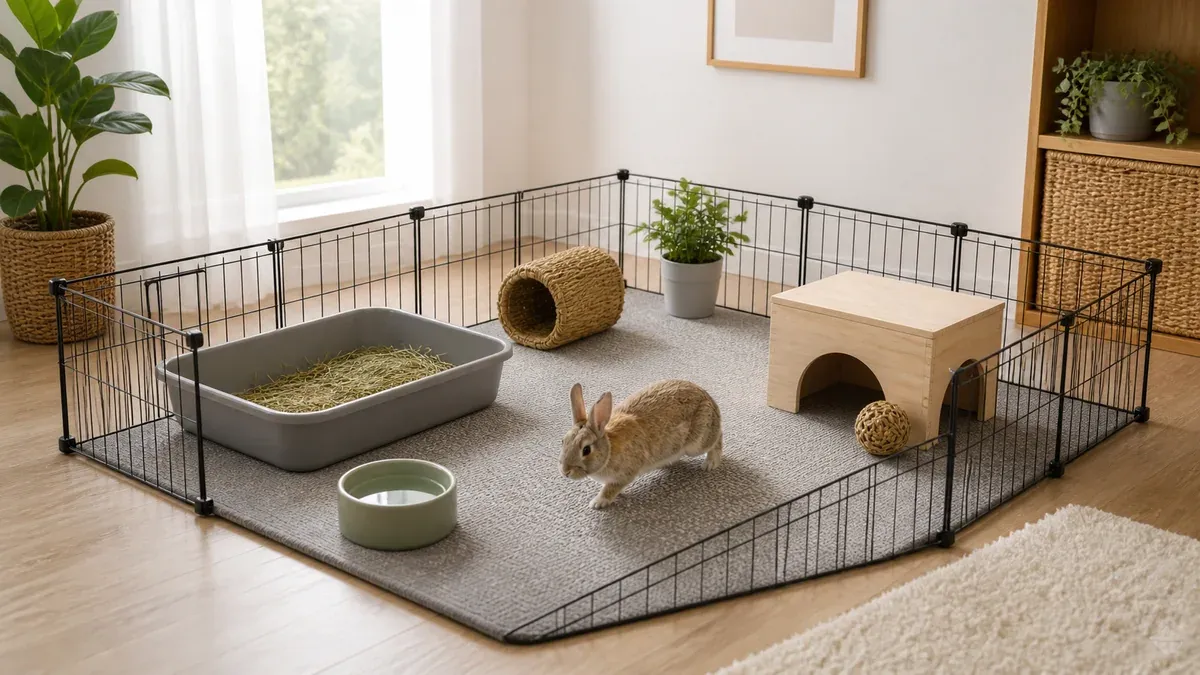
A well-housed rabbit is not just a rabbit kept safe. Its pen should allow it to sleep, eat, act on its natural instincts and stay mentally occupied. How you set up that space directly affects your rabbit’s stress levels, unwanted behaviours and long-term health. This guide covers how to organise an indoor rabbit pen in a practical way, matched to the animal’s real needs.
Step 1 — Get the size right first
Before organising the interior, confirm the footprint is adequate. A standard commercial cage is almost always too small to serve as a rabbit’s main living space. For size references, see our guide on what size enclosure a rabbit needs: a liveable space must allow the rabbit to make at least three consecutive hops, stand fully upright without touching a ceiling, and stretch out flat on the floor.
Common configurations:
- Modular pen made from grid panels clipped together — the most flexible option
- Extra-large open cage with a floor-level extension
- Dedicated room section bounded by a pen barrier
The pen is a home base, not an exclusive living space: your rabbit should leave it every day for free-roaming sessions in a larger area.
While you are at it, check where the pen actually stands: a lived-in room, one or two sides against a wall, away from a radiator and direct sun. That choice weighs as much as the interior layout, and the criteria are in where to put a rabbit enclosure.
Step 2 — Choose the floor surface
The pen floor is your rabbit’s most constant contact point with its habitat. The standard wire-grid floors of many commercial cages are poorly suited to rabbits: they cause pressure sores on the hocks over time and predispose to pododermatitis. For floor options, see our guide on the best floor surfaces for rabbits.
The most practical options for an indoor pen:
- Interlocking EVA foam tiles covered with a washable liner or a natural-fibre mat
- Tiled or wooden floor covered with a natural non-slip rug
- Bedding over the pen floor — hemp, linen or recycled paper — over the entire surface or confined to the litter corner
Avoid synthetic fibre rugs or looped-pile materials that the rabbit could ingest by chewing.
Step 3 — Organise the living zones
A well-set-up pen is divided into functional zones that mirror the natural organisation of a burrow:
Feeding zone
- Hay rack fixed at the rabbit’s head height to reduce waste — hay should make up the bulk of the diet
- Water bowl (or bottle, depending on the rabbit’s preference) on the opposite side from the litter corner
- Pellet bowl if you use pellets — kept away from the hay to avoid contamination
Rest and hide zone
A rabbit needs a closed space to retreat to. A wooden house with a flat roof (which the rabbit can also sit on), a closed tunnel or a simple cut cardboard box all work well. The entrance must be wide enough for the rabbit to enter and exit comfortably without squeezing.
Litter corner
Rabbits are naturally clean and prefer to urinate and defecate in one consistent spot. Place the litter tray in the corner your rabbit has already chosen on its own — or in a corner well away from the feeding and rest zones.
Step 4 — Add enrichment
An empty pen is a boring pen. Environmental enrichment reduces unwanted behaviours (bar chewing, compulsive digging, restlessness) and improves mental wellbeing.
Chewing materials
- Natural untreated wood branches: apple, hazel, willow, lime
- Compressed hay cubes or hay balls
- Recycled cardboard tubes and boxes to shred freely
Exploration items
- Wicker or cardboard tunnel with both an entry and a separate exit
- Box filled with shredded paper for digging and foraging
- Foraging mat for rabbits that enjoy rooting around for food
Levels and platforms
A rabbit that can climb makes better use of vertical space. A stable platform with a gently sloped, non-slip ramp can effectively double the usable area. Keep ramps low, wide and gently sloped, and fit raised edges to the platform to prevent falls.
What to avoid
| What not to do | Why |
|---|---|
| Overcrowding with objects | Rabbits need open floor space to run |
| Leaving cables accessible inside or near the pen | A vital hazard — see protecting cables from rabbits |
| Using uncoated plastic or coloured foam | Fragments are dangerous if swallowed |
| Rearranging the layout too often | Rabbits are territorial — frequent changes cause stress |
| No hide | Chronic stress from having nowhere to retreat |
Ongoing upkeep
- Litter: remove droppings and wet patches daily; full change 1–2 times a week
- Bowls and hay rack: rinse daily
- Hide and toys: clean weekly; replace worn cardboard
- Pen floor: thorough sweep and wipe with each full litter change
A clean pen reduces the risk of bacterial infection and respiratory issues from ammonia build-up in the urine.
The indoor pen is not a fixed setup: it should evolve with your rabbit’s age and preferences. A senior rabbit will need gentler ramps and a softer floor; a very active rabbit benefits from more vertical options and variety in enrichment.
Frequently asked questions
Does a rabbit's pen need a hide?
Yes. Rabbits are prey animals and need a closed space to retreat to in order to feel safe. A hide (wooden house, cardboard box, closed tunnel) reduces stress and improves sleep quality. Without one, the rabbit remains constantly alert, which causes chronic stress.
Can I add raised platforms to a rabbit's pen?
Yes, provided the access ramps are low, wide, gently sloped and have a non-slip surface. Platforms should have raised edges to prevent falls. Be cautious with dwarf breeds and senior rabbits whose mobility is reduced.
What is the minimum pen size for an adult rabbit?
Aim for enough room for several hops, standing upright and stretching fully, with more floor space whenever possible. Even a comfortable pen must be paired with daily free-roaming time in a larger area.
Can rabbits have plastic toys in their pen?
Best avoided. Rabbits chew everything in reach, and swallowed plastic fragments can cause digestive blockages. Stick to untreated wood, wicker, cardboard or sisal — natural materials that are safe if small amounts are ingested.