Why does my rabbit thump? Rabbit thumping explained
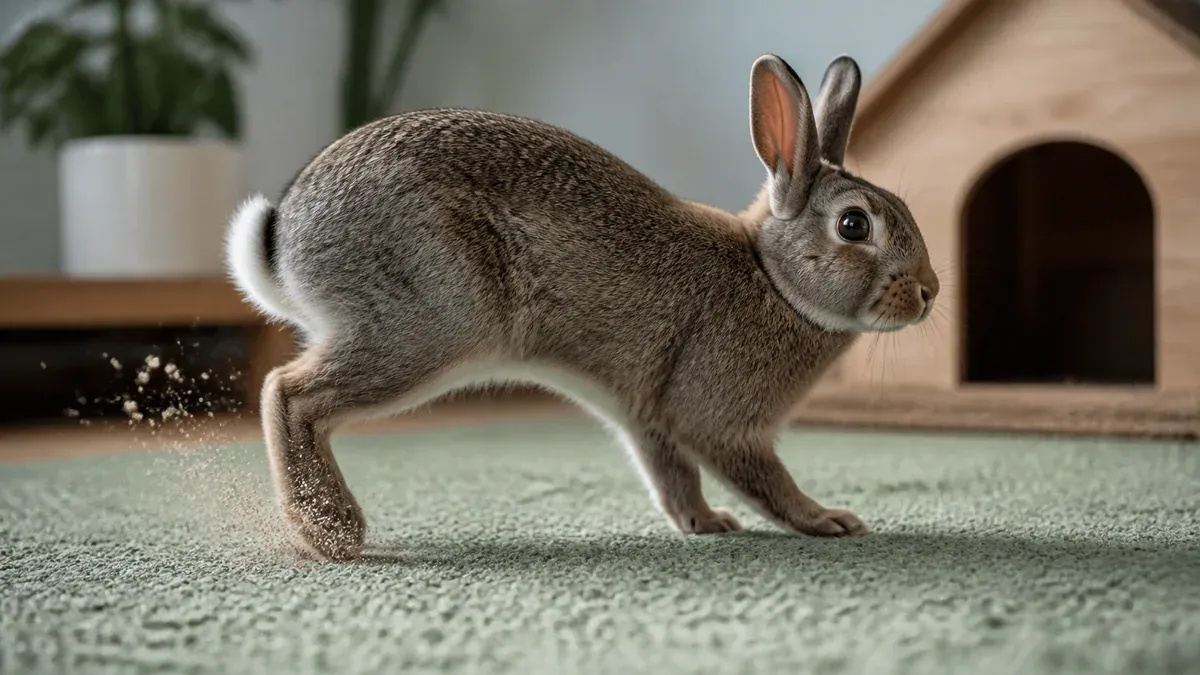
Rabbits thump by forcefully striking the ground with their hind legs, producing a distinctive dull thud. This is one of a rabbit’s clearest forms of communication. Understanding what thumping means helps you respond to your rabbit’s needs more effectively and builds a stronger relationship with it.
What thumping means
Alarm signal: the original function
In the wild, rabbits live in groups in burrows. When a rabbit perceives danger — a predator, a suspicious sound, an unusual movement — it thumps to alert every member of the group. The vibration travels through the ground and instantly communicates the warning to all nearby individuals. It is an emergency signal: reliable, fast, and hard to ignore.
In domestic rabbits, this instinct is fully intact. A rabbit that perceives something unusual in its environment — a strange noise, an unfamiliar smell, the shape of a predator through a window, a sudden movement — will thump to “sound the alarm”, even when living alone.
Expression of displeasure
Thumping is not only an alarm signal. It also expresses:
- Frustration: a rabbit forced back into its pen when it wants to stay out, or denied something it wants, may thump to show disapproval — how to get him in without forcing anything is set out in my rabbit won’t go back in its pen
- Impatience: some rabbits thump to attract attention or ask to be let out
- Post-handling annoyance: after a grooming session, nail trim, or any forced handling, some rabbits deliver a pointed thump as they hop away
Response to a sensory stimulus
Rabbits have highly developed hearing and smell. They detect high-frequency sounds humans cannot hear, and subtle scents imperceptible to us. A thump may therefore be triggered by:
- A low-frequency thud from neighbours or another room
- A vibration in the floor (construction, passing lorry, distant thunder)
- The scent of a predator (a neighbour’s cat through the window, a fox outside)
- An unfamiliar animal entering the home
Common thumping situations
| Situation | Likely interpretation |
|---|---|
| Sudden loud noise | Alarm: stimulus perceived as threatening |
| Presence of an unfamiliar animal | Alarm or territorial warning |
| Being put back in the enclosure | Frustration, disapproval |
| End of a free-roam session | Protest, impatience |
| At night without obvious reason | Sensing sounds/vibrations inaudible to you |
| After handling or a vet procedure | Post-constraint displeasure |
| Before mealtimes | Impatience, solicitation |
How to respond to thumping
Avoid unintentionally reinforcing it
If your rabbit thumps to get something (to go out, to eat, to get attention) and you consistently comply, it learns that thumping works and uses it more and more. The right response is to wait until the rabbit is calm before meeting its request — without ignoring it entirely.
Identify and address the source
When thumping occurs repeatedly or in a specific context, look for the cause:
- Check the temperature: an overheating rabbit may become agitated and thump. For the thresholds to watch, see our article on rabbit temperature tolerance.
- Check the noise environment: the presence of a dog, construction noise, or a loud TV nearby can trigger repeated thumping
- Check the security of the space: a poorly secured enclosure or a visible outdoor presence through a window can generate chronic stress
Reassure calmly
When your rabbit thumps in response to a real or perceived alarm, a calm, reassuring presence helps it settle. Speak quietly, avoid sudden movements. Do not force it out of its safe space.
Take the alarm signal seriously
If your rabbit thumps unusually insistently with no obvious cause, check the living space. It may have detected something you missed — a pest, an electrical problem, an unusual smell.
Thumping in an apartment
In a flat, thumping can be heard by neighbours, especially on bare parquet flooring without acoustic insulation. A thick rug under the rabbit’s main area significantly reduces the vibration transmitted to the floor below.
A rabbit that thumps frequently in an apartment often signals either too little space (insufficient exercise time, an enclosure that is too small) or a persistent stressor (noise, other animals, heat). For setting up the living space correctly, see our complete guide to keeping a rabbit in an apartment.
Thumping as a welfare indicator
A rabbit that thumps occasionally is communicating normally. However, very frequent thumping — repeated day after day — is a signal that something is wrong in its environment. It may indicate chronic stress, pain making it more reactive, or a living space that does not meet its needs.
A thump is never read on its own: what gives it meaning is the combination with posture, ears and context. The full decoding map is in how to read rabbit body language, and the method for rebuilding trust in a rabbit that thumps out of fear is in our guide on taming a fearful rabbit.
If your rabbit does not thump but regularly licks you, that is an equally expressive signal — find out what it means in our article on why does my rabbit lick me.
For a complete overview of rabbit needs and natural behaviour, visit the rabbit species page.
Frequently asked questions
Is thumping normal behaviour in rabbits?
Yes, it is a natural, instinctive behaviour. In the wild, rabbits thump to alert their group to danger. It is a form of body language, not a tantrum. In domestic rabbits, it can signal genuine fear, frustration, or simply excitement.
My rabbit thumps at night — what should I do?
Rabbits are crepuscular and may perceive sounds or vibrations at night that you cannot detect (neighbours, animals, outside noise). If night thumping is frequent, check that the living space is calm, secure, and at a comfortable temperature. A rabbit that thumps repeatedly at night may be suffering from chronic stress.
My rabbit thumps when I put it back in its enclosure — is it angry?
Probably yes. A rabbit forced back into its pen when it would rather stay out often expresses disapproval with one or more thumps. This is its way of 'protesting'. The behaviour is normal but signals that the rabbit strongly values its freedom — worth factoring into how you schedule its exercise time.