Why does my rabbit do binkies?
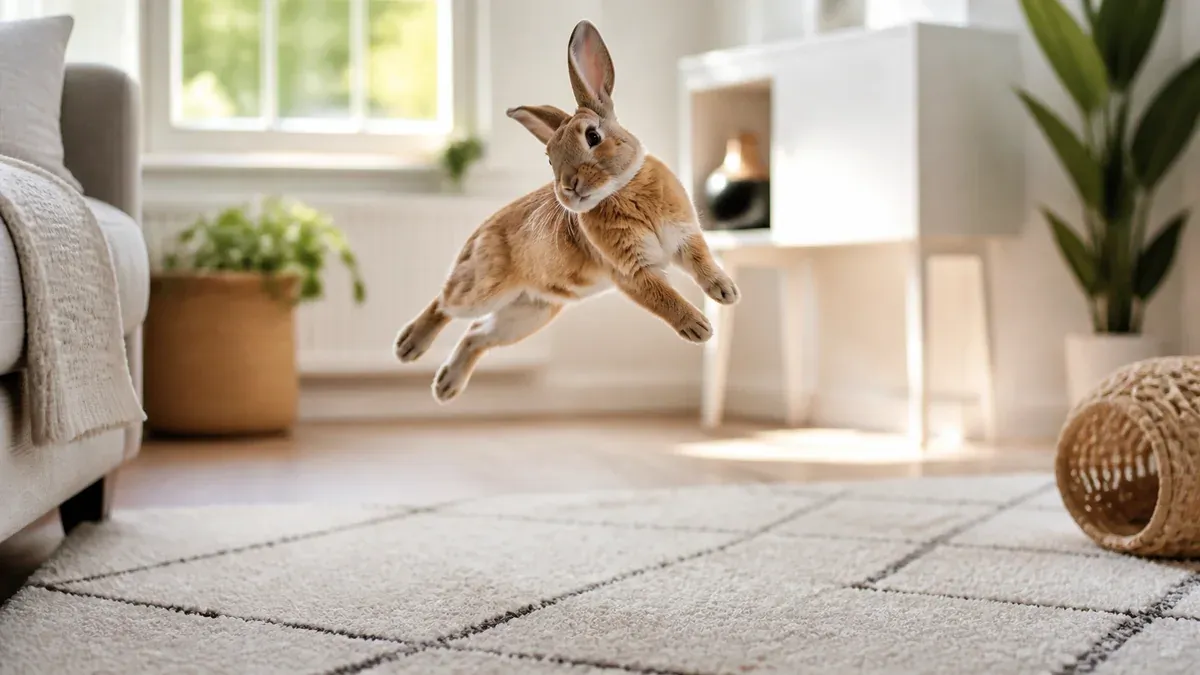
Your rabbit sprints across the room, launches into a mid-air twist and lands heading the other way — then does it again. If you have witnessed this, you have seen a binky. It is not uncontrolled excitement or a problem: it is the most direct expression of happiness a rabbit can make.
What exactly is a binky?
A binky is a rapid, brief combination of movements:
- A leap — often upward or forward
- A mid-air twist or body torsion — the spine curves laterally
- A direction change on landing, usually followed by a sprint or another leap
The whole thing lasts one to two seconds. Several binkies can be chained together, punctuated by fast sprints.
There are also mini-binkies: just the head shaking sideways, or the ears flicking while walking. Less dramatic, but expressing the same thing — a light flash of satisfaction or excitement.
Why does a rabbit binky?
A direct expression of joy
A binky happens when a rabbit experiences a strong positive surge: pure joy, the pleasure of exploring, excitement from freedom of movement. It is not a learned or conditioned behaviour — it is a natural, spontaneous response.
Binkies occur most often in these contexts:
- When let out of the enclosure — the freedom of open space often triggers a series of binkies
- After a long rest (rabbits are most active at dawn and dusk — waking up active can spark a binky)
- While exploring a new space or after a new toy or area is introduced
- When interacting with a trusted person — sometimes your mere arrival triggers one
A release of positive energy
Rabbits are built for bursts of speed and sharp direction changes. The binky uses exactly that physical capability — it is a surge of positive energy expressed through the most extravagant movement the rabbit can make.
For other ways rabbits express wellbeing, see our article on why rabbits lick you — licking is another strong signal of affection and comfort.
How to encourage binkies
Binkies cannot be commanded, but certain conditions make them more frequent:
| Condition | Why it helps |
|---|---|
| Sufficient free-roaming space | Rabbits need room to run and jump freely |
| Daily out-of-pen sessions | A rabbit that comes out every day maintains consistent positive energy |
| New areas to explore | Varied access keeps curiosity and excitement alive |
| Enrichment inside the pen | A stimulated rabbit shows more joy on release |
| Strong bond with the owner | Trust and attachment fuel spontaneous bursts of happiness |
A rabbit that follows you around and binkies in your presence has truly bonded with you. See our article on why your rabbit follows you everywhere to understand the attachment behaviour behind it.
Binkies and other happiness signals
The binky is the most visible happiness signal, but not the only one:
- The flop — suddenly collapsing sideways, eyes half-closed: a sign of total relaxation and trust
- Tooth purring — a soft grinding sound, distinct from tooth chattering which signals discomfort: a sign of contentment
- Licking — affection towards the owner or a companion rabbit
- Playful digging — scratching and foraging without agitation or stress signals
The binky → flop sequence is common: the explosive joy is immediately followed by total release. If you see your rabbit leap and then sprawl on its side with half-closed eyes, everything is fine.
What binkies say about your rabbit’s environment
A rabbit that binkies regularly is a rabbit whose fundamental needs are being met: sufficient free-roaming space, physical and mental stimulation, security in its environment, positive social connection with you or a companion.
Conversely, a rabbit that never binkies and stays prostrate or apathetic deserves attention — this can indicate an under-stimulating environment, chronic pain or an underlying health issue. To learn to spot a rabbit quietly suffering, see our guide on how to tell if a rabbit is in pain.
Frequently asked questions
Does a rabbit that never binkies feel unhappy?
Not necessarily. Some calmer rabbits, or senior rabbits, express wellbeing differently — through the flop (collapsing onto their side), tooth purring or affiliative behaviours like licking and companionship. A rabbit that does not binky is not necessarily stressed or unhappy.
At what age do rabbits binky?
Binkies are often more frequent in young rabbits, who are more active and less inhibited. Adult or senior rabbits can still binky, but less often and with less amplitude. Healthy, well-stimulated rabbits continue to express joy throughout their lives in various ways.
Why does my rabbit binky then flop on its side?
That is the classic peak-happiness sequence: the binky expresses a burst of joy; the flop that follows — the rabbit collapsing onto its side — expresses full relaxation and trust. Both behaviours in sequence are an excellent sign of wellbeing.
My rabbit binkies every time I let it out — is that normal?
Yes, and it is a great sign. Being let out of the enclosure is one of the most exciting moments for a rabbit: space, freedom of movement, exploration. If it happens consistently at every session, your rabbit genuinely enjoys its free-roaming time.