Why does my rabbit lick me? Meaning and how to respond
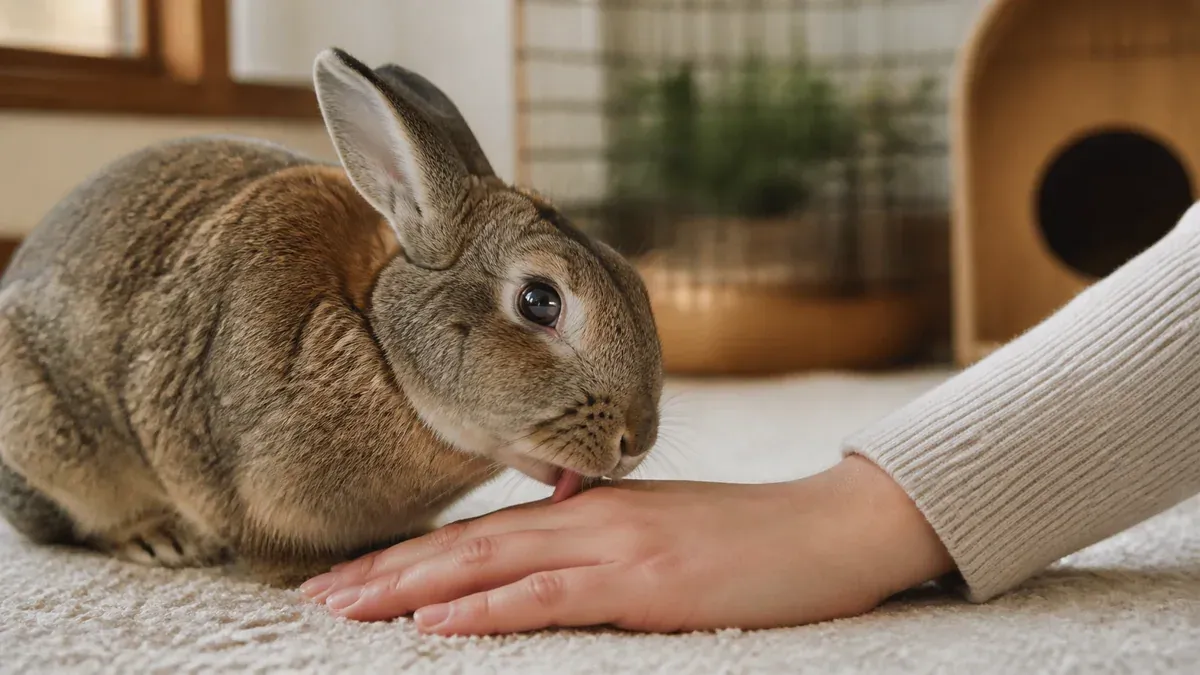
A rabbit that licks your hand, arm, or even your face is communicating something meaningful. Licking is one of the most positive gestures in a rabbit’s behavioural repertoire — and it is not trivial, especially from an animal that does not naturally seek physical contact the way a dog does. Understanding what this gesture means helps you read your rabbit better and deepen your bond with them.
The main meaning: social grooming (allogrooming)
Among wild rabbits, social grooming — or allogrooming — is a fundamental behaviour for group cohesion. Rabbits lick each other to:
- Clean areas they cannot reach themselves (top of the head, between the ears, around the eyes)
- Reinforce social bonds within the group
- Express a gentle hierarchy (the subordinate often grooms the dominant)
- Demonstrate trust and belonging
When your rabbit licks you, it is including you in its social group. This is one of the strongest signs of attachment a rabbit can express towards a human. A rabbit that licks its owner is, quite literally, treating you as a trusted member of its social family.
Other possible reasons
Curiosity and sensory exploration
Rabbits explore their environment through smell and taste. Licking your skin gives them information about you: what you have eaten, products you have applied to your skin, hormonal variations. Some rabbits are particularly curious and lick everything around them — without this being a specific sign of deep attachment.
Attraction to salty taste
Human sweat contains salt. Some rabbits are simply drawn to the slightly salty taste of skin after physical activity or on warm days. This is not a sign of nutritional deficiency — it is ordinary curiosity.
Attention-seeking
Some rabbits have learned that licking their owner generates a reaction (a stroke, a word, eye contact). They then use licking as a bid for attention. If you consistently respond, you reinforce this behaviour — which in this case is quite pleasant.
Comfort and relaxation
A rabbit that licks in a relaxed context (after being stroked, during a calm shared moment) is simply expressing its well-being. It is the rabbit equivalent of a cat purring while curled up against you.
Licking in the context of your relationship
Licking is an indicator of trust. A fearful or stressed rabbit never licks. If your rabbit licks you, it means it feels genuinely safe with you.
That said, not all affectionate rabbits lick — some prefer other forms of expression such as:
- Following you from room to room — an equally clear sign of attachment
- Binkying in your presence — the mid-air twisting leaps that signal pure joy
- Resting their chin on your hand to request strokes
- Circling around you during free-roaming time
- Thumping to attract your attention
Some attached rabbits even refuse to be petted while actively seeking your presence: do not measure their affection by how much handling they tolerate.
To understand the full range of rabbit communication, see our guide on how to tame a fearful rabbit to distinguish affectionate behaviours from defensive ones.
How to respond to licking
Respond positively (without overdoing it)
Licking is a gesture of trust — welcoming it positively strengthens your bond. A gentle stroke on the back or between the ears in response is the most natural reaction.
Don’t pull away sharply
Pushing your rabbit away or standing up abruptly when it licks can be experienced as rejection and erode trust. If you prefer it to stop, calmly move your hand or shift position.
Don’t force reciprocity
Trying to “groom back” by kissing or intensely stroking is not always well received by rabbits. Natural reciprocity is simply offering a stroke in return — not forcing closeness.
When licking becomes excessive
Excessive or compulsive licking can sometimes signal:
- Boredom: an under-stimulated rabbit repeats behaviours in loops. Enriching its environment with more exercise and variety will help.
- Anxious dependency: rare, but possible if the rabbit has no other source of social stimulation
- Compulsive behaviour: if licking is constant, frantic, and hard to interrupt, discuss this with a rabbit-savvy vet
If licking escalates into grunting or harder nipping, your rabbit may be shifting from an affectionate signal to a defensive one — see why does my rabbit grunt to tell the difference.
In the vast majority of cases, a rabbit that licks its owner is simply expressing what it feels as clearly as it can: you are part of its family.
To interpret licking accurately, focus on the context, posture, and intensity of the contact.
Frequently asked questions
Does a rabbit that licks its owner always have a very social personality?
Not necessarily. Some very confident, attached rabbits rarely lick; others that seem less cuddly lick regularly. Licking is one of many ways rabbits communicate — interpret it alongside the rest of the rabbit's behaviour, not in isolation.
My rabbit licks me then nips me — what should I do?
This sequence (licking followed by a gentle nip) is typical of social grooming between rabbits. The nip is part of the ritual: rabbits lick and then gently nibble each other while grooming. It is not aggressive. If the nip is hard and painful, calmly move your hand away without shouting.
Is it hygienic to let a rabbit lick me?
The risk is very low. Rabbit saliva contains few pathogens dangerous to humans. Avoid licking on open wounds, mucous membranes, or the face of a young child. A rabbit regularly seen by a vet poses no particular health risk.
My rabbit licks the floor or furniture — is this the same behaviour?
No. A rabbit that compulsively licks surfaces (floor, sofa, cage bars) may be lacking certain minerals, bored, or expressing a compulsive behaviour. This is entirely different from licking its owner. If the behaviour is repetitive and intense, consult a rabbit-savvy vet.