My rabbit doesn't like being picked up: is that normal?
Veterinary warning — A rabbit that suddenly starts refusing to be held, squealing or biting when it used to tolerate it, may be in pain (back, joints, digestive, dental). A poorly lifted rabbit can also seriously injure its spine with a single kick. If the refusal is new, especially with reduced appetite, see a rabbit-savvy vet.
Yes, it’s completely normal: the vast majority of rabbits dislike being picked up, and it’s not a personality flaw or a lack of affection. Being lifted off the ground mimics exactly what a prey animal experiences when caught by a predator, so the fear is instinctive, hard-wired into the species. The goal is not to “fix” this trait, but to understand why it exists, to handle the rabbit safely when necessary, and to tell this normal refusal apart from a genuine pain signal.
Why being picked up scares nearly every rabbit
A rabbit is a prey animal that keeps constant control of its body and footing. This fundamental trait, noted on the rabbit species page, explains most of its reaction:
- Losing the ground under its feet feels like capture. In the wild, what lifts a rabbit is a bird of prey or a predator.
- No longer being able to flee is distressing for an animal whose whole survival strategy rests on fleeing.
- Height and restraint amplify the panic: a rabbit that feels trapped struggles, freezes, or may bite.
So it isn’t your rabbit “being difficult”: it’s a species-wide reflex. A rabbit deeply bonded to you can love your company, follow you everywhere, and still hate being lifted. A rabbit’s attachment isn’t measured by what it tolerates in your arms.
The real danger: injury, not just stress
Beyond fear, holding a rabbit badly is physically dangerous. A rabbit’s spine is fragile relative to the power of its hind legs: a poorly held rabbit that gives a violent kick can fracture or dislocate its spine, sometimes with irreversible consequences.
That’s why the question isn’t only “how do I reassure it” but “how do I hold it without risk”. A rabbit struggling in badly positioned arms is a rabbit in danger, not just an annoyed one.
How to pick up a rabbit safely, when you must
Sometimes you have to lift your rabbit: to examine it, put it in a carrier, treat it. When you do, technique matters more than willpower:
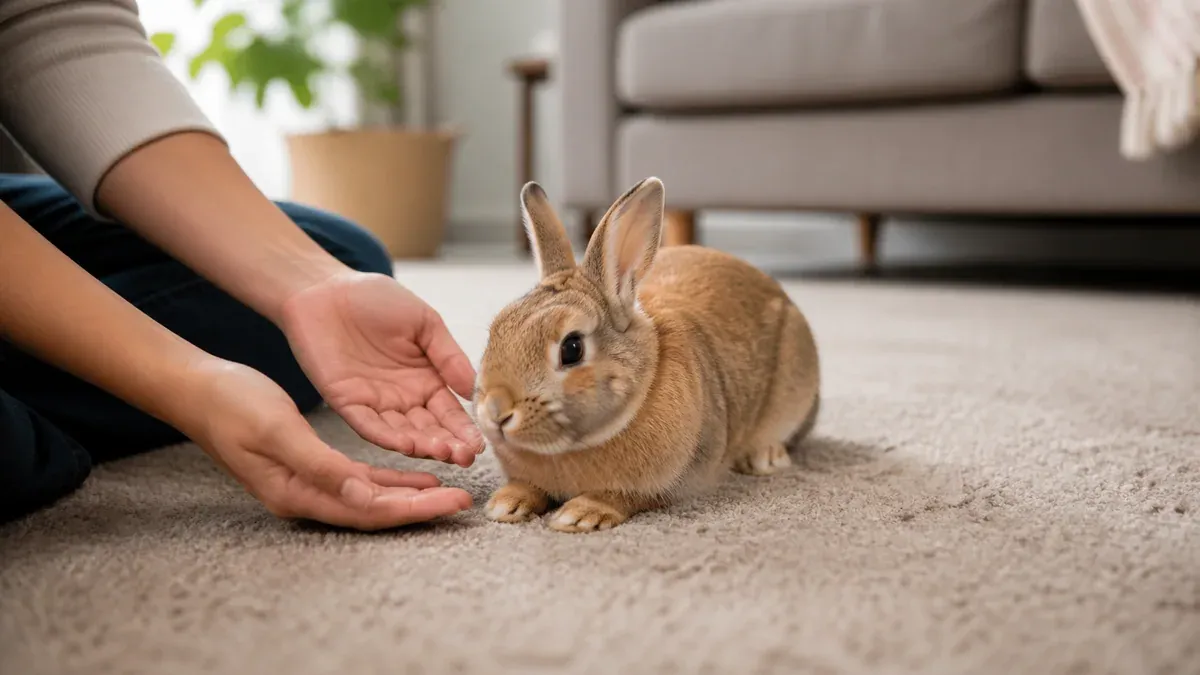
- Approach calmly, at ground level, without swooping down from above.
- Always support the hindquarters: one hand under the chest or front, the other firmly under the back legs and lower back. The hind legs must never dangle.
- Bring it against your body, its head toward the crook of your elbow, its feet against you. A well-tucked rabbit feels more stable.
- Stay low: lift and move close to the ground, so any fall is harmless.
- Set it down gently, hindquarters first, and let it move off straight away.
Never lift a rabbit by the ears, by the scruff alone, or by the legs. If you’re not confident, it’s better not to pick the rabbit up and to do the task another way.
Avoiding lifting: the best everyday strategy
Most situations where you think you must pick a rabbit up can be handled without lifting it:
- Moving it: guide it toward its carrier or pen with a treat or by steering it, rather than grabbing it.
- Routine care: many tasks are done on the floor or on a non-slip surface placed up high, holding it gently without suspending it.
- The carrier: present it open in advance so the rabbit enters on its own, rather than dropping it in by force.
This approach follows the logic of respecting a rabbit’s limits: as with a rabbit that won’t let you pet it, forcing contact erodes trust, whereas letting it choose builds it.
It is also the hardest point to get a child to accept, since scooping the animal up is the instinctive move: the floor-level rule and how to apply it by age are covered in are rabbits good pets for children.
Getting it used to handling gently (never by force)
You can’t teach a rabbit to “love” being picked up, but you can reduce its fear of necessary handling:
- Start by touching it on the floor, briefly, pairing your hand with a familiar vegetable.
- Progress very slowly: a hand under the body, then a lift of a few seconds just above the floor, then a little more, over several weeks.
- Always end on a positive note and on a still-calm rabbit, never on a struggle.
If your rabbit is generally fearful, first work through the step-by-step method in our guide on how to tame a fearful rabbit: a confident rabbit copes far better with essential handling.
When the refusal should raise a flag
Refusing to be held is normal and stable. What should worry you is a sudden change or pain:
- a rabbit that squeals, tenses or bites when touched in a specific spot;
- a new refusal in a rabbit that used to tolerate handling;
- a refusal alongside reduced appetite, a hunched posture or listlessness.
In these cases, the medical angle takes priority. Our guide on how to tell if a rabbit is in pain helps spot the pain signals a rabbit conceals.
Going further
To better read your rabbit and strengthen your bond, browse all our rabbit behavior guides.
Frequently asked questions
Is it a problem if my rabbit hates being picked up?
No, it's the case for the vast majority of rabbits. Being lifted off the ground mimics capture by a predator, so the fear is instinctive and normal. A rabbit that refuses to be held but eats well, explores and interacts in its own way is perfectly happy. The goal isn't to make it enjoy this, but to make necessary handling safe and rare.
How do I pick up a rabbit without hurting it?
Always support its hindquarters and back legs with one hand and its front with the other, and keep it against your body, head toward your elbow. A poorly held rabbit can give a violent kick and fracture its spine. Never lift it by the ears or the scruff. If you're not confident, favour ground-level techniques instead.
Should I force a rabbit to be held to get it used to it?
No. Repeated forcing increases fear and mistrust, and the injury risk when it struggles. Better to get it used very gradually to being touched, then briefly lifted, pairing handling with something positive. For routine care, many tasks can be done without picking the rabbit up, on the floor or on a non-slip surface.
My rabbit used to tolerate being held and suddenly refuses — why?
A sudden change deserves attention. A rabbit that starts squealing, tensing or biting when lifted, when it used to tolerate it, may be in pain (back, joints, belly, teeth). If the refusal is recent and clear, especially with reduced appetite or a hunched posture, see a rabbit-savvy vet to rule out pain.