How to tame a fearful rabbit: a step-by-step method
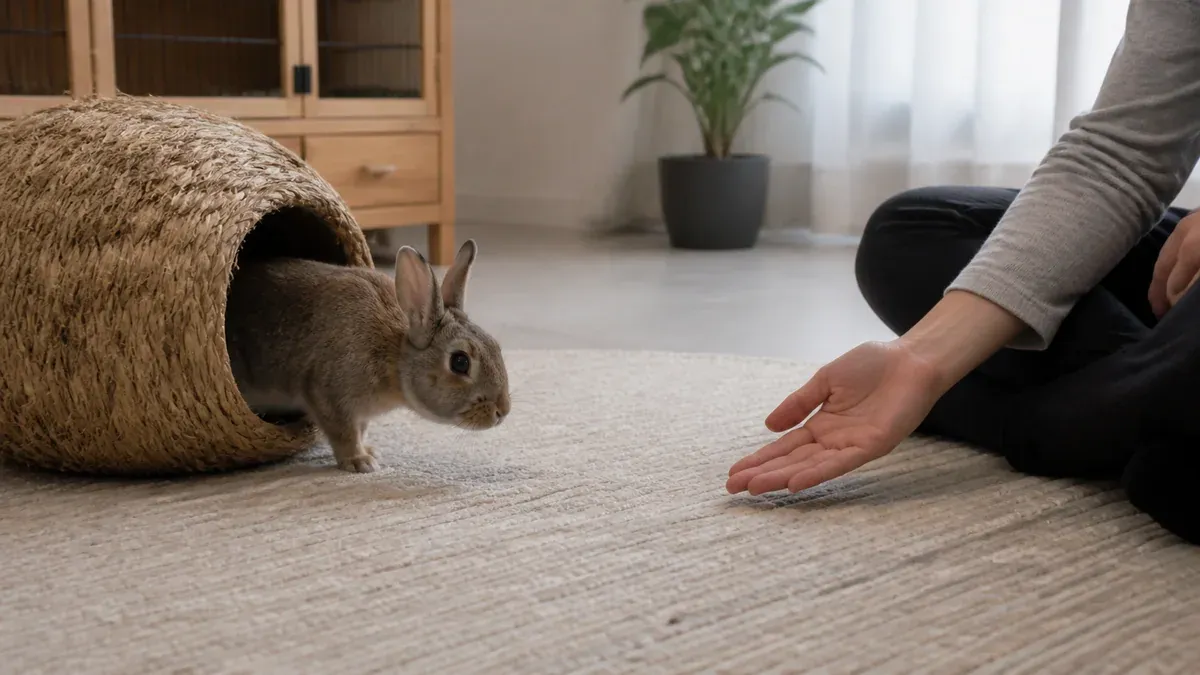
Understanding fear in rabbits before taking action
The rabbit is a prey animal. Its entire nervous system is wired to detect danger and flee rapidly. Fear of humans is not an abnormality — it is an adaptive response that has been inherited. What taming aims to achieve is associating human presence with safety and pleasure — not forcing tolerance.
The rabbit species page summarises the fundamental biological traits that explain this natural reactivity. Before you put a hand out, being able to read the rabbit changes everything: the posture-and-ear combinations that say “you can approach” or “definitely not now” are set out in how to read rabbit body language.
Common causes of a fearful rabbit
- Lack of early socialisation: a kit that was not handled regularly before 8 weeks tends to remain more timid as an adult.
- Past negative experiences: being chased, handled roughly, exposed to shouting.
- Stressful environment: loud noises, smells of predator animals (cat, dog), very active children.
- Underlying pain: a rabbit in pain (dental or joint problem) may flee contact. If a previously confident rabbit suddenly becomes fearful, see a vet.
- Individual personality: some rabbits are naturally more wary regardless of their history.
The progressive method in 5 steps
Step 1 — Presence without interaction
Sit on the floor next to the pen or in the same room. Make no attempt to touch the rabbit. Read, work, use your phone. The goal is for the rabbit to associate you with neutrality, not danger.
Duration: 10–20 minutes a day for several days.
Signs of progress: the rabbit continues eating, moving normally in your presence, and stops freezing or fleeing when you come near.
Step 2 — Hand on the floor, no forcing
Sit on the floor with your hand placed flat nearby, without entering the rabbit’s space. Let the rabbit approach if it chooses. Do not move your hand.
If the rabbit approaches, stay still. Let it sniff. It is setting the pace.
Duration: 10–15 minutes, repeated several times a week.
Signs of progress: the rabbit approaches, sniffs your hand, perhaps moves away, then returns.
Step 3 — Introducing food as a bridge
Offer a small piece of vegetable or a strand of hay directly from your hand. Stay still and calm. Food helps associate your presence with something positive.
Do not try to draw the rabbit towards you. If it refuses, put the food down and try again in the next session.
For suitable vegetables to use as rewards, see what vegetables can rabbits eat.
Step 4 — First strokes
Once the rabbit is eating from your hand and no longer flees your approach, try a first gentle stroke on the head or behind the ears — the least sensitive areas. Slow, soft, brief.
Avoid at first: the belly, tail, hindquarters and flanks.
If the rabbit thumps, grunts or moves sharply away, go back to the previous step. This is not failure — it is information. If your rabbit stubbornly refuses all contact, our dedicated guide my rabbit won’t let me pet it breaks down the right moves area by area.
Step 5 — Building the routine
Trust is built through repetition and consistency. A rabbit that knows you will come at the same time each day, that your movements are predictable and gentle, will make progress. A rabbit exposed to unpredictable interactions (sometimes gentle, sometimes abrupt, sometimes absent) will struggle to settle.
Mistakes that set trust back
- Picking the rabbit up by surprise: grabbing or cornering it suddenly destroys weeks of work. Remember that fear of being lifted is instinctive: see my rabbit doesn’t like being picked up: is that normal.
- Shouting or speaking loudly near it.
- Forcing affection: a rabbit that tolerates contact without enjoying it is not tamed.
- Too many different people during the taming phase: limit interactions at first.
- Punishing fear behaviour: scolding a rabbit that runs away increases anxiety.
Telling fear from pain
One thing is worth settling before you start the method: a rabbit that stays permanently under cover is not necessarily a fearful one. Sorting normal withdrawal from a medical signal or a badly arranged room is covered in why does my rabbit hide all the time, and it comes before any trust work.
A rabbit that was confident and suddenly becomes fearful or aggressive deserves a vet visit. Chronic pain (malocclusion, arthritis, parasites) can radically change behaviour. If your rabbit has also stopped eating, read rabbit not eating — what to do.
Frequently asked questions
How long does it take to tame a fearful rabbit?
It depends on the animal's history and personality. A kit socialised early can become confident within days. An adult rescue rabbit with minimal human contact may need several weeks to several months of consistent, patient work.
My rabbit hides all the time. Is that a problem?
Not necessarily — hiding is a natural defensive behaviour for a prey animal. If the rabbit eats, drinks and produces droppings normally, it is physically fine. The issue is behavioural: it has not yet learned to trust its environment or you. The method below addresses this gradually.
Should I force contact to get the rabbit used to being handled?
No. Forcing contact makes the fear worse and destroys trust. The effective approach is gradual desensitisation: you reduce distance and increase interaction only when the rabbit shows comfort signs.
My rabbit bites when I try to pet it. What should I do?
A bite during petting usually means the rabbit is not ready for that contact, or that you are approaching a sensitive area. Go back to an earlier stage of the method — presence without contact. Read our article on why rabbits bite to identify the exact cause.