Male or female rabbit: which should you choose?
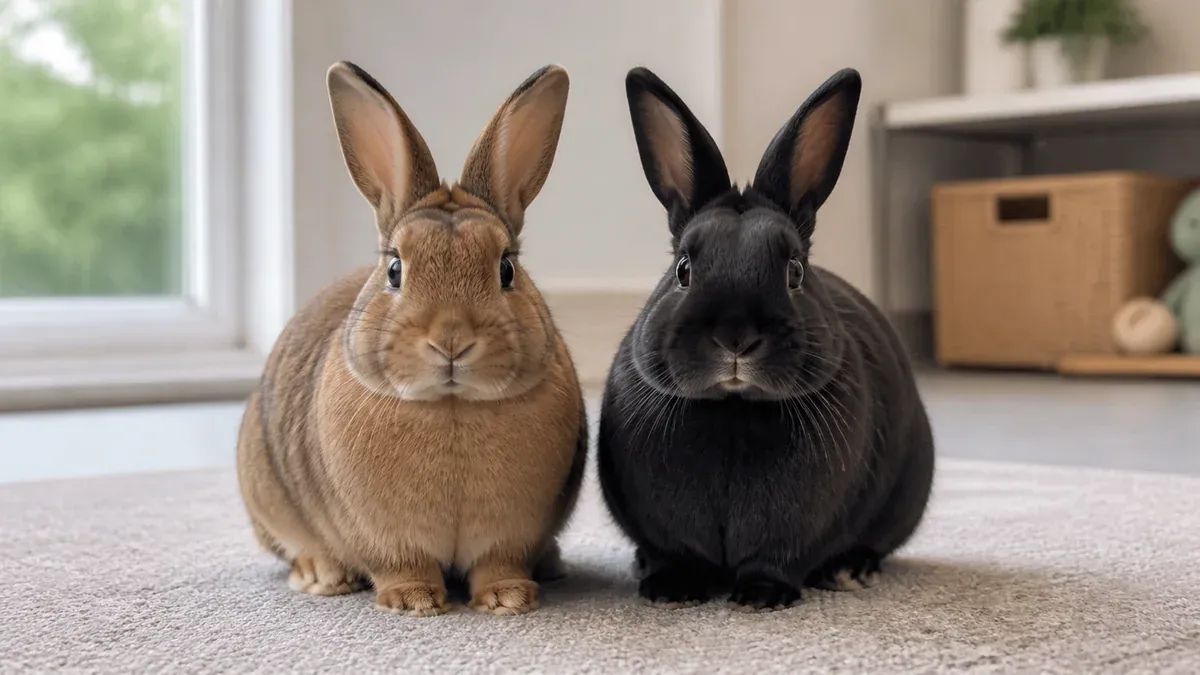
What sex actually changes
Before neutering, a rabbit’s sex measurably influences its behaviour. After neutering, these differences largely fade and individual character takes over.
The rabbit species page covers the general traits of the domestic rabbit, regardless of sex.
The unneutered male: what to expect
An intact buck can develop the following behaviours from around 3–5 months of age:
- Urine spraying: he marks his territory, sometimes reaching walls, furniture and people nearby.
- Mounting behaviour: he may attempt to mount objects, your arms or other animals.
- Mild territorial aggression: he may growl or bite if his space is invaded.
- Restlessness and agitation during hormonal peaks.
These behaviours are hormonal, therefore predictable and reversible. Neutering, ideally carried out between 4 and 6 months, reduces them significantly within a few weeks.
A neutered buck is typically calm, curious, playful and easy to bond with. He shows few notable behavioural differences from a spayed female.
The unspayed female: risks to anticipate
An unspayed doe is subject to near-permanent hormonal cycles. The consequences include:
- Phases of aggression and compulsive digging during false pregnancies (reproductive cycles without mating).
- Energetically defended territory: the doe may bite when her litter tray or sleeping corner is approached.
- Very high risk of uterine cancer: 50–80 % of unspayed females over 4–5 years develop uterine adenocarcinoma. This is the strongest medical argument for spaying.
If territorial behaviour mainly shows up as growling, lunging or biting, also read our guide on why does my rabbit bite.
After neutering: the real criteria for choosing
Once both sexes are neutered, sex-linked behavioural differences are minor. What matters more:
- Age at adoption: a rabbit socialised early will be more confident than one adopted late, regardless of sex.
- Background: a rescue rabbit may have apprehensions to overcome that are unrelated to sex.
- Individual personality: some rabbits are naturally more outgoing, others more independent.
What sex does not change
- Space required: identical for both sexes.
- Diet: identical (see what do rabbits eat).
- Bedding and habitat: identical.
- Exercise and stimulation needs: identical.
Once the rabbit is neutered, sex actually matters less than coat, size and an already-observed temperament: the criteria that genuinely decide a first adoption are gathered in how to choose your first rabbit.
Cohabitation: which pairing works best?
| Pairing | Compatibility | Condition |
|---|---|---|
| Neutered male + spayed female | Excellent | Neutral-territory introduction |
| Two neutered males | Good | Both must be neutered |
| Two spayed females | Good | Spaying both recommended |
| Intact male + intact female | Avoid | Risk of unwanted pregnancies |
| Two intact males | Avoid entirely | Fighting almost guaranteed |
Any cohabitation between two rabbits, whatever the sex combination, requires a gradual introduction and monitoring during the first weeks: the sessions themselves are described in how to introduce two rabbits.
One practical consequence: the sex you are told at handover is not always reliable, especially in a young rabbit. Depending on where you get your rabbit, that check has already been done or is entirely down to you — see should you adopt or buy a rabbit.
Going further
The monthly rabbit budget will help you plan for the cost of neutering or spaying in the first year.
Frequently asked questions
Are male rabbits more affectionate than females?
Not necessarily. Personality depends far more on early socialisation, individual character and whether the rabbit is neutered than on sex. A neutered male is often calm and cuddly; a spayed female can be just as much so. Sex-based generalisations are unreliable before neutering.
Are female rabbits more aggressive than males?
An unspayed doe can develop aggressive territorial phases, especially during false pregnancies. These behaviours disappear almost entirely after spaying. An unneutered buck can be just as territorial.
Which is better for a child — a male or a female rabbit?
For a child, the priority is gentle, predictable behaviour. A neutered animal of either sex offers that. Avoid any unneutered rabbit regardless of sex, as hormones lead to unpredictable behaviour.
Can two male rabbits live together?
Yes, if both are neutered and introduced properly from the start. Two unneutered bucks will almost certainly fight. Cohabitation between any two rabbits requires a neutral-territory introduction and a gradual adaptation period.