Why does my rabbit lie on its side?
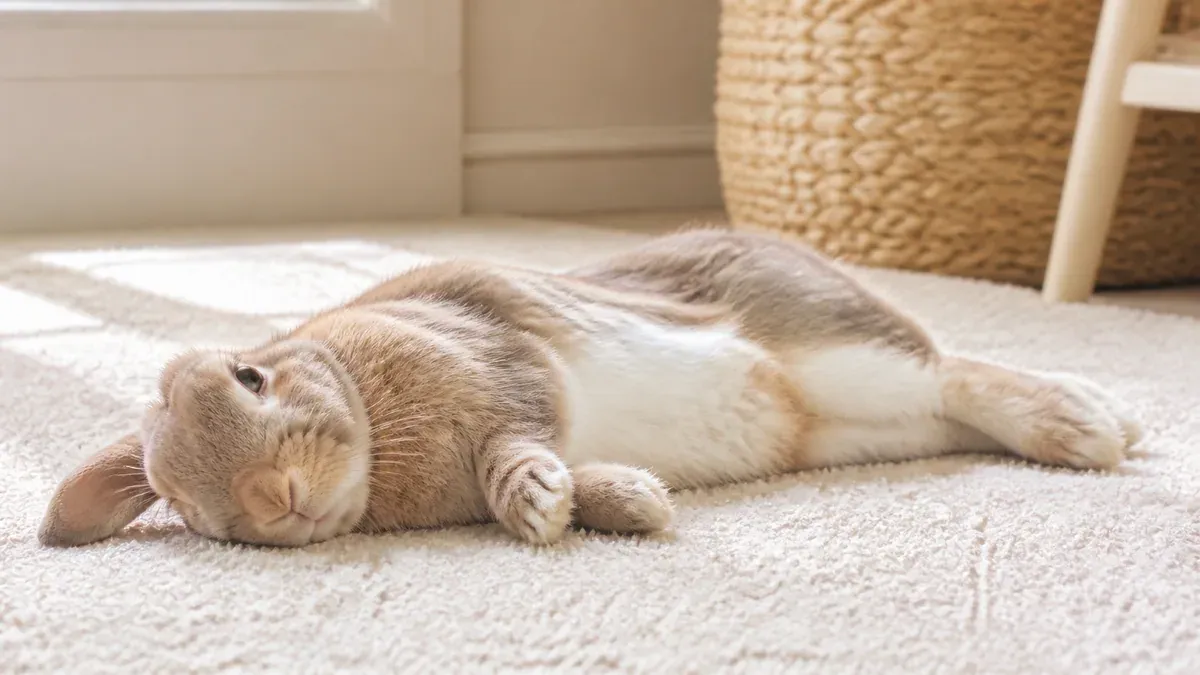
A rabbit lying on its side with its legs stretched out and its whole body loose is most often showing a relaxed posture known as a flop — a sign of wellbeing, not a warning sign. This guide explains why the position often startles new owners, how to recognise a normal flop, and the few signs that do call for real attention.
The “flop”: total relaxation
A flop is when a rabbit drops onto its side, legs stretched out, sometimes quite suddenly and dramatically. Seeing it for the first time can be alarming — the rabbit looks like it has collapsed. In reality, it is an expression of maximum trust and relaxation: a rabbit that does not feel safe never exposes itself this way, lying flat and unable to flee quickly.
This posture typically shows up:
- after a play or running session,
- after a grooming session,
- in the evening, as the rabbit’s crepuscular activity peak winds down before resting,
- in a calm, familiar environment where it feels fully secure.
Why a flop can be startling at first
Some rabbits drop onto their side very fast and dramatically, almost toppling over from a sitting position in one motion. Seen without warning, this abrupt movement can look like a fainting spell or a medical episode, which worries a lot of new owners. It is, however, just one more way a rabbit settles down: the speed of the movement does not reflect an emergency — if anything, it reflects a rabbit confident enough not to bother settling in gradually.
Flop, loaf or sphinx: rabbit resting postures
| Posture | Description | What it suggests |
|---|---|---|
| Loaf | Sitting, paws tucked under the body | Alert rest, ready to react quickly |
| Relaxed sphinx | Lying on the belly, front paws stretched out | Rest with moderate alertness |
| Side flop | Lying on its side, legs stretched out, body loose | Maximum relaxation, full trust |
| Sudden collapse with other signs | Unusual collapse, abnormal breathing, no response | A warning sign that needs close attention |
The same rabbit often moves through several of these postures over the course of a day, depending on its tiredness and how safe it feels at the time.
How to recognise a normal flop
A relaxed flop is identified by the overall picture, not the position alone:
- the body is loose and relaxed, with no visible muscle tension,
- breathing is calm and regular,
- the rabbit reacts to a sound or your presence (an ear twitching, an eye opening),
- it gets up normally and resumes activity whenever it chooses,
- it often alternates this position with other resting postures throughout the day.
When to worry: telling a flop apart from a medical issue
A few related signs call for different levels of concern:
- A sudden, unusual collapse onto its side, especially with abnormal breathing or prostration, can signal pain or a digestive emergency.
- A rabbit that stays flat on its belly, with hot ears and very fast breathing, points more toward heatstroke than a relaxed flop — the position and thermal context are different.
- A rabbit that does not get up normally, stays limp, or does not react to a familiar stimulus should be examined promptly: see our guide on signs of pain in rabbits to assess the full clinical picture.
The simple rule to remember: a flop is voluntary, framed by normal behaviour before and after; a medical issue comes with other clear signs of distress.
What encourages this resting posture
- An environment that feels safe, free of sudden noises or potential threats (other household pets not yet introduced).
- A trusting relationship built with the people in the household.
- A comfortable ambient temperature, neither too cold nor too hot.
- Enough physical activity during the day, especially around crepuscular activity peaks — a rabbit often flops like this to recover right after a series of binkies.
Frequently asked questions
My rabbit suddenly drops onto its side — is that a flop?
It depends on the context. A flop is a voluntary movement, often preceded by a moment of watching or grooming, followed by a relaxed body and calm breathing. A sudden, unusual collapse, especially with prolonged stillness or abnormal breathing, is a sign that warrants attention — see our guide on signs of pain in rabbits.
My rabbit never lies on its side — is that a problem?
Not necessarily. Some rabbits stay more alert and prefer less exposed resting positions (loafed or in a sphinx pose). It becomes worth a closer look if the rabbit seems generally tense or unable to relax even in a familiar, secure environment.
Can a rabbit stay in this position for a long time?
Yes, some rabbits stay flopped for anywhere from a few minutes to over half an hour, sometimes drifting into light sleep. The duration alone is not concerning as long as the rabbit reacts normally to a sound or your presence.
Should I wake a flopped rabbit to check it is okay?
In most cases, no — a light sound or your usual approach is generally enough to get a reaction (an ear twitching, an eye opening). Routinely waking it by touch just disrupts its rest for no reason.