Why does my rabbit chew the bars of its enclosure?
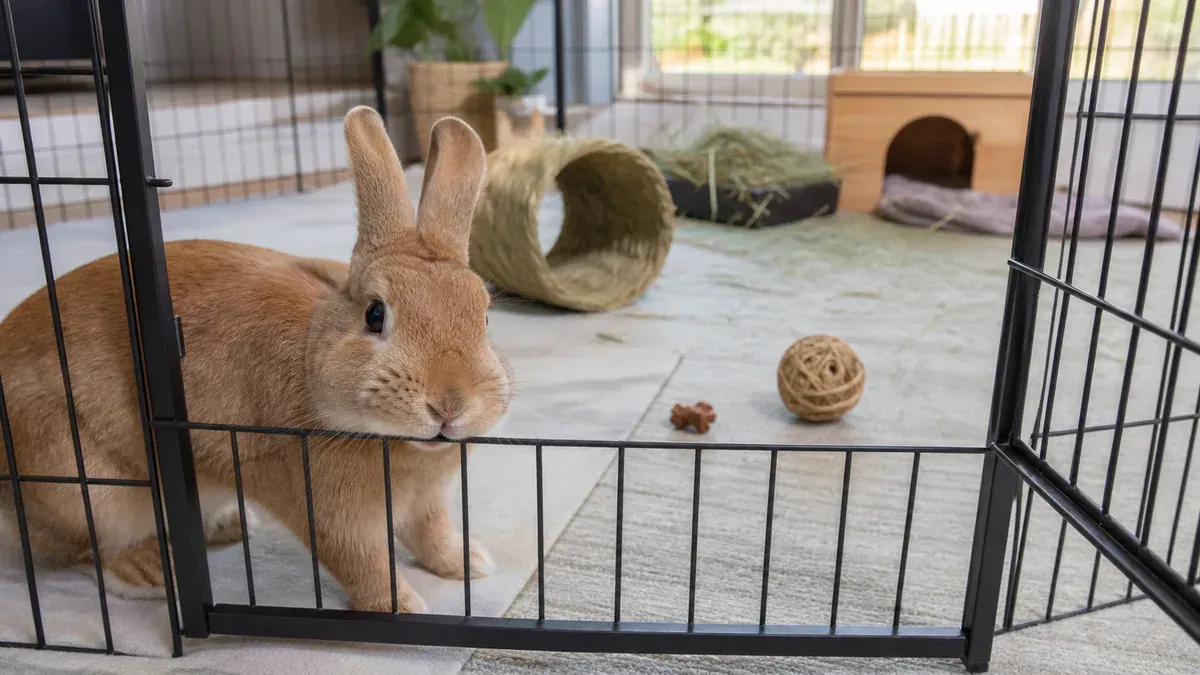
A rabbit that chews the bars of its enclosure is sending a signal, not misbehaving. This behaviour is almost always reactive: it appears when something in the rabbit’s environment or routine is not meeting its needs. Identifying the specific cause is the only way to address it effectively and prevent it from becoming a permanent habit.
The main causes of bar chewing
Boredom and under-stimulation
This is the most common cause in otherwise healthy rabbits. An under-stimulated rabbit develops repetitive behaviours to fill the void — bar chewing is one of them, alongside compulsive digging. The rabbit chews, sometimes gets a reaction from you, and the behaviour is reinforced.
Signs pointing to genuine boredom: chewing at fixed times (usually morning or evening), spending long periods lying still, showing little interest in objects inside the enclosure.
Enclosure too small or insufficient free-roaming time
A rabbit confined in an inadequate space without regular exercise expresses its frustration physically. Bar chewing can then be read as an attempt to expand its space or access what lies beyond. Useful guidelines: an enclosure large enough for the rabbit to move, stretch out and hop without restriction, plus long, predictable daily free-roaming sessions outside the enclosure.
For a similar destructive behaviour driven by burrowing instinct, see our article on why rabbits dig everywhere.
Natural tooth wear
A rabbit’s teeth grow continuously. In a well-enriched environment, it wears its incisors on natural wood, compressed hay or appropriate toys. When these alternatives are absent or insufficient, it turns to whatever is available — the bars.
This type of chewing is less targeted and more random: the rabbit gnaws the bars sporadically, without particular agitation. It is not trying to escape — it is wearing down its teeth.
Frustration and stress
Some rabbits chew the bars in response to a specific frustration: food visible but out of reach, another animal nearby, or a recent environmental change. This chewing is often brief and contextual — it disappears when the source of frustration is removed.
A rabbit kept alone without enough social contact may also develop stereotypies including bar chewing. For rabbit social needs, see our article on whether rabbits can live alone.
How to identify the cause
| When chewing occurs | Likely cause |
|---|---|
| Always at the same times (morning, evening) | Demand behaviour for release or food (learned operant behaviour) |
| Random, without obvious agitation | Tooth wear — lack of chewing alternatives inside the enclosure |
| With agitation, grunting, thumping | Frustration or insufficient space |
| New behaviour after a change | Environmental stress (move, new animal, new sounds) |
| Always the same bars, at one specific spot | Curiosity or escape attempt towards what is on the other side |
What to do
Increase free-roaming time
This is the most direct response to insufficient space. A rabbit with meaningful daily free-roaming time in a secure area has fewer reasons to chew its bars. Regularity matters as much as duration: predictable sessions at the same times reduce the agitated anticipation that typically precedes them. For the reference durations and how to fit them around a working day, see how many hours of exercise does a rabbit need.
To secure the free-roaming area — particularly electrical cables — see our guide on protecting cables from rabbits.
Enrich the enclosure
Provide appropriate chewing materials to replace the bars:
- Natural untreated wood branches (apple, hazel, willow): the most natural option and usually the most popular
- Compressed hay cubes or hay balls: chew like wood and add fibre
- Wicker or rattan toys: vary the textures
- Cardboard tubes and boxes: to chew and explore
Refresh what you offer regularly to maintain interest. An object ignored for a week is worth removing and replacing with something new — that is the rotation principle set out in how to keep a bored rabbit busy.
When to see a vet
If your rabbit chews the bars with unusually high intensity, or if it is accompanied by other signs (reduced appetite, weight loss, drooling), consult a rabbit-savvy vet. A dental problem — molar malocclusion or spurs — can drive a rabbit to seek hard material to gnaw in an attempt to relieve oral discomfort.
What not to do
Do not let the rabbit out immediately in response to bar chewing — you reinforce the behaviour. The rabbit learns that chewing bars triggers release and will try harder.
Do not apply repellent sprays to the bars — beyond uncertain effectiveness, this does not address the underlying cause, and some products may be harmful if ingested in quantity.
Do not simply cover the bars with cardboard without addressing the root cause — if the problem is insufficient space or enrichment, the rabbit will find another outlet for the same need.
Frequently asked questions
My rabbit only chews the bars in the morning — is that normal?
Yes, this fits the rabbit's crepuscular rhythm — most active early morning and evening. If the chewing happens consistently before you get up, it is likely a demand for release or food: the rabbit has learned this behaviour triggers your response. Avoid letting it out immediately in reaction to the chewing, or you will reinforce the pattern.
Can metal bars damage a rabbit's teeth?
Chewing galvanised steel bars does not directly damage teeth in the short term, but prolonged repetitive contact on very hard metal can weaken incisors over time. More concerning: if your rabbit chews hard enough to bend or break bars, check it is not swallowing metal fragments — see a vet if you observe that level of damage.
Should I remove my rabbit from its enclosure as soon as it starts chewing the bars?
No — doing so teaches the rabbit that bar-chewing is an effective way to get your attention. Instead, plan regular, predictable free-roaming sessions on a fixed schedule independent of the chewing. Let the rabbit out before it starts chewing, not as a reaction to it.
Will neutering or spaying reduce bar chewing?
Sometimes. Neutering reduces some hormonal and territorial behaviours. But boredom and insufficient space are not hormonal causes — neutering alone will not solve a stimulation problem.