My rabbit won't let me pet it: what to do
Veterinary warning — A rabbit that suddenly starts refusing all contact, fleeing or nipping when it used to accept petting may be in pain (dental, back, joint, digestive). If the change is recent and marked, especially with a drop in appetite, see a rabbit-savvy vet to rule out a health problem.
A rabbit that won’t let you pet it is not necessarily rejecting you: most often it is saying “not there, not like that, or not now”. Rabbits are not naturally contact-seeking the way dogs are; they show affection differently, and they have areas and rhythms that must be respected. Before concluding that it “doesn’t like” being petted, check three things: that it isn’t in pain, that you are going about it the right way, and that you are leaving it a choice.
First, rule out pain
This is the priority reflex, especially if the refusal is new. A rabbit that accepted petting and starts fleeing, grunting or nipping at contact may be hurting where you touch it: back, joints, belly, or teeth.
- A sudden refusal, a rabbit that tenses or squeaks when touched in one specific spot, should raise the thought of pain.
- If the rabbit is also eating less, sitting hunched or staying prostrate, the medical angle becomes the priority.
To weigh up the signs, lean on our guide on how to tell if a rabbit is in pain. An isolated refusal of contact in a rabbit that is otherwise lively and eating well, on the other hand, is almost always behavioural rather than medical.
Understanding why it refuses
Once pain is ruled out, the refusal almost always comes down to the nature of the rabbit — a prey animal that likes to keep control of its body:
- The area touched: most rabbits dislike being stroked on the chin, cheeks, flanks, belly, legs or hindquarters. Those contacts evoke a predator’s grip.
- The angle: a hand descending from above onto a rabbit mimics a bird of prey’s approach. Many rabbits flee the vertical hand but accept one that arrives at floor level.
- Being picked up: a rabbit that struggles won’t associate petting with pleasure if it has just been grabbed or held against its will. This dislike of being lifted is actually the norm in rabbits; we explain it in my rabbit doesn’t like being picked up: is that normal.
- Temperament: some rabbits are simply not very tactile while being deeply attached. They prefer other languages, such as following you everywhere or lying down near you.
A rabbit’s attachment is not measured by how many strokes it tolerates: a rabbit that licks you or settles against you is showing trust, even if it dislikes being handled.
The right moves to earn its acceptance
The goal is not to “force” petting, but to make contact feel pleasant and safe from the rabbit’s point of view.
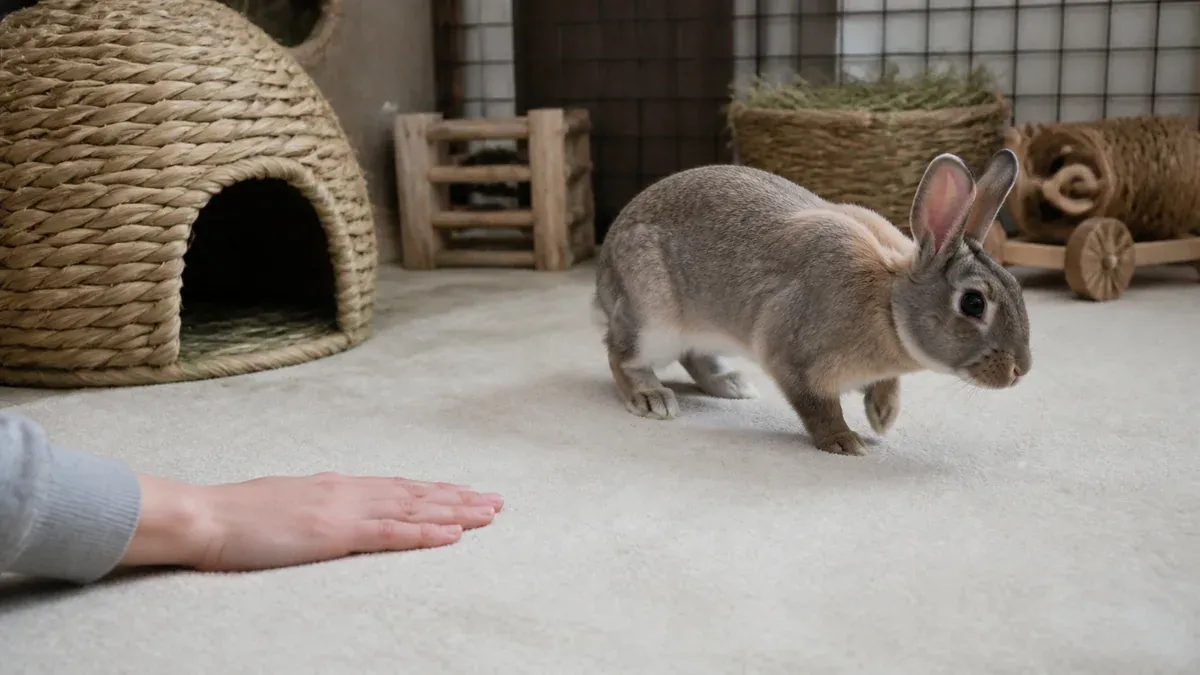
- Get down to its level. Sit on the floor and let the rabbit come. A rabbit accepts a hand that doesn’t loom over it far more easily.
- Start with the head. The forehead and crown, between the ears, are the best-accepted areas — that is where rabbits groom each other. Slow, soft, brief movement.
- Read the posture. A rabbit that flattens its head to the floor in front of your hand is asking for a stroke. A rabbit that crouches, widens its eyes or backs away is saying “stop”: stop.
- Always leave an exit. Never corner the rabbit. If it can leave whenever it wants, it comes back more readily.
- Pair your presence with something positive. Offering a familiar vegetable from your hand, without trying to touch, helps the rabbit see the hand as a good thing.
This gentle progression follows the same logic as taming: if your rabbit is fearful overall, work back through the step-by-step method in our guide on how to tame a fearful rabbit.
Mistakes that make the refusal worse
- Insisting or chasing with your hand when the rabbit pulls away: every forced contact sets trust back.
- Grabbing then petting: the rabbit mostly remembers the restraint of the grab.
- Going straight for the sensitive areas (belly, hindquarters, legs).
- Reading the refusal as a whim to correct: scolding or pinning a rabbit that refuses only raises its stress.
A rabbit that grunts, thumps or gives a small nip when you push is not “being difficult”: it is setting a clear limit. Respecting it is, paradoxically, what opens the door to more contact later.
Should you worry about a rabbit that dislikes petting?
No, as long as the refusal is stable and isolated. A rabbit that is barely tactile but eats well, explores, follows you and interacts in its own way is a thriving rabbit: it simply has a different language of affection.
What should raise concern is change: a once-cuddly rabbit that starts fleeing all contact, especially alongside other signs (drop in appetite, prostration, hunched posture), should be examined by a rabbit-savvy vet.
To decode your rabbit’s other signals and strengthen your relationship, explore all our rabbit behavior guides as well as the rabbit species profile.
Frequently asked questions
Where should you pet a rabbit so it accepts?
The forehead and top of the head, between the ears, are the best-accepted areas: that is where rabbits groom each other. Avoid the chin, cheeks, underside, legs, tail and hindquarters at first, which often feel intrusive. Many rabbits that 'refuse petting' actually accept a stroke on the head very well.
My rabbit lowers its head when I reach out — is it scared?
Not necessarily. A relaxed rabbit that lowers and flattens its head to the floor in front of your hand is often asking for a stroke (grooming), not fleeing. If instead it crouches with wide eyes, ready to bolt, that is fear: in that case do not push, and go back to simply being calmly present.
Can a rabbit learn to enjoy petting over time?
Often yes, but at its own pace. By respecting its comfort zones, letting it come to you, and associating your hand with something positive, many rabbits gradually accept more contact. Some stay barely tactile for life: that is a personality trait, not a failure.
My rabbit accepted petting and suddenly refuses it — is that serious?
A sudden change deserves attention. A rabbit that starts fleeing or nipping at contact when it used to accept it may be hurting somewhere (teeth, back, joints, belly). If the refusal is recent and clear, especially with a drop in appetite, see a rabbit-savvy vet to rule out pain.