Why does my rabbit follow me everywhere? Attachment and behaviour
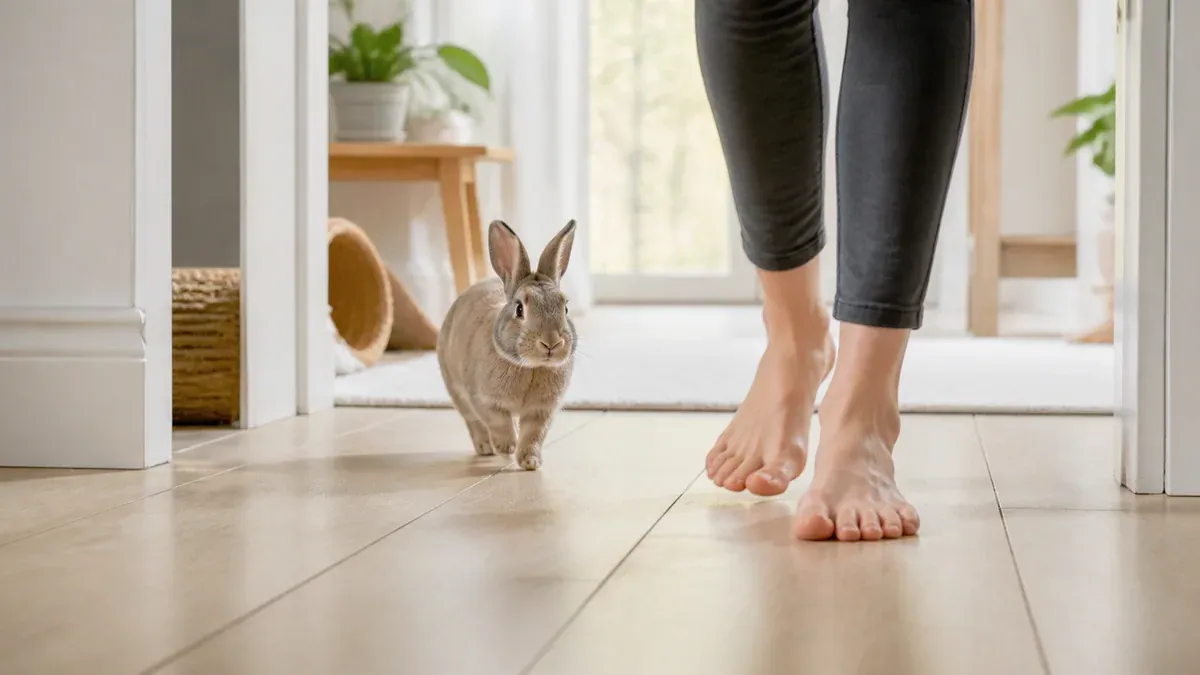
A rabbit that pads after you from room to room is not behaving strangely — it is showing one of the clearest signs that a bond has formed between you. Domestic rabbits are social animals that build lasting attachments, and they express them in characteristically understated but consistent ways.
What following behaviour means
Attachment and social recognition
Rabbits establish a social hierarchy, even in a human household. When a rabbit follows you, it recognises you as an important member of its group — a source of security, food and positive interaction. This is not pathological dependence: it is healthy attachment.
Rabbits that have been gently socialised and handled positively from a young age are far more likely to display this kind of following behaviour than rabbits with little human contact.
Curiosity and social engagement
Rabbits are naturally curious animals. They want to know what you are doing, where you are going, and what new smells or activities you bring. Following you allows them to participate in the environment rather than just observe it from their enclosure.
Requests for attention or food
A rabbit that trots closely behind you and then stops to stare is often making a request: time outside the enclosure, a stroke, a treat, or a play session. It has learned that you are the source of these good things and adopts the most effective strategy — staying in your line of sight.
Hormonal behaviour (unneutered rabbits)
In unneutered rabbits, particularly intact males during a hormonal peak, following may be accompanied by urine marking or mounting attempts. In that case, the behaviour is driven by reproductive instinct rather than attachment. Castration or spaying generally reduces it.
How to respond
Encouraging bonding without creating excessive dependency
Following behaviour is healthy — respond to it naturally. Give attention when you are available, without always dropping everything the instant the rabbit appears. A rabbit that learns you always respond immediately may become more insistent.
What works:
- Sitting on the floor regularly and letting the rabbit come to you
- Offering shared exploration of a safe room
- Alternating between attentive interaction and getting on with your day without ignoring the rabbit
What the rabbit may be asking for
If your rabbit is following you and seems to want something, check the basics:
- Is it time for its daily exercise outside the enclosure?
- Is the enclosure too small or too unstimulating?
- Is it getting enough time out of its space?
A rabbit that is bored in an insufficiently stimulating environment will be more insistent in its attention-seeking. Improving environmental enrichment often reduces this behaviour.
Following in the context of other attachment behaviours
Following you is part of a broader set of attachment behaviours. A bonded rabbit may also:
- Lie down near you or press against your leg
- Lick your hands or feet — a social grooming gesture between bonded companions
- Grunt if another animal or person approaches you (guarding a social resource)
To understand why your rabbit licks you, see our article on licking behaviour. A deeply attached rabbit may even follow you everywhere while refusing to be petted: attachment does not necessarily run through physical contact.
If your rabbit does not follow you and seems unsociable, see our guide on how to tame a fearful rabbit: some rabbits simply need more time to build this kind of bond.
When to be concerned
Following becomes a concern if the rabbit:
- Refuses to eat or drink when you leave the room
- Destroys things the moment you are out of sight
- Shows clear anxiety signs (frantic thumping or scratching, vocalising)
These behaviours may indicate environmental stress, insufficient stimulation, or, less commonly, separation anxiety. A rabbit-savvy vet or animal behaviourist can help identify the cause.
For a complete overview of domestic rabbit behaviour and social needs, visit the rabbit species page.
Frequently asked questions
My rabbit only follows me at certain times of day — why?
Rabbits are crepuscular, most active in early morning and in the evening. If your rabbit follows you mainly at those times, that is consistent with its natural rhythm: it is awake, social, and looking for interaction during those windows.
My rabbit follows me and then nips my feet — what does this mean?
Trotting after you and then nibbling your feet is often a play behaviour or a way of getting your attention. It can also reflect a herd instinct: the rabbit sees you as a companion and is 'nudging' you the way it would another rabbit. It is generally not aggression.
Is a rabbit that follows me everywhere too dependent?
Not as long as it can also spend time alone without visible distress. An attached rabbit that follows you when you are home but rests or plays independently in your absence has a healthy bond. If the rabbit refuses to eat or shows clear anxiety signs the moment you leave the room, consult a rabbit-savvy vet or a behaviourist.
Does my rabbit follow everyone, or just me?
Rabbits form clear social preferences. A rabbit that follows you specifically but ignores others in the household has simply chosen you as its primary social reference. That is a sign of a strong bond built through consistent positive interactions.