Why is my rabbit peeing outside the litter box, and what to do
Veterinary warning — A previously clean rabbit that starts urinating outside the box should first have a medical cause ruled out (urinary pain, infection, sludge, arthritis). This article helps you sort through the leads, but it does not replace an exam by a rabbit-savvy vet.
A rabbit that was already litter-trained and starts peeing outside the box is not “unlearning”: it is signalling something. Three leads, to work through in this order: a medical cause (urinating hurts, or the rabbit can no longer get into the box), a hormonal cause (sexual maturity, territorial marking) and a setup cause (box, litter, changes in the environment). If your rabbit was never trained in the first place, that is a different subject: start with how to litter train a rabbit.
First: what exactly are you dealing with?
Three very different behaviours get lumped under the same phrase. Sorting them changes everything that follows:
| What you find | What it is | Main lead |
|---|---|---|
| Small sprays on vertical surfaces, furniture, chair legs | Territorial marking | Hormonal, territory |
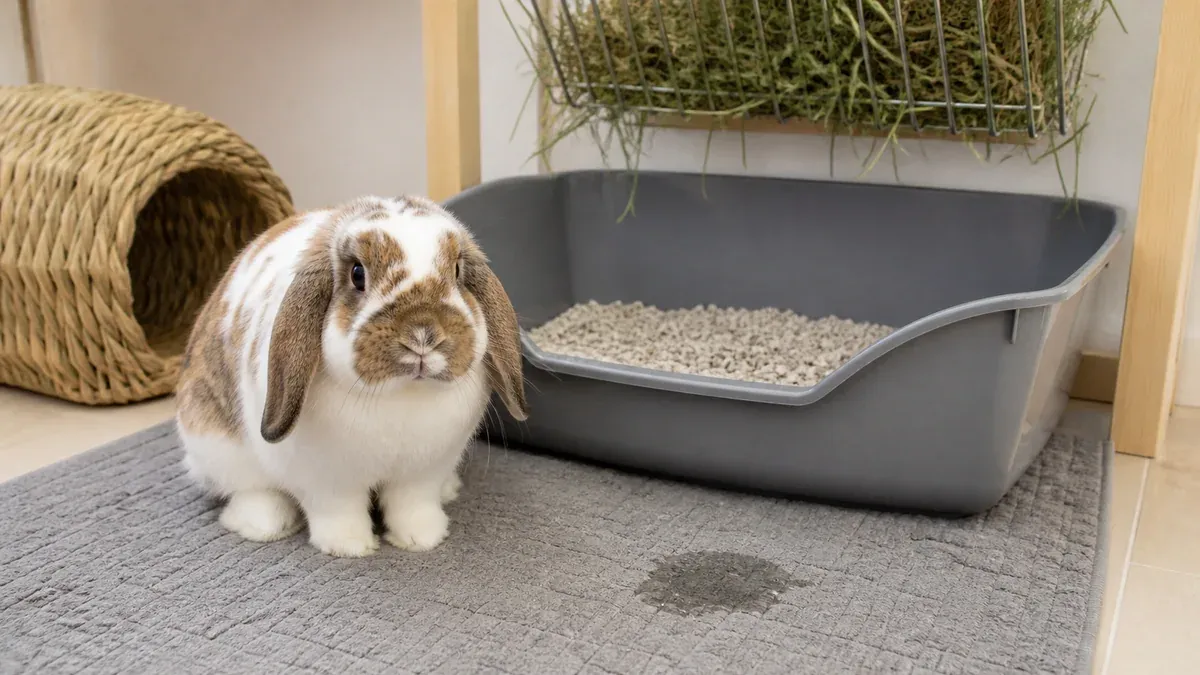
| Clear puddles on the floor, in one or two set corners | The rabbit has picked another “toilet corner” | Setup, the box |
| Puddles everywhere, with no corner logic | Loss of control or pain | Medical |
| Permanently wet rear end, yellowed fur | Urine leakage, incontinence | Medical, consultation |
| Scattered hard droppings, urine always in the box | Normal marking, not a training failure | Nothing urgent to fix |
Scattered hard droppings are not a cleanliness problem: they are common, especially in an unneutered rabbit. Only urine should reliably go in the box.
Lead 1: rule out the medical cause
This comes first, because it is the only one a better box will never fix.
- Urinary pain (infection, sludge or stones). The rabbit passes small amounts often, strains, stays hunched for a long time. Chalky or oddly coloured urine is worth documenting: red urine in rabbits explains how to tell a harmless dietary pigment from a real warning.
- Increased thirst and urine output. If the tray soaks through far faster than before and overflows, the problem may not be cleanliness but volume: see my rabbit is drinking a lot.
- Joint pain or excess weight. An older, arthritic or overweight rabbit may simply no longer manage to step over the rim, or to hold the posture. A box with one lowered side sometimes solves everything — and if weight is the issue, see my rabbit is getting fat.
- E. cuniculi. This parasite can cause incontinence and a wet rear end, sometimes before any neurological sign: E. cuniculi in rabbits.
Seek advice without delay if the rabbit strains to urinate, cries out, has a permanently wet rear end, or if the regression comes with dullness or a drop in appetite.
Lead 2: the hormonal lead
Rabbits reach sexual maturity at around four to six months (sometimes as early as three): that is the classic age at which a perfectly clean youngster starts spraying urine on walls, furniture and sometimes on its owner. This is not messiness, it is marking.
Neutering strongly reduces the behaviour in both sexes and makes litter habits far more stable (should you neuter a male rabbit, should you spay a female rabbit). Two useful caveats: the effect is not immediate — allow several weeks after surgery for hormone levels to settle — and habits formed beforehand may need retraining.
In an unspayed doe, cyclical marking episodes, sometimes paired with nesting behaviour, follow the same logic.
Lead 3: the box, the litter and the environment
Once a medical cause is ruled out and the rabbit has been neutered for a while, the answer is almost always in the setup.
- Box too small. The rabbit must fit entirely inside, turn around and crouch. A box it only half fits into is a box it will eventually walk past.
- Rim too high. A classic problem for older rabbits, overweight rabbits and young kits.
- Box too clean. A thorough scrub that leaves no trace of scent removes the olfactory landmark. Keep a small amount of soiled litter in the bottom after washing — see how to clean a rabbit litter box.
- Box not clean enough. The opposite excess is real too: rabbits refuse a tray saturated with urine.
- Litter changed. Switching substrate (to pellets, corn cob, or a scented product) is enough to make a rabbit desert the box. Selection criteria are in the best bedding for rabbits.
- Box in the wrong place. The rabbit picks the corner, not you. If it always pees in the same spot outside the box, move the box to that spot rather than fighting it.
- Space expanded too fast. After a move to part-time or full free-roaming, one box is no longer enough: add one per living area (can a rabbit live cage-free full time).
- Change in the household. Moving, new furniture, a new pet, a long absence: marking is a classic response to territorial stress (moving house with a rabbit).
A seven-day action plan
- Day 1 — Observe and log: where, how often, sprays or puddles, what the urine looks like. That log is what your vet will want.
- Day 1 — Rule out the emergency: straining, wet rear end, dullness, falling appetite → consultation.
- Day 2 — Clean soiled areas with white vinegar (ammonia-based products smell of urine and call the rabbit straight back).
- Day 2 — Move or add a box in the corner the rabbit has actually chosen, and put hay right next to it: eating and eliminating in the same place is a natural reflex.
- Days 3–5 — Temporarily shrink the accessible space. A smaller territory is easier to keep clean; expand again in stages afterwards.
- Days 3–7 — Change only one variable at a time (box, litter, location), or you will not know what worked.
- Day 7 — Review. If nothing has shifted despite a correct setup and a neutered rabbit, the medical lead moves back to the top: book an appointment.
Going further
Logical next step: once clean habits are back, review your litter routine so the problem does not rebuild — how to reduce rabbit litter odour rounds this guide out. Browse all our rabbit housing guides and the rabbit species page.
Veterinary sources and caution notes
The sources below serve as veterinary or institutional reference points to frame the medical part of this topic cautiously: this article helps you sort through possible causes, but it does not replace an exam by a rabbit-savvy vet. No treatment or dose is suggested here.
Sources used to frame the recommendations:
- RSPCA — Rabbit health and welfare
- Merck Veterinary Manual — Noninfectious diseases of rabbits
- VCA Hospitals — Rabbits, diseases
Frequently asked questions
My rabbit pees right next to the box — what does that mean?
That is usually a box problem rather than a training problem: too small to turn around in, sides too high to step over, litter swapped for a type it dislikes, or a box scrubbed so thoroughly that every familiar scent is gone. The rabbit is aiming for the right corner but avoiding the container.
Should I tell off a rabbit that pees outside the box?
No. Punishment connects to nothing in a rabbit's mind and adds stress, which usually makes things worse. Clean the spot with white vinegar to kill the scent, put the blotted urine or a few droppings in the box, and fix the cause: pain, hormones or setup.
My rabbit is neutered and has become messy again — is that hormonal?
Unlikely if the neutering was months ago. In a neutered, previously clean rabbit, a clear regression points first at a medical cause (urinary pain, arthritis making the box hard to enter) or at an environmental change such as a new pet in the home.
Two rabbits keep soiling each other's spots — what now?
A hierarchy being renegotiated, or a bond that never fully settled, often shows up as cross-marking. Provide at least two boxes in two separate areas so each rabbit has one without having to defend access, and check that both animals are neutered.