My rabbit is getting fat: how to act without putting it at risk
Veterinary warning — Rabbit obesity is corrected through the ration, never through fasting: in this species, going without food is a life-threatening emergency. This article gives practical reference points, but a markedly obese, elderly or already ill rabbit should be followed by a rabbit-savvy vet.
A rabbit that is getting fat almost always has too many pellets and treats, not enough hay and not enough room to move. The safe approach is unlimited hay, sugary treats removed and a pellet ration adjusted with your vet to body condition, age and activity — and above all no fasting, not even for a day. In rabbits, not eating triggers gut stasis within hours.
First, check it really is fat
Fur misleads in both directions: it hides thinness just as it rounds out a silhouette. Assessment is done by touch, exactly as for a rabbit losing weight, but looking for excess rather than lack:
- The ribs: they should be detectable under a thin layer. If you have to press firmly to find them, there is excess.
- Pelvis and spine: buried under a thick layer in an overweight rabbit.
- The belly when sitting: a roll that clearly spreads out on either side is mass, not posture.
- The dewlap (fold under the chin): normal in many does. It becomes a warning when it thickens enough to hinder grooming or to stay damp.
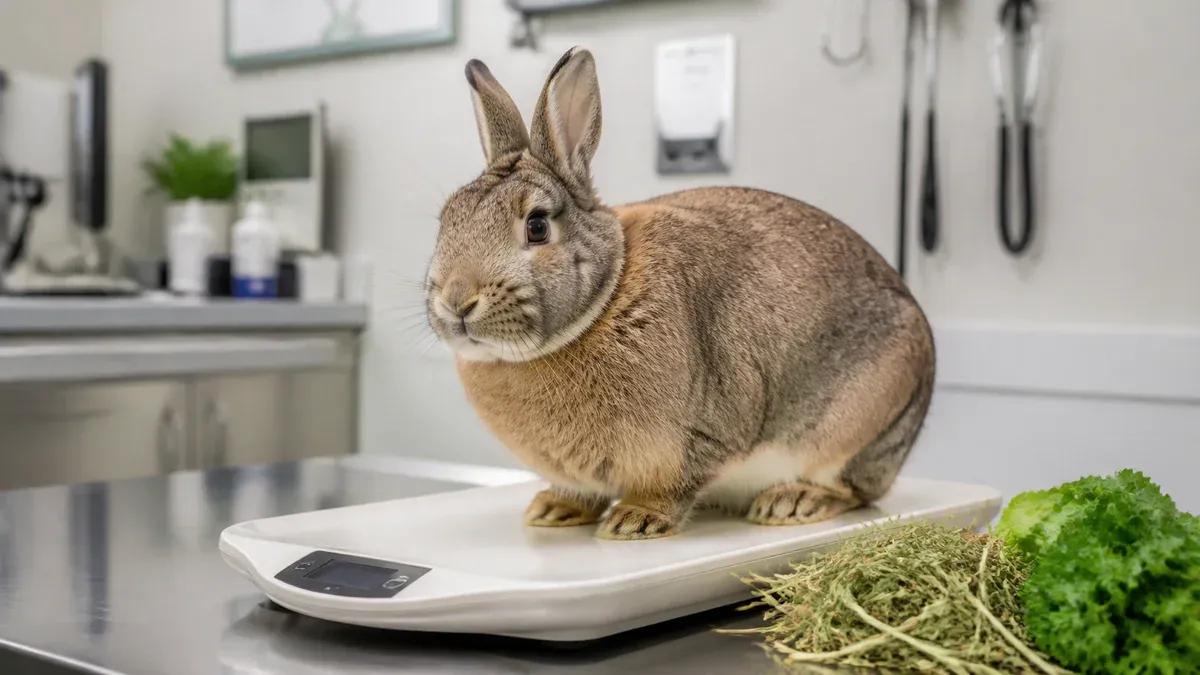
Vets use a standardised body condition score; at home, regular weighing remains the best tool. A kitchen scale, a figure written down each week — and it is the trend that matters, not a single number (how to weigh a rabbit at home). A steady rise warrants reviewing food and activity with your vet, because target weight depends on build and body condition rather than a generic number.
Why excess weight really matters in a rabbit
This is not about looks. An overly fat rabbit stacks up concrete risks:
- It can no longer reach its anus and cannot eat its caecotrophs: they build up, stick to the perineum and soil the rear end. That is a frequent reason for consultation, and it must be told apart from diarrhoea (see soft droppings in rabbits).
- A soiled rear end attracts flies: in warm weather, the risk of flystrike (maggots laid on the skin) becomes serious. What to do — and above all what not to do — in that case is described in can you bathe a rabbit.
- Its feet carry an overload and sore hocks set in more easily, especially on hard or wire flooring — see sore hocks in rabbits.
- It copes worse with heat: body fat insulates and thermoregulation suffers, raising the risk of heatstroke.
- It grooms poorly, which worsens skin and coat problems.
- Anaesthesia and surgery become trickier, which matters if neutering or dental treatment is needed.
The most common causes
1. Too many pellets
The number one cause. Unlimited pellets suit a growing kit, not an adult: the amount should be adjusted to body condition. For feeding reference points and their limits, see how much pellets to feed a rabbit. A bowl topped up “when it’s empty” nearly always ends in excess.
2. Treats and seed mixes
Honey sticks, yoghurt drops, colourful mixes: highly calorific, highly palatable, they displace hay both in the stomach and in the daily routine. Seed mixes also let the rabbit pick out the fattiest pieces.
3. Not enough hay
Hay must remain the base of the ration and be available at all times. Hay supports dental wear and gut function while displacing more energy-dense foods. If yours snubs it, find out why before changing anything else — see why has my rabbit stopped eating hay.
4. Not enough movement
A rabbit living in a cramped pen with no run time gains weight even on a correct ration. It needs daily access to an area where it can genuinely run and stand up; rather than relying on one universal hourly quota, watch its activity and progressively increase opportunities to move: how to set up an indoor pen for a rabbit covers the layout.
5. Neutering and age
After neutering, energy needs fall: if the ration does not change, weight climbs over the following months. The same applies to an older, less active rabbit. That is no reason to skip neutering — it is a reason to readjust the ration at that point.
Losing weight safely: the method
- Never cut off access to hay. It stays unlimited from start to finish. Weight loss comes from rebalancing, not from overall restriction.
- Remove commercial treats first, before touching the pellets. It is the step with the best benefit-to-risk ratio.
- Reduce pellets in stages, over several weeks, down to the amount agreed with your vet. An abrupt cut makes some rabbits snub the whole ration — precisely the danger.
- Keep the daily greens: low in calories, high in water, they help with satiety (see what greens to give a rabbit every day).
- Increase run time and enrichment: hiding hay in cardboard tubes or spreading it across several spots makes the rabbit move with no effort on your part.
- Weigh weekly, always under the same conditions, and record it. Aim for a slow, steady decline over several weeks to several months.
Immediate stop signal: if the rabbit spontaneously eats less hay, stops passing droppings or becomes listless, the plan stops and the vet takes over. A marked reduction or stop in eating needs same-day veterinary advice; do not wait for an hourly threshold (my rabbit is not eating, GI stasis in rabbits).
When it is not fat at all
Some increases in bulk have nothing to do with diet, and confusing them wastes time:
| What you see | Likely lead | What to do |
|---|---|---|
| Distended belly but ribs still easy to feel | Bloat, abdominal mass or fluid | Consultation; urgent if the belly is tight or painful |
| Bulk gained within days | This is not fat | Prompt consultation |
| Unspayed doe, growing belly, dullness | Possible uterine disease | Consultation; see should you spay a female rabbit |
| Round belly plus scarce or absent droppings | Digestive emergency | Same day, no waiting |
| Bulkier outline but a stable figure on the scale | Coat or moult, not weight | Simple monitoring |
Fat accumulates gradually, over weeks. A rapid change in outline calls for a consultation, not a diet.
Going further
Logical next step: weigh out what you actually give each day, in grams, for a week. That is usually where the gap hides. Browse all our rabbit health guides and the rabbit species page to frame ration and activity.
Veterinary sources and caution notes
The sources below serve as veterinary or institutional reference points to frame the topic cautiously: this article helps you correct a ration and monitor a weight, but it does not replace an exam by a rabbit-savvy vet, the only one able to assess an obese or unwell rabbit.
Sources used to frame the recommendations:
- RSPCA — Rabbit health and welfare
- Merck Veterinary Manual — Noninfectious diseases of rabbits
- PDSA — Obesity in rabbits
Frequently asked questions
How do I know my rabbit is genuinely overweight?
Run your hand along the ribs and pelvis. In a rabbit in good condition the ribs can be felt under a thin layer; in an overweight rabbit you have to press to find them, and the belly forms a roll that spreads out when the rabbit sits. A dewlap under the chin, common in does, is not on its own a sign of excess weight.
Can I fast my rabbit for a day to help it lose weight?
No, never. A rabbit's gut shuts down when it stops eating: a few hours without food is enough to trigger potentially fatal GI stasis. Weight loss comes from correcting what the ration is made of, with hay always freely available.
How long does it take for a rabbit to get back to a healthy weight?
Several weeks to several months depending on the starting gap. The aim is a slow, steady decline tracked by weekly weighing. Rapid loss is a bad sign in a rabbit, not a success: it usually reflects a drop in appetite that needs veterinary assessment.
My rabbit's belly is swollen but it is thin elsewhere — is that fat?
No, and this is the confusion to avoid. A distended abdomen in a rabbit whose ribs you can still feel suggests bloat, an abdominal mass or fluid, not fat. If the belly is tight or painful, or droppings have slowed, seek veterinary advice without delay.