What greens to give a rabbit every day: the complete guide
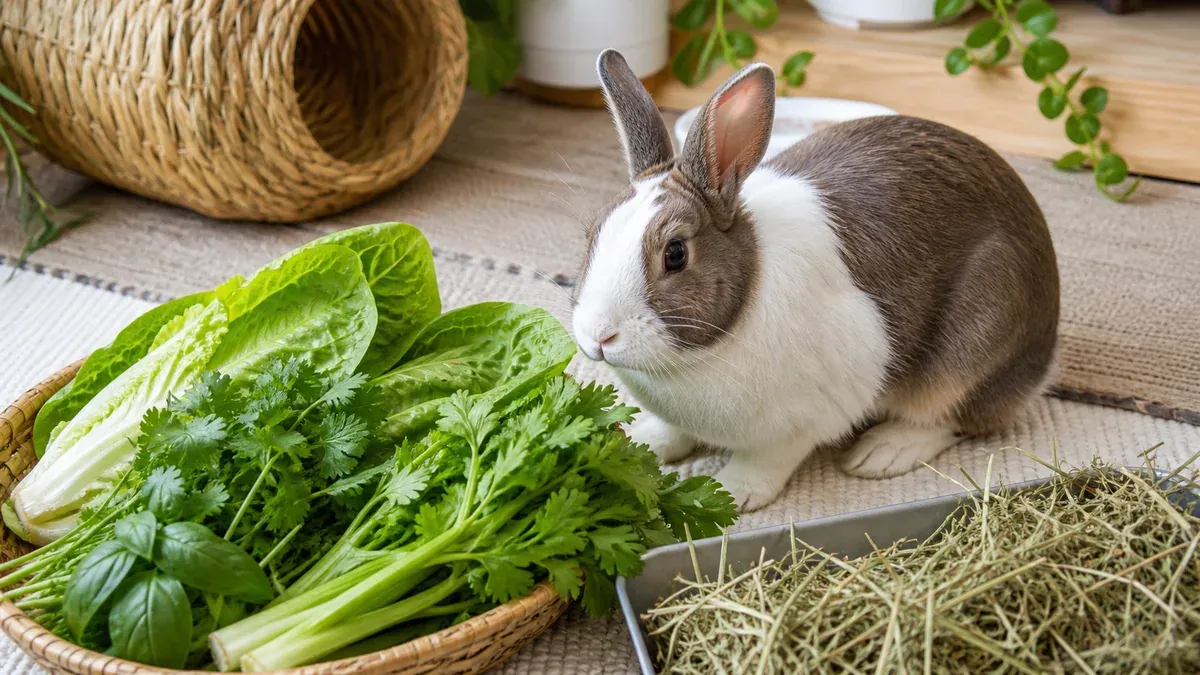
For a healthy adult rabbit, the best daily greens are usually the simplest ones: a rotation of 2 or 3 well-tolerated options such as romaine, endive, chicory, basil, coriander, fennel fronds or bok choy, at roughly 100 g per kilogram of body weight per day. You do not need exotic “superfoods” to feed a rabbit well. What matters is safe variety, sensible quantities, and a gradual introduction if your rabbit is new to fresh food.
Getting the selection right matters. Some greens are excellent every day; others should be rationed to a few times a week; and a handful of common vegetables should be avoided entirely.
Before adding greens to any rabbit’s diet, make sure your rabbit is at least 12 weeks old. For kits under that age, even small amounts of fresh food carry a serious risk of digestive upset — see our guide on what to feed a 2-month-old baby rabbit for the full picture. For first-time introductions in older rabbits, follow the step-by-step approach in our diet transition guide.
How much to give
A practical daily target is around 100g of mixed fresh greens per kilogram of your rabbit’s body weight. For a typical 1.5–2 kg domestic rabbit, that works out to one to two generous handfuls spread across the day.
Rather than measuring precisely every time, develop a feel for the right amount: a portion large enough to provide real dietary benefit, but small enough that your rabbit finishes it within a couple of hours. Any uneaten greens should be removed before they wilt and ferment.
Split the daily portion across two or three varieties rather than offering a large pile of a single green. Diversity matters both nutritionally and for gut health.
If your rabbit refuses greens
A rabbit that ignores greens is not always a permanently “picky” rabbit. Most refusals come down to a practical detail you can correct:
- Greens are too cold. Leaves straight from the fridge are often less appealing. Let them come to room temperature for 15–20 minutes first.
- The texture is unfamiliar. Some rabbits reject large whole leaves but accept torn leaves, fine fronds, or strongly scented herbs.
- The introduction was too fast. A big bowl of unfamiliar greens often gets sniffed and abandoned. Start with a tiny amount.
- The timing is wrong. Offer greens when your rabbit is naturally active — often early morning or evening — not in the middle of a sleep cycle.
- The starting choice is too challenging. Romaine, endive, basil or coriander are often accepted sooner than bitter or chewy greens.
If your rabbit is also refusing hay or producing fewer droppings, treat that as a health warning rather than fussiness and read our guide on what to do if your rabbit stops eating.
The best greens for daily rotation
These are safe to include in the regular rotation and work well as the backbone of your rabbit’s fresh-food diet.
Romaine and other loose-leaf lettuces
Romaine lettuce (cos lettuce) is one of the most reliable daily greens. It’s well tolerated, has a reasonable fibre content, and most rabbits genuinely enjoy it. Butter lettuce, green leaf lettuce and red leaf lettuce are also good options.
Avoid iceberg lettuce entirely. It has almost no nutritional value, a very high water content and contains lactucarium, which can cause loose stools and diarrhoea in some rabbits. The name “lettuce” covers a wide range — not all are equal. For a full breakdown of which varieties are best — romaine, lamb’s lettuce, arugula, endive — see our guide: can rabbits eat lettuce?
Endive and chicory
Both are slightly bitter, which some rabbits love and others take time to accept. Endive and chicory are among the most nutritionally sound daily greens: good fibre, moderate calcium, and well tolerated even in reasonable quantities. Worth persisting with if your rabbit is initially indifferent.
Fresh herbs: basil, coriander and flat-leaf parsley
Fresh herbs make excellent rotation greens and are often the gateway to getting a picky rabbit interested in fresh food. Basil and coriander (cilantro) are both safe in daily amounts. Flat-leaf parsley is fine in moderate quantities — it’s higher in calcium than some herbs, so keep portions sensible (a few sprigs per day rather than a large bunch).
Curly parsley and flat-leaf parsley are both safe, but as with any higher-calcium green, moderation is the right approach for daily feeding.
Rocket (arugula)
Rocket has a peppery flavour that divides rabbits. Those that like it tend to be enthusiastic about it. It’s safe for daily inclusion at reasonable quantities and provides a useful contrast in flavour to milder greens like romaine.
Fennel fronds
The feathery fronds from a fennel bulb are safe for rabbits and bring a gentle aniseed flavour that many find appealing. They’re also a reasonable source of fibre. The bulb itself can be offered in small amounts too, though the fronds are more typically used.
Bok choy
A good reliable daily green that most rabbits accept readily. Stick to moderate amounts — like many brassica-adjacent greens, large quantities could cause gas, so treat it as part of a varied rotation rather than a dietary staple on its own.
Swiss chard (in limited amounts)
Swiss chard is nutritious but contains oxalic acid, so it should appear in the rotation rather than every day. Two or three times a week in small portions is appropriate.
Greens to give less frequently
These are safe but come with a reason to limit them — typically either high oxalate content, high calcium, or a tendency to cause gas in large amounts.
Spinach
Spinach is the classic example of a high-oxalate green. It’s fine a couple of times a week in small portions, but daily feeding over time can contribute to urinary sludge or kidney issues. It’s worth including occasionally because rabbits often like it, but it shouldn’t anchor the daily rotation.
Kale and watercress
Both are high in calcium. Occasionally is the right frequency — once or twice a week at most, in small amounts. If your rabbit already has a history of urinary problems or calcium-related issues, ask your vet before including these regularly.
Beet greens
Similar situation to spinach: high in oxalic acid, safe occasionally but not ideal for daily feeding. The beetroot itself is too high in sugar for regular use.
Vegetables and greens to avoid
Some common household vegetables should not be given to rabbits at all, or only in very particular circumstances.
Cabbage, Brussels sprouts and raw broccoli florets are known to cause significant gas buildup, which in rabbits can progress to painful and dangerous bloating. The stems and leaves of broccoli are better tolerated than the florets, but it’s simplest to leave the entire brassica family out of the daily rotation. A small piece of broccoli stem occasionally is unlikely to cause harm, but there’s no reason to take the risk when there are so many other good options.
Iceberg lettuce — already mentioned, but worth repeating. Despite being called a lettuce, it has no place in a rabbit’s diet.
Onions, garlic, leeks and chives are toxic to rabbits. Never offer any member of the allium family.
Potatoes and cooked vegetables have no place in a rabbit’s diet at all.
For the full list of foods to avoid, including common plants that are toxic, see our foods rabbits cannot eat guide.
How to introduce new greens safely
Even once your rabbit is old enough to eat fresh food, new varieties should be introduced carefully rather than all at once. The digestive system needs time to adapt.
The protocol is simple:
- Introduce one new green at a time, alongside greens the rabbit already tolerates
- Start with a very small portion — a few leaves or a small sprig
- Observe for at least three days before adding anything else
- Watch for soft cecotropes, loose droppings or reduced hay consumption — any of those means slow down or stop
Soft cecotropes smearing around the hindquarters (rather than being eaten cleanly) are one of the earliest signs that the digestive system is under stress. A rabbit that develops loose stools after a new green should have that green removed and be returned to a plainer diet until things settle.
Our complete guide to transitioning a rabbit’s diet covers the wider process of safely adding new foods.
Practical serving tips
Wash everything thoroughly. Even organic produce should be rinsed well before serving. Pesticide residues are a genuine concern, and a clean rinse removes surface bacteria too.
Dry greens before serving, or leave them slightly damp. Soaking wet leaves can add more water than intended and contribute to loose stools. Lightly damp is fine and may even encourage a rabbit to eat more. Completely waterlogged leaves are best dried off first.
Serve at room temperature. Cold greens straight from the fridge can cause digestive upset, especially in rabbits with sensitive guts. Leave them out for 15–20 minutes before offering.
Remove uneaten greens after a few hours. Wilted, warm greens can ferment and grow bacteria. A rabbit that ignores fresh food for more than two hours has had enough — remove what’s left rather than letting it sit.
Vary the presentation. Some rabbits are more motivated to eat when greens are tucked into the hay rack, scattered in the enclosure, or offered by hand rather than left in a bowl. A little foraging enrichment goes a long way.
Building your weekly rotation
A practical approach is to cycle through five or six reliable greens across the week rather than relying on one or two. A simple rotation might look like:
- Monday/Thursday: romaine lettuce + fresh basil
- Tuesday/Friday: endive + coriander
- Wednesday/Saturday: rocket + a few sprigs of flat-leaf parsley
- Sunday: fennel fronds + bok choy
This isn’t a rigid prescription — adapt it to what grows well locally, what’s seasonal, and what your rabbit actually likes. The goal is genuine variety, not strict scheduling.
If you have access to a garden, know that fresh grass is excellent for rabbits and can complement the weekly rotation — provided the lawn hasn’t been treated with pesticides or herbicides.
For in-depth guides on specific vegetables you may be wondering about:
- Can rabbits eat parsley? — vitamin-rich herb with calcium to keep in mind
- Can rabbits eat endive? — bitter green with prebiotic properties
- Can rabbits eat broccoli? — leaves yes, florets with care
- Can rabbits eat cucumber? — hydrating, but low in fiber
- Can rabbits eat carrot tops? — far better than the root, excellent daily green
- Can rabbits eat dandelions? — all parts edible, naturally loved, rotate for calcium balance
Wild greens follow the same rotation: dandelions are among the best, provided you are careful where you pick them.
Fresh greens pair best with a diet that already has the right foundation: unlimited hay (the most important single factor in rabbit health), appropriate pellet quantities, and fresh water at all times. For the full picture of how fresh food fits into a rabbit’s overall diet, see our complete rabbit feeding guide.
Sources
- RSPCA — Rabbit diet — gives the reference points for quantity and variety: “rabbits need a large handful of safe, washed leafy green vegetables, herbs and weeds daily”, and “it’s best to give them a variety each day – ideally five to six different types”. The same source puts hay and fresh grass at 85% of the diet, and advises introducing any new greens gradually and in small amounts.
Root vegetables and fruit stay occasional treats. A change of greens followed by soft droppings or a drop in appetite warrants veterinary advice. This article has not been reviewed by a veterinarian.
Frequently asked questions
How much fresh greens should I give my rabbit each day?
A useful rule of thumb is roughly 100g of mixed greens per kilogram of body weight per day — that works out to about one or two large handfuls for a 1.5–2 kg rabbit. Always spread across two or three varieties rather than a single large portion of one green.
Can I give my rabbit spinach every day?
No. Spinach is high in oxalic acid, which can contribute to urinary issues and kidney strain over time if fed daily. Offer it at most two or three times a week in small amounts, and balance it with low-oxalate greens the rest of the time.
My rabbit won't eat the greens I offer. What should I try?
Rabbits have individual preferences. Try different textures and flavours — some prefer the slight bitterness of endive or chicory, others like the fragrance of fresh basil or coriander. Serve greens at room temperature rather than cold from the fridge, and introduce new varieties gradually alongside a green the rabbit already accepts.
Is it safe to give greens every day, or should I give rest days?
Daily fresh greens are part of a healthy adult rabbit's balanced diet, not just an occasional treat. The key is variety and appropriate quantity. Rest days are not necessary if you're rotating your greens and staying within the recommended amounts.