Can rabbits eat parsley?
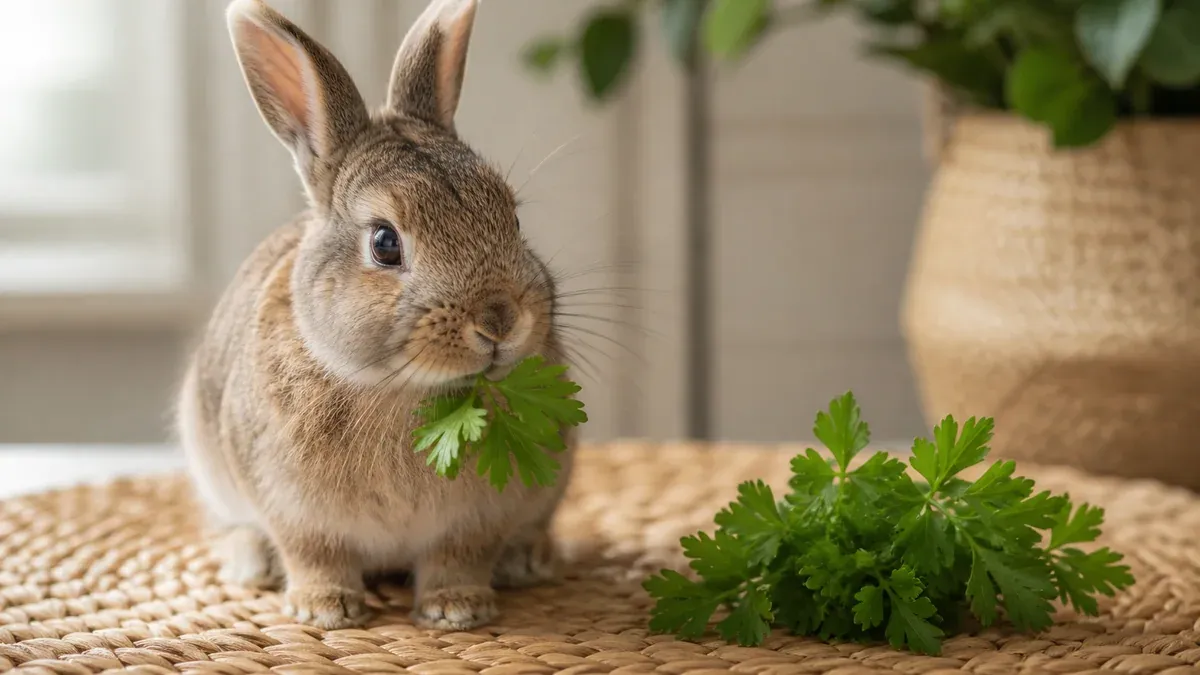
Yes, parsley is an excellent herb for rabbits. Rich in vitamins C, K, and folate, and very palatable, it makes an outstanding greens complement. The only caveat: a relatively high calcium content that calls for thoughtful frequency — not avoidance.
Why parsley is a good green for rabbits
Parsley (Petroselinum crispum) is one of the most commonly fed herbs for rabbits, and deservedly so. Its nutritional profile places it well above bland greens like iceberg lettuce:
| Nutrient | Parsley (per 100 g) |
|---|---|
| Water | ~88 % |
| Fiber | ~3.3 g |
| Vitamin C | ~133 mg |
| Vitamin K | ~1640 µg |
| Calcium | ~138 mg |
| Iron | ~6.2 mg |
| Folate (B9) | ~152 µg |
Vitamins C and K stand out. Rabbits synthesize their own vitamin C, but additional dietary sources through fresh herbs are welcome. Vitamin K plays a role in blood clotting and bone health.
Key strengths:
- Highly palatable — most rabbits love parsley
- Rich in vitamins and minerals
- Good fiber content
- Very low in sugar
- Easy to find year-round, often available organically grown
The calcium nuance: why to moderate
Calcium is the main point to keep in mind with parsley. At approximately 138 mg of calcium per 100 g, it ranks among the most calcium-rich herbs commonly available — two to three times more than romaine lettuce.
In adult rabbits, long-term excess calcium intake can contribute to hypercalciuria (excess calcium in urine) and, in predisposed individuals, to the formation of sludge or stones in the bladder or kidneys. These issues don’t develop after a few days of parsley — they emerge after months or years of a diet chronically overloaded with calcium.
This doesn’t mean avoiding parsley — not at all. It means integrating it into a varied rotation rather than as a sole or dominant food.
Other calcium-rich herbs to moderate similarly
- Basil: ~177 mg/100 g
- Tarragon: ~119 mg/100 g
- Fresh mint: ~243 mg/100 g
These herbs are all safe and nutritious, but work best in rotation rather than as a daily exclusive base.
Recommended frequency and amount
For a standard adult rabbit (1.5–3 kg):
- Frequency: 2–3 times per week
- Amount: 5–8 sprigs per serving (stems and leaves)
- Context: always paired with other lower-calcium greens
Parsley can represent 20–30 % of the greens ration on a given day. The goal is simply not to offer it alone, every day, in large quantities.
Parsley and young rabbits
Baby rabbits under 4–6 months have higher calcium requirements than adults to support bone growth. They can receive small amounts of parsley without concern — their renal system handles excess calcium more efficiently at that age. After 6 months, return to the moderated frequency appropriate for adults.
How to incorporate parsley into the rotation
Parsley pairs naturally with lower-calcium greens to build a balanced daily ration:
Sample daily rotation:
| Green | Calcium | Role in ration |
|---|---|---|
| Romaine lettuce | Low | Main base |
| Parsley | High | Aromatic complement |
| Lamb’s lettuce | Moderate | Soft texture |
| Endive | Low | Appetite-stimulating bitterness |
For a complete and varied rotation, see our rabbit daily greens guide and our full rabbit vegetable guide.
Fresh or dried parsley?
Always fresh. Dried parsley concentrates nutrients — including calcium — and loses most of its water content and heat-sensitive vitamins. It shouldn’t be used as a daily green; it can serve, in very small amounts, as an aromatic supplement in homemade treat recipes.
Also avoid cooked or marinated parsley: rabbits should only consume raw foods.
Parsley in the broader picture
Parsley is one of the most nutritionally valuable herbs to include in a rabbit’s diet, provided it’s done thoughtfully. Its rich profile makes it a quality complement — and its bold aroma makes it an excellent tool for stimulating appetite in fussy or recovering rabbits.
For a complete overview of rabbit nutrition, refer to our complete rabbit feeding guide, which places each food in its proper context.
Remember that the foundation is always ad-libitum hay, which covers 70–80 % of a rabbit’s nutritional needs. Parsley, however nutritious, is a flavorful complement — not the base.
Summary table
| Criterion | Parsley |
|---|---|
| Safety | ✅ Safe, non-toxic |
| Nutritional value | High (vitamins C, K, iron) |
| Calcium | ⚠️ High — rotation advised |
| Recommended frequency | 2–3 times/week |
| Portion (2 kg rabbit) | 5–8 sprigs per serving |
| Flat-leaf vs curly | Equivalent |
| Monitor in | Pre-existing kidney/bladder issues |
Frequently asked questions
Is parsley toxic to rabbits?
No, parsley is completely safe for rabbits. It is a widely enjoyed herb with no toxicity. The only nuance is its relatively high calcium content: fed too frequently or in very large amounts over the long term, it can contribute to urinary calcium deposits in predisposed individuals.
How much parsley per day can I give a rabbit?
A few sprigs (5–8 stems with leaves) is enough for a standard-sized rabbit, two to three times a week. Parsley shouldn't make up the whole daily greens ration — pair it with lower-calcium vegetables like romaine, lamb's lettuce, or zucchini.
Flat-leaf or curly parsley: which is better for rabbits?
Both varieties suit rabbits equally well. Flat-leaf parsley has a stronger flavor and softer texture that tends to appeal more to picky rabbits. Curly parsley is slightly milder but equally nutritious. The difference is minor — offer whichever your rabbit prefers.
Can I give parsley to a rabbit with kidney problems?
If your rabbit has been diagnosed with kidney stones, bladder sludge, or hypercalciuria, limit high-calcium foods including parsley. Consult your vet to adapt the diet to your rabbit's specific health condition.