What to feed a 2-month-old baby rabbit: the complete guide
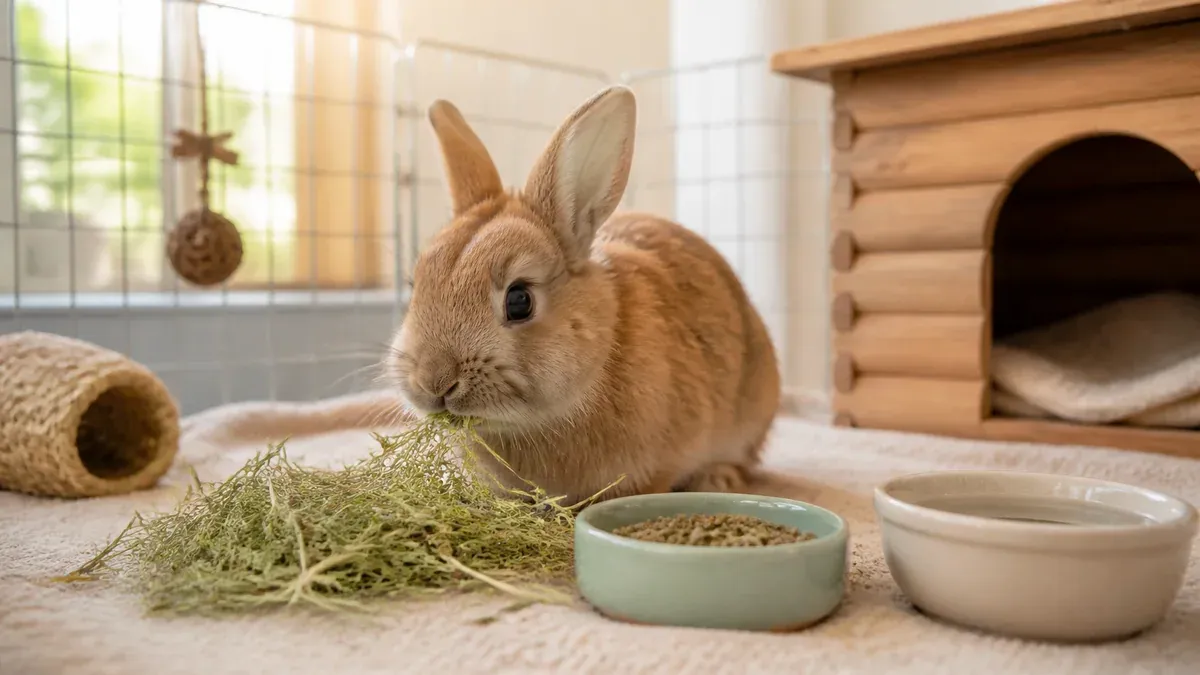
At 2 months, a baby rabbit needs unlimited hay, fresh water at all times and a plain pellet suited to growth, and above all no sudden change to the diet it already tolerates. Treats, fruit and muesli mixes stay off the menu; any new food comes one at a time, with a vet’s advice.
Why 2 months is such a vulnerable stage
A kit’s digestive system is still settling around weaning. The cecal flora — the microorganisms that process fibre and produce essential nutrients — is still establishing itself, so a sudden change, an unfamiliar food or an unsuitable item can trigger diarrhoea or gut stasis within hours. The House Rabbit Society recommends that kits stay with their mother for at least eight weeks, because separating them too early often leads to chronic digestive problems.
Young rabbits also need more protein and calcium for growth than a healthy adult. That is why a kit’s ration is not simply a smaller version of the adult one.
Was my kit weaned too early?
If your kit left its mother before 8 weeks, treat it as extra fragile. The House Rabbit Society sets eight weeks as the minimum time with the mother; earlier separation often leads to chronic digestive problems. Change nothing in the diet, keep hay and water within reach, and book a vet check in the first few days.
The checks to run before collection are gathered in when is a rabbit weaned. A kit sold before weaning is finished is also one of the criteria separating the places you can get a rabbit — see should you adopt or buy a rabbit.
The first week at home: what to do first
In order of priority:
- Ask exactly what the kit was eating: pellet brand, type of hay, any greens and the amounts.
- Keep that diet unchanged while the kit settles in. The RSPCA advises avoiding sudden changes because they can upset the digestive system and make a rabbit ill.
- Check droppings every day: number, size and consistency. It is the fastest signal that something is wrong.
- Only then, if the ration needs improving, agree a target with a vet and move towards it gradually.
The three pillars of a kit’s diet
Hay: available at all times
Hay should be available without restriction. Growing rabbits can be fed alfalfa, which is higher in calcium and protein — the House Rabbit Society reserves it for babies, nursing mothers and elderly or injured rabbits. That does not make Timothy or meadow hay useless: the same organisation recommends unlimited grass hay as kits start nibbling solids. What matters is the whole ration, hay plus pellets.
Good hay is green, smells fresh and has a mix of stems and leaf. Dusty, yellowed or musty hay should be discarded. Store it in a breathable bag or an open container, never in sealed plastic, which encourages mould.
Growth pellets: follow the product and the rabbit
Choose a plain pellet with no seeds, dried fruit, coloured pieces or corn: rabbits pick out the most palatable bits of a muesli mix and unbalance their intake. Look for a product whose first ingredient is grass or hay rather than grain, and follow the label’s directions for growing rabbits.
Fresh water: always present, always clean
Fresh water must be available around the clock, in a sipper bottle or a heavy bowl washed and refilled at least once a day. See how much water rabbits drink for daily habits.
How many pellets does a 2-month-old rabbit need?
There is no fixed gram figure for a kit. The RSPCA’s benchmark of 25 g of nuggets per kilogram of body weight applies to healthy adults; it states that growing rabbits may need larger portions. The right amount depends on the product, weight, body condition and hay intake, so let a vet set it.
The frequent mistake is to apply the adult ration straight away, or the opposite, to leave pellets unlimited without ever checking body condition. If the kit loses weight, gains fast or stops eating hay, have the ration reassessed. Our pellet guide covers the adult context.
New foods: age alone is not the rule
Greens: account for what was already eaten
If the kit already ate a particular safe green without trouble, do not automatically remove it. If it did not, do not introduce anything new just after adoption. The House Rabbit Society advises introducing a single safe green at a time, in tiny amounts, and removing it if droppings soften. See safe vegetables.
No fruit, seeds or treats
Fruit, seed mixes, dried fruit, commercial “treat sticks” and flavoured pellets have no place in a kit’s diet. They are too rich in sugar and starch for a flora that is still settling.
Soft droppings: cecotropes or diarrhoea?
If your kit eats small, soft, grape-like droppings straight from its bottom, that is normal: these are cecotropes, re-ingested for their nutrients. True diarrhoea is liquid and unformed, soils the fur around the tail and, in a kit, means calling a vet straight away.
Between the two sits a situation to watch: soft cecotropes left stuck to the fur under the tail. They often point to a ration with too little hay or a food that does not suit the kit. Our article on rabbit diarrhoea helps tell them apart.
Signs to watch vs. when to call the vet now
Signs to watch — adjust the ration and ask your vet in the next few days:
- Uneaten cecotropes stuck under the tail
- Less hay eaten than usual, with normal droppings
- A kit that sorts its pellets or leaves its hay
Call a vet immediately — the House Rabbit Society lists these as signs needing urgent care:
- Diarrhoea: liquid droppings, fur soiled around the tail
- Stopped droppings or a sharp drop in their number
- Refusal to eat or a marked fall in appetite; do not wait for an hourly threshold
- Bloated belly, hunched posture or tooth grinding
- Lethargy
A kit can deteriorate within hours. If it has stopped eating, read my rabbit is not eating: what to do while you contact a vet with exotic-animal experience.
The road ahead: moving to an adult diet
The timing depends on size, growth, body condition and the feed used, so plan it with a vet rather than on a fixed date. The move means making grass hay the main forage, gradually adjusting pellets to an adult formula, and keeping or introducing safe greens one at a time. For comparison, the RSPCA advises switching a rabbit off muesli slowly over 14 to 28 days: any diet change at this age deserves the same patience.
Your next step: read how to transition a rabbit’s diet safely before changing anything, then the complete rabbit diet guide to see what the adult ration will look like.
Veterinary sources
- RSPCA — what do rabbits eat? Rabbit diet advice
- House Rabbit Society — baby bunny basics
- House Rabbit Society — rabbit diet FAQ
Frequently asked questions
The breeder can't tell me what my kit was eating. What now?
Offer unlimited grass hay and fresh water, plus a plain pellet with no coloured pieces, and hold back greens and treats for now. Book a vet check in the first days so the vet can confirm weight and body condition and set the ration from there.
My kit lives with an adult rabbit. Can they share the same food?
They can share grass hay and water. The difference is in the extras: the House Rabbit Society reserves alfalfa hay for babies, nursing mothers and elderly or injured rabbits, and portions for a growing kit are not an adult's. Ask your vet how to split the ration if the two eat together.