Timothy hay, meadow hay or orchard grass: which to choose for your rabbit?
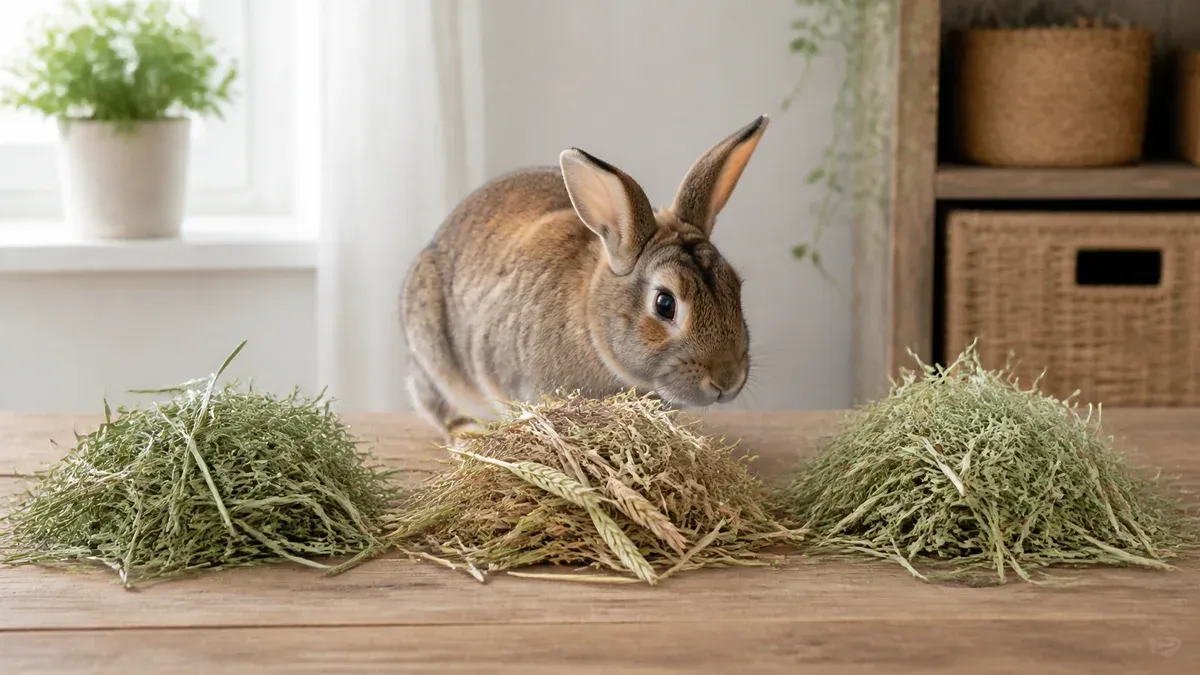
For a healthy adult rabbit, the best starting choice is usually straightforward: good-quality Timothy, meadow hay, or orchard grass as the daily base; alfalfa only for kits and nursing does; oat hay only as a supplement. The best hay is not automatically the most expensive or the most fashionable — it is the one that stays fresh, suits your rabbit’s life stage, and gets eaten in large amounts every single day.
For the quantities your rabbit needs, see our hay quantity guide. This article focuses on the type question.
The main hay types compared
Timothy hay: the standard recommendation
Timothy hay (from the grass Phleum pratense) is the hay most commonly recommended by rabbit vets and specialists. It’s not necessarily because it’s dramatically superior to all alternatives — it’s because it has a well-established nutritional profile, is widely available in good quality, and suits the majority of adult rabbits.
Nutritional profile: moderate protein (around 7–8%), low calcium, high in long fibre. This balance is close to ideal for adult rabbits: enough fibre for excellent gut motility, low enough calcium to avoid urinary issues, and not enough protein to cause weight gain.
Texture and palatability: Timothy has long, moderately coarse stems that require real chewing effort — which is exactly what rabbit teeth need. The chewing action provides natural molar wear that helps prevent the dental problems that are common in pet rabbits.
Timothy is harvested multiple times per season, and the cut matters:
- First cut: harvested earliest, with the coarsest texture and highest fibre content. The stems are long and tough. Ideal for gut motility and dental health. Some rabbits with very selective eating habits reject it in favour of softer cuts.
- Second cut: softer, more fragrant, and slightly richer in nutrients. This is the cut most pet owners encounter. It’s the middle ground — excellent for most adult rabbits as a daily base.
- Third cut: the softest and most nutrient-dense cut. It has a higher protein and fat content and should be treated more as a supplement or enrichment than a dietary staple. Some owners use it to encourage picky eaters.
For the majority of healthy adult rabbits, first- or second-cut Timothy as the daily hay base is a reliable choice.
Meadow hay: variety and palatability
Meadow hay isn’t a single grass species — it’s a blend of grasses, wildflowers and herbs cut from managed meadows. Because the composition varies by season and supplier, the nutritional content also varies, but a good meadow hay from a reputable source is an excellent daily option.
Why choose it: the diversity of flavours and textures in meadow hay is genuinely appealing to many rabbits, particularly those that find plain Timothy uninteresting. The variety also provides a degree of natural enrichment — a rabbit that sorts through a pile of meadow hay looking for the bits it likes most is engaged in something close to natural foraging behaviour.
Considerations: quality varies significantly between suppliers. Poor meadow hay can be dusty, stemmy and low in nutritional value; good meadow hay is bright, fragrant and obviously varied. Buy from a supplier known for freshness, and assess the batch when it arrives — the quality indicators below apply.
Meadow hay is also a natural choice for rabbits that are sensitive to the dust that can be present in some Timothy batches.
Orchard grass: the reliable alternative
Orchard grass (Dactylis glomerata) is less widely available than Timothy in many UK and European pet shops, but it’s worth seeking out, particularly for rabbits that consistently refuse Timothy.
Nutritional profile: similar to Timothy — moderate protein, good fibre, low calcium. The nutritional difference between orchard grass and Timothy is minor enough that either works well as a daily base.
Texture: notably softer and slightly sweeter-smelling than first-cut Timothy. This makes it more palatable for some rabbits without compromising on fibre. It’s an excellent first recommendation for owners whose rabbits are rejecting coarser hay.
Orchard grass and Timothy can be mixed freely — offering both together is a common way to improve overall hay consumption.
Oat hay: a useful supplement
Oat hay is made from oat plants cut before the grain heads fully mature. The stalks are hollow and hollow stems are enjoyed by many rabbits. It’s slightly higher in calories and carbohydrates than Timothy, with a pleasant, slightly sweet smell.
How to use it: oat hay works well as a supplement to the main hay rather than as the sole source. A portion mixed into Timothy or meadow hay adds variety and often encourages increased hay eating overall. It’s not the best choice as the only hay because of its higher carbohydrate content, particularly for sedentary or overweight rabbits.
Alfalfa: not for adult rabbits as a daily hay
Alfalfa (lucerne) is in a different nutritional category from the grasses above. It’s a legume rather than a grass, and has significantly higher protein (15–20%) and calcium than any of the grass hays.
For growing rabbits under 6 months old, these characteristics are an advantage — kits need extra protein and calcium for development. Alfalfa is the correct daily hay for young rabbits, and it’s also appropriate for pregnant or nursing does.
For healthy adult rabbits, alfalfa as a daily hay creates problems over time: excess calcium is excreted through the kidneys and can contribute to urinary sludge and stones; excess protein can lead to weight gain and soft cecotropes.
Some owners offer a small amount of alfalfa occasionally as a treat, and this is generally fine. But it should not replace Timothy or meadow hay as the daily base for any adult rabbit.
If you have a baby rabbit and are working out the transition from alfalfa to adult hay, see our article on what to feed a 2-month-old baby rabbit and the diet transition guide for how to manage the change safely.
How to assess hay quality
The type of hay matters less than its quality. A fresh, well-harvested meadow hay beats a poorly stored or stale Timothy batch every time. Use these indicators:
Colour: should be bright green to golden-green. Brown, bleached or grey hay has lost its nutritional value. Some natural colour variation is normal, but predominantly brown hay is not good.
Smell: fresh, grassy and slightly sweet. Any mustiness, ammonia-like smell, or the damp-socks odour of mould means the batch should be discarded immediately. If you’re not sure whether hay smells right, smell a fresh bag from a good supplier as a reference point.
Texture: dry and pliable. Brittle hay that turns to dust when you handle it, and hay that feels even slightly damp, are both signs of poor storage or quality.
Dust: some dust is inevitable, but a hay that releases a significant dust cloud when you shake it is likely to irritate airways — both yours and your rabbit’s. Respiratory problems from dusty hay are a real concern. Meadow hay tends to be less uniformly dusty, but quality varies.
Visible problems: any dark spots, clumping, or signs of foreign material (particularly seeds from toxic plants in hay harvested from unmanaged land) should cause you to discard the batch.
Age-based guide
| Life stage | Recommended hay |
|---|---|
| Under 6 months (kit) | Alfalfa as the main hay; can supplement with Timothy |
| 6 months to adult | Timothy or meadow hay as the daily base |
| Adult (1–7 years) | Timothy (first or second cut) or meadow; orchard grass as alternative |
| Senior or overweight | Lean toward Timothy first-cut or meadow; avoid high-calorie additions |
| Pregnant/nursing doe | Alfalfa appropriate during pregnancy and nursing |
Which hay should you choose in practice?
| Situation | Best first choice | Watch out for |
|---|---|---|
| Healthy adult rabbit | Timothy or good meadow hay | Batch freshness matters more than branding |
| Picky hay eater | Meadow hay, orchard grass, or second-cut Timothy | Coarse first-cut hay may be rejected |
| Overweight rabbit | Fibre-rich Timothy | Avoid making alfalfa or oat hay the main base |
| Senior rabbit or weaker chewing | Softer second-cut Timothy or tender meadow hay | Keep an eye on dental comfort and waste |
| Rabbit under 6 months | Alfalfa as the base, Timothy as a supplement | Do not switch to adult hay too early |
| Rabbit eating less hay than usual | Try a fresher batch or a mixed hay approach | Do not delay a vet call if droppings are also dropping |
Availability and budget: think locally first
The best hay choice also depends on your market. In many UK and Irish shops, Timothy is the easiest premium hay to source consistently, while orchard grass can be harder to find. In other parts of Europe, a locally produced meadow hay may be fresher and better value than imported branded Timothy.
That means the practical priority order should be:
- Fresh hay your rabbit truly eats
- Reliable quality from one batch to the next
- A type that fits your rabbit’s age and chewing comfort
- A price you can sustain long term, because hay must be offered generously every day
A very fresh local meadow hay often beats a prestigious imported hay that arrives dry, stale, or too stemmy for your rabbit.
Mixing hays: encouraged, not just tolerated
There’s no reason to stick to a single hay type, and many good reasons not to. Offering two or three types in rotation — or even mixed together in the hay rack — has several advantages:
- Improves palatability and encourages greater overall hay consumption
- Provides a more diverse range of nutrients and plant compounds
- Makes transitions between hay types easier because the rabbit is already accustomed to variety
- Reduces the risk that a temporary stock issue with one supplier disrupts your rabbit’s diet
If you’re currently relying on one type and your rabbit’s hay consumption has been lower than you’d like, introducing a second variety is often the simplest first step to try. For context on how much hay a rabbit should be eating, see our hay quantity guide.
Storage: getting the most from good hay
Even the best hay deteriorates quickly if stored poorly.
Do: store in a breathable fabric bag, a wicker basket, a cardboard box, or any open-weave container that allows air circulation. Keep in a dry, well-ventilated location away from direct sunlight.
Don’t: store in sealed plastic bags or airtight containers. Moisture becomes trapped, and even dry hay can develop mould within weeks in a sealed bag.
Buy in quantities you’ll use within 4–6 weeks. Very large bulk purchases can seem economical but result in stale hay by the end of the supply — a false economy if your rabbit stops eating it. If hay refusal is a persistent issue, freshness is one of the first things to investigate, as we discuss in our guide to why rabbits stop eating hay.
Where to buy
Good hay is available from specialist rabbit and small-animal shops, reputable online suppliers, and some direct farm sources. Quality tends to be more consistent from suppliers that focus specifically on small-animal fodder rather than general pet shops with slow stock turnover.
Reading recent customer reviews with comments about freshness and palatability gives a more reliable picture than packaging claims. A supplier whose customers consistently report that even fussy rabbits eat their hay enthusiastically is a strong recommendation.
For the rest of the feeding picture — how hay fits alongside pellets and fresh food — see our complete rabbit diet guide.
Frequently asked questions
Is Timothy hay always the best choice for adult rabbits?
Timothy hay is the gold standard and the one most vets recommend as a daily base for adult rabbits, but it isn't the only good option. High-quality meadow hay and orchard grass are excellent alternatives, and mixing two or three types is perfectly fine — in fact, variety often improves palatability and encourages rabbits to eat more hay overall.
What is the difference between first-cut and second-cut Timothy hay?
The cut refers to which harvest the hay comes from in a given season. First-cut Timothy is coarser, with longer tougher stems and higher fibre content — it's ideal for gut motility and dental wear. Second-cut is softer, more fragrant and slightly higher in protein. Third-cut, the softest, is closest to a treat and is often used sparingly. For most adult rabbits, first or second cut as the daily base is ideal.
Can I mix different hay types together?
Yes, and it's often a good idea. Mixing Timothy with meadow hay, or adding a small amount of oat hay or orchard grass alongside the main hay, provides variety in texture and flavour that many rabbits respond to positively. Mixing also smooths the transition if you're changing from one type to another.
My rabbit refuses Timothy hay. What should I try?
Try orchard grass first — it has a similar nutritional profile but a softer texture and slightly sweeter smell that some Timothy-refusers accept readily. A high-quality meadow hay with wildflower inclusions is another good option. You can also experiment with a different cut of Timothy: second-cut is noticeably softer and more fragrant than first-cut, and some rabbits that refuse the coarser variety eat the softer one without hesitation.