Why has my rabbit stopped eating hay? Causes and solutions
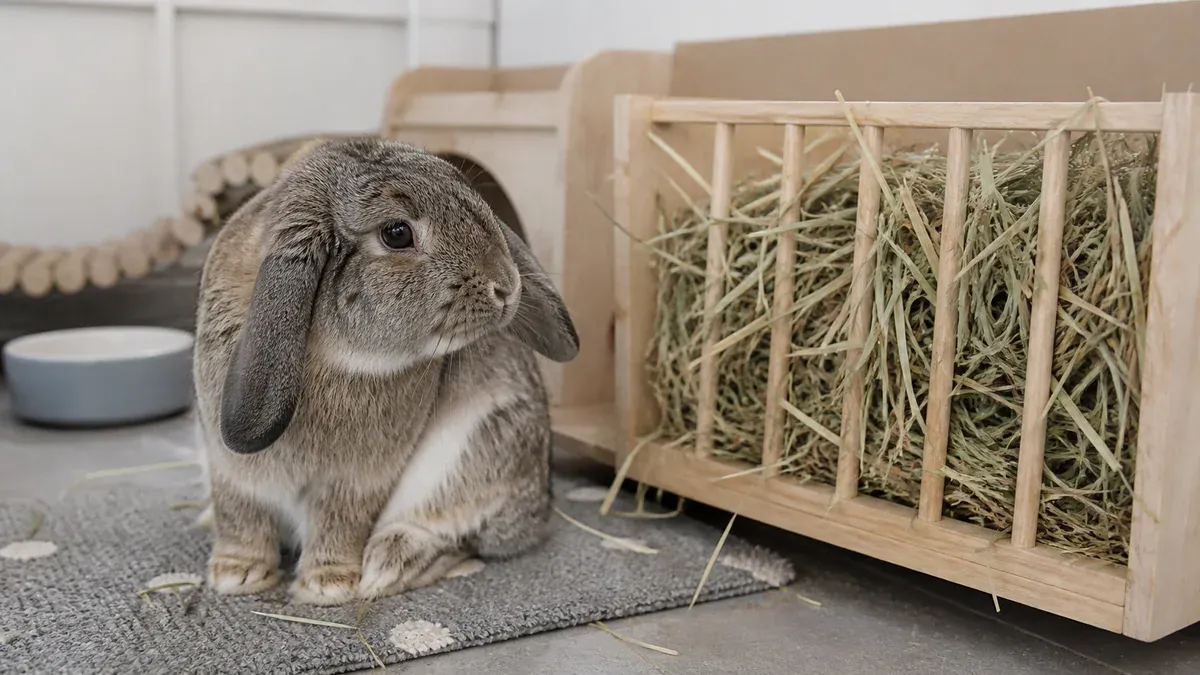
If your rabbit has stopped eating hay, check four things immediately: dropping output, appetite for other food, hay freshness, and any sign of dental pain. A rabbit that is snubbing hay but still eating something else can often be helped quickly; a rabbit that is hardly eating anything and producing few droppings is already in digestive danger. Because hay should make up around 80–85% of the daily diet, a sustained drop in hay intake is never something to dismiss.
That said, many cases of hay refusal have straightforward, fixable causes. Working through this list systematically will resolve most situations — and help you identify the ones that need veterinary attention quickly.
1. Too many pellets or treats
This is the most common cause of reduced hay intake, and the most overlooked. Pellets are calorie-dense and taste better to most rabbits than plain hay. If your rabbit has learned that a large bowl of pellets is waiting, it will eat those first — and by the time the bowl is empty, appetite for hay has gone.
The same applies to treats: dried fruit, seed sticks, biscuits or “natural” chews all deliver fast-burning energy and leave a rabbit disinterested in fibrous hay.
Solution: Review your pellet quantities against the guidelines in our pellet feeding guide. For most adult rabbits, the daily pellet ration is around 1 tablespoon per kilogram of body weight — a surprisingly small amount. Cut back gradually and see whether hay consumption increases within 24–48 hours. Remove all treats for at least a week. If you’re feeding a seed mix rather than uniform pellets, that’s often the root cause — read why seed mixes are bad for rabbits and which treats are actually safe.
This adjustment won’t cause hunger. Unlimited hay provides the bulk of the calories a rabbit needs.
2. Stale, dusty or poor-quality hay
Rabbits have a sensitive sense of smell and will reject hay that has lost its freshness. Hay that has been sitting in a plastic bag, exposed to damp, or stored in a warm cupboard for weeks can become musty, dusty or even mouldy — all good reasons for a rabbit to refuse it.
Good-quality hay should be:
- Bright green to golden-green in colour (not brown, grey or bleached)
- Dry and pliable, not brittle or damp
- Fresh-smelling and slightly grassy or sweet — never musty, ammonia-like or mouldy
- Free from visible dark spots, dust clouds when shaken, or any off smell
Solution: Open the current supply and assess it honestly. If it smells flat or stale, replace it immediately. Buy fresh hay from a supplier with good turnover (large pet stores or specialist rabbit shops tend to have fresher stock than bulk discount bags that have been sitting in a warehouse). Store hay in a breathable fabric bag or an open ventilated container — never sealed in plastic, which traps moisture and accelerates mould.
Our guide to hay types for rabbits covers quality indicators and storage in more detail.
3. Hay in the wrong location
The position of the hay rack makes a bigger difference than many owners expect. Rabbits are most motivated to eat hay while they are also using the litter tray — the two behaviours are strongly linked, and rabbits typically spend a significant part of each tray visit nibbling at nearby hay.
A hay rack on the opposite side of the enclosure from the litter tray breaks this connection. A rabbit won’t cross the enclosure just to eat hay in the same way it will snack opportunistically while already settled in the tray.
Solution: Move the hay rack so it is directly adjacent to, or positioned above, the litter tray. This simple change often produces a noticeable increase in hay consumption within days. If the drop started the day the rack went in, the holder itself may be the cause: the three-day removal test is described in does a rabbit need a hay rack.
A common tell that the hay is too far away: the rabbit falls back on the nearest fibrous material, which is its bedding. That case is sorted out in full in my rabbit is eating its litter.
4. Dental problems
Rabbits’ teeth grow continuously throughout their lives. When molar teeth become overgrown or develop sharp spurs, chewing the coarse fibres in hay becomes painful. The rabbit doesn’t stop wanting to eat — it simply finds hay too uncomfortable and shifts toward softer foods.
Dental problems are more common than many owners realise. Signs to watch for include:
- Drooling or wet chin fur
- Dropping food (chewing and then letting it fall)
- Jaw grinding (distinct from normal tooth-purring — this is uncomfortable rather than contented)
- Preferring soft pellets and greens while ignoring hay
- Asymmetrical jaw movement, or one side of the face appearing different
- Weight loss despite appearing to eat
Solution: Any suspected dental issue requires a veterinary examination. Rabbit molars sit far back in the mouth and cannot be properly assessed without specialist equipment, including a good light source and often anaesthesia for a thorough check. Dental problems in rabbits are treatable but need professional management — do not attempt to assess the back teeth yourself.
5. Stress
Rabbits are creatures of routine and territory. Significant disruptions can suppress appetite across the board, with hay consumption often the first visible indicator.
Common stress triggers include:
- Moving to a new home or a different room
- A new pet joining the household — especially a predator species like a cat or dog
- A companion rabbit being separated, ill or having recently died
- Loud or unpredictable noises (building work, fireworks, new equipment)
- Changes to daily routine: different feeding times, different owner handling
Solution: Identify the likely stressor and, where possible, address it directly. Provide additional hiding spots and elevated resting areas to help your rabbit feel secure. Reduce handling to a minimum until appetite normalises. Most stress-related appetite changes resolve within a few days as the rabbit acclimates to the new situation.
6. A sudden hay type change
Switching from one type of hay to another without a gradual transition can cause enough difference in smell, texture and taste that a rabbit simply rejects the new variety. This is especially common when moving from a fragrant meadow hay to a plainer Timothy, or vice versa.
Solution: Don’t swap hay types abruptly. Mix the old and new together, starting with a small proportion of the new hay and increasing it over two weeks. The diet transition guide covers this in detail.
7. Illness
Any systemic illness reduces a rabbit’s appetite. If your rabbit is unwell for any reason — an infection, pain from an injury, urinary problems, respiratory illness — hay intake will typically drop along with appetite for everything else.
The critical difference between “hay refusal as the main problem” and “hay refusal as a symptom of illness” is that in the latter case, the rabbit will also be off its other food, less active, and showing other signs of being unwell.
Solution: If hay refusal is accompanied by other symptoms, or if no obvious cause applies and the rabbit seems subdued, call a vet promptly. Do not wait for an hourly threshold if overall intake or droppings are falling.
8. Boredom with the same hay or a shift in preference
Some rabbits do not reject “hay” as a category — they get bored with a very uniform batch, a cut that feels too coarse, or a single variety offered month after month with no variation. This is especially common in selective eaters that strip out the leafy parts and leave the stems behind.
Typical clues include:
- The rabbit sorts heavily and wastes more stems than usual
- A new bag is eaten enthusiastically for a few days, then interest drops again
- Softer cuts or mixed meadow hay are accepted more readily than coarse first-cut Timothy
Solution: try a different cut (for example second-cut Timothy), blend two hay types together for a week, or temporarily switch to a more varied meadow hay to restart interest. Our hay comparison guide can help you choose the most suitable alternative.
When to contact the vet urgently
Some situations should not wait for a “watch and see” approach. Contact an exotic-animal vet immediately if:
- Your rabbit has stopped eating hay and other food altogether
- Droppings have stopped or significantly reduced in number
- Your rabbit is sitting in a hunched or loaf position and does not respond to normal stimulation
- You can hear or feel gut sounds that are absent (a healthy rabbit’s gut makes audible gurgling sounds if you hold your ear close)
- Your rabbit is grinding its teeth audibly in apparent discomfort
- The abdomen looks distended or feels hard
These are the classic signs of early to moderate GI stasis. At this stage, the situation can still be turned around with prompt veterinary treatment — but it moves toward irreversible very quickly. Our rabbit not eating guide covers the broader picture of appetite loss and when it becomes an emergency.
Tricks to encourage hay eating
Once you’ve addressed the underlying cause, these techniques can help rebuild the habit:
Offer hay in different ways. Some rabbits respond better to floor-level “buffet” piles than to wall-mounted racks. Others prefer a paper bag stuffed with hay that they have to dig through. Variety in presentation counts as enrichment.
Mix in a pinch of fresh herbs. Tucking a few sprigs of fresh basil or coriander into the hay rack makes the whole pile more appealing without disrupting the nutritional balance.
Try a different cut or variety. A rabbit bored with first-cut Timothy might eat second-cut Timothy enthusiastically (it’s softer and more fragrant). A meadow hay with wildflower inclusions often appeals to picky eaters. See our hay comparison guide for the differences between types.
Use foraging toys. Pressing hay into cardboard tubes, stuffing it into paper bags or scattering a handful through the enclosure makes eating hay into a mentally engaging activity rather than a passive one.
Review the complete diet. Hay refusal rarely exists in isolation. Take it as a prompt to reassess the whole feeding setup — how much hay, pellet quantities, and the balance of fresh food in the daily routine.
Sources
- MSD Veterinary Manual — Nutrition of Rabbits — states the principle that makes this refusal a concern: “a rabbit should always have an unlimited supply of hay, because they frequently need to nibble on it to keep peristalsis active”. The source puts the fibre requirement at around 15% crude fibre “to promote intestinal motility and minimize intestinal disease”, and keeps ad lib timothy hay as the maintenance diet for adults.
A lasting refusal of hay is therefore not a food preference: it is a digestive risk. If the rabbit also stops eating everything else, seek advice without delay. This article has not been reviewed by a veterinarian.
Frequently asked questions
How long can a rabbit go without eating hay?
Do not wait for a fixed number of hours. Call promptly if hay refusal comes with reduced intake of other foods or fewer droppings, a hunched posture, a tight abdomen or lethargy. Complete food refusal is an emergency.
My rabbit only eats the soft parts of hay and ignores the stems. Is that a problem?
Selective eating is common and, in mild cases, not alarming. However, the coarser stems are actually the most beneficial part for dental wear and gut motility. Selective eaters often benefit from a change of hay type or cut — second-cut Timothy is softer throughout, which can reduce selectivity. If your rabbit is dropping large amounts of hay uneaten, try a finer-stemmed hay or a different variety.
Could dental problems be causing my rabbit to avoid hay?
Yes, this is one of the most common medical causes of hay refusal. Overgrown molars, dental spurs or malocclusion can make chewing long hay stems painful. Signs include drooling, grinding teeth, dropping food, visible jaw asymmetry, or preferring soft food over hay. Any suspected dental issue requires a veterinary examination, as rabbit molars sit far back in the mouth and cannot be assessed without proper equipment.
Will adding pellets or treats help if my rabbit isn't eating hay?
No — in fact, it often makes things worse. If a rabbit is filling up on pellets or treats, it has less appetite for hay. The correct response is to temporarily reduce pellets to push the rabbit back toward hay. Never add richer food to compensate for reduced hay intake.