Sore hocks (pododermatitis) in rabbits: signs, causes and treatment
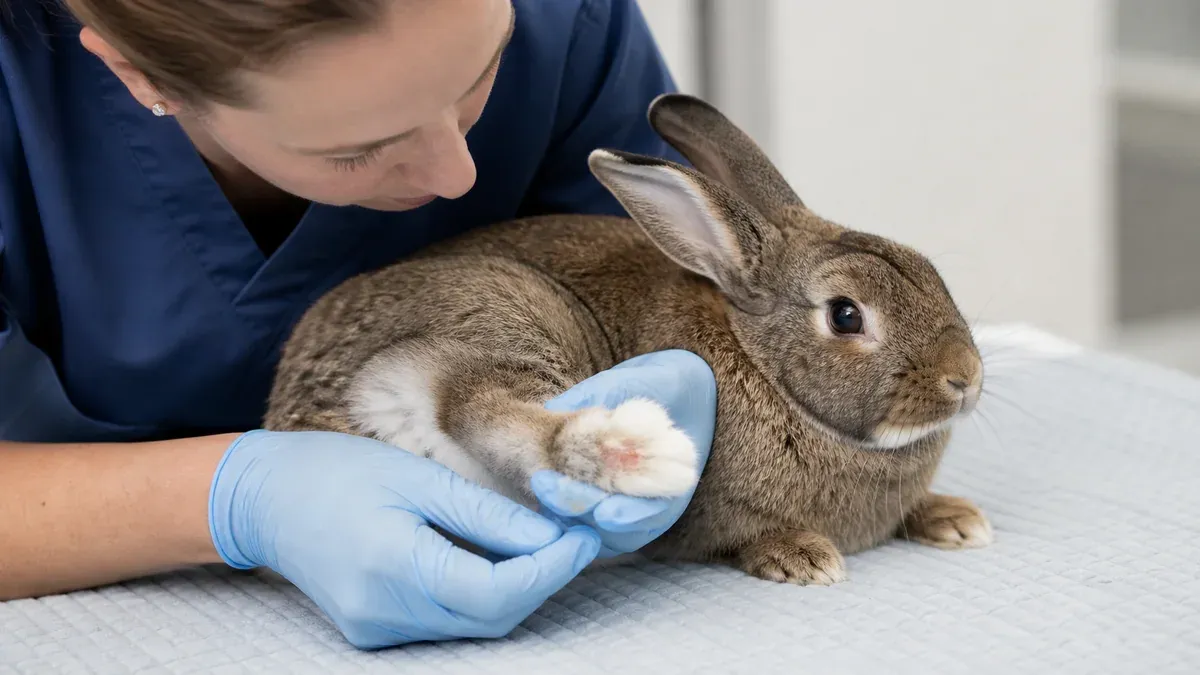
Veterinary warning — Sore hocks beyond mild redness (scabbing, open sores, limping) need evaluation by a rabbit-savvy vet. A neglected lesion can become deeply infected and hard to treat.
A rabbit with a red, bald or scabbed patch on the underside of its hind paws is most likely dealing with sore hocks, also called pododermatitis. It is an inflammation of the foot pads caused by repeated pressure or friction on unsuitable flooring. This guide covers the causes, the stages of progression, and how to treat and prevent it.
What is pododermatitis in rabbits?
Unlike dogs or cats, rabbits have no thick foot pads — their paws are protected only by dense fur, with almost no fatty cushioning underneath. When that fur wears thin or stays constantly damp and compressed, the skin beneath becomes irritated and eventually ulcerates. The area most affected is the underside of the hind paws, at the hock, which bears most of a rabbit’s weight at rest.
Without correcting the underlying cause, the lesion progressively worsens and can develop into a deep infection reaching the underlying tissue, or even bone in the most severe cases.
Main causes
| Cause | Why it promotes sore hocks |
|---|---|
| Hard, slippery or wire flooring | Constant pressure and friction on an area with no thick natural cushioning |
| Damp or soiled bedding | Skin maceration, weakened skin barrier |
| Overweight or obese rabbits | Increased pressure over a reduced contact surface |
| Lack of movement | Prolonged weight-bearing on the same spot rather than shifting posture |
| Heavy breeds (notably the Flemish Giant) or thin-furred paws (the Rex) | Less natural cushioning under the paw |
| Old age or arthritis | Fewer position changes, prolonged pressure on the same areas |
The floor of the living space is the most common underlying cause: a rabbit kept permanently on wire mesh, bare tile or hardwood, with no cushioned resting area, will almost inevitably develop sore hocks sooner or later.
Signs to watch for by stage
| Stage | What you will see |
|---|---|
| 1 — Mild | Faint redness, thinning fur on the paw, no open wound |
| 2 — Moderate | Thickened skin, thin scab, tenderness to touch |
| 3 — Advanced | Open ulcer, possible bleeding, limping or shifting weight to the other paw |
| 4 — Severe | Deep infection, marked swelling, risk of tendon or bone involvement |
Rabbits at stages 3 and 4 often avoid bearing weight normally on the affected paw and may show broader signs of pain: a hunched posture, reduced movement, irritability when touched.
What the vet does
A rabbit-savvy vet assesses the lesion through a visual exam and palpation, noting its depth and extent. For advanced wounds, a bacterial swab helps guide antibiotic choice if a secondary infection is suspected. An X-ray may be requested if the damage appears to reach a bone or joint. The vet also distinguishes it from an abscess, which presents as a firm lump rather than a flat sore on the paw.
How sore hocks are treated
Care always combines two parts:
- Correct the environment immediately: remove hard or wire flooring, add thick, clean, dry rugs across every resting and movement area, and clean bedding more often.
- Treat the lesion itself, based on the stage:
- Stage 1–2: gentle cleaning, close monitoring, sometimes a light protective dressing.
- Stage 3–4: regular dressing changes by the vet, antibiotics if infected, pain relief to manage discomfort. The most severe cases may need surgical debridement of the wound.
Healing is slow, often taking several weeks to several months depending on the stage, since the area stays under pressure every time the rabbit puts weight on it.
Preventing sore hocks
- Provide non-abrasive, dry flooring across the whole living space (use thick, dry, non-abrasive rugs or mats on resting and traffic areas).
- Maintain a healthy weight and encourage daily movement.
- Clean the litter box frequently to limit prolonged dampness under the paws.
- Check the underside of the paws regularly during grooming sessions, especially in older, overweight or Rex-breed rabbits.
- Keep the nails trimmed: overgrown nails change how the foot lands and add pressure under the paw. See how to trim a rabbit’s nails.
When to seek emergency care
See a rabbit-savvy vet promptly if the rabbit has:
- an open wound that bleeds or has an unusual smell,
- limping or a clear refusal to bear weight on a paw,
- marked swelling around the lesion,
- loss of appetite linked to the lesion.
If limping was the first thing you noticed and the undersides of the feet look healthy, the other possible causes are sorted in my rabbit is limping.
Veterinary sources and caution notes
This article was reviewed to keep the advice cautious: it can help you recognise possible signs, but it does not replace an examination by a rabbit-savvy veterinarian. If you are unsure, or if your rabbit shows pain, an open wound, or rapidly worsening signs, contact a veterinary clinic without delay.
Sources used to frame the recommendations:
- Merck Veterinary Manual — Noninfectious diseases of rabbits
- RSPCA — Rabbit health and welfare
- Rabbit Welfare Association & Fund — Sore hocks
Frequently asked questions
Will sore hocks heal on their own if I change the flooring?
At stage 1 (mild redness, thinning fur) improving the surface and hygiene is often enough to stop it progressing. Once a scab or open sore appears, spontaneous healing is rare — veterinary follow-up is needed to prevent it worsening into an infected ulcer.
Are all rabbit breeds equally at risk?
No. Large or overweight rabbits and breeds with thin foot fur (such as Rex rabbits, whose short coat gives less cushioning) are notably more prone. An active rabbit at a healthy weight, kept on suitable flooring, stays at fairly low risk.
Can I disinfect a sore on my rabbit's paw myself?
A gentle rinse with water or saline is fine while waiting for the appointment, but any open, crusted or foul-smelling wound needs veterinary evaluation. An unsuitable ointment or antiseptic can delay healing or mask a deeper infection.
Can a rabbit with sore hocks keep free-roaming?
Yes, provided the environment is adjusted right away: remove wire grids and hard flooring, add thick, clean rugs across every resting and movement area. Temporarily limiting risky surfaces speeds up healing without isolating the rabbit.