E. cuniculi in rabbits: symptoms, treatment and outlook
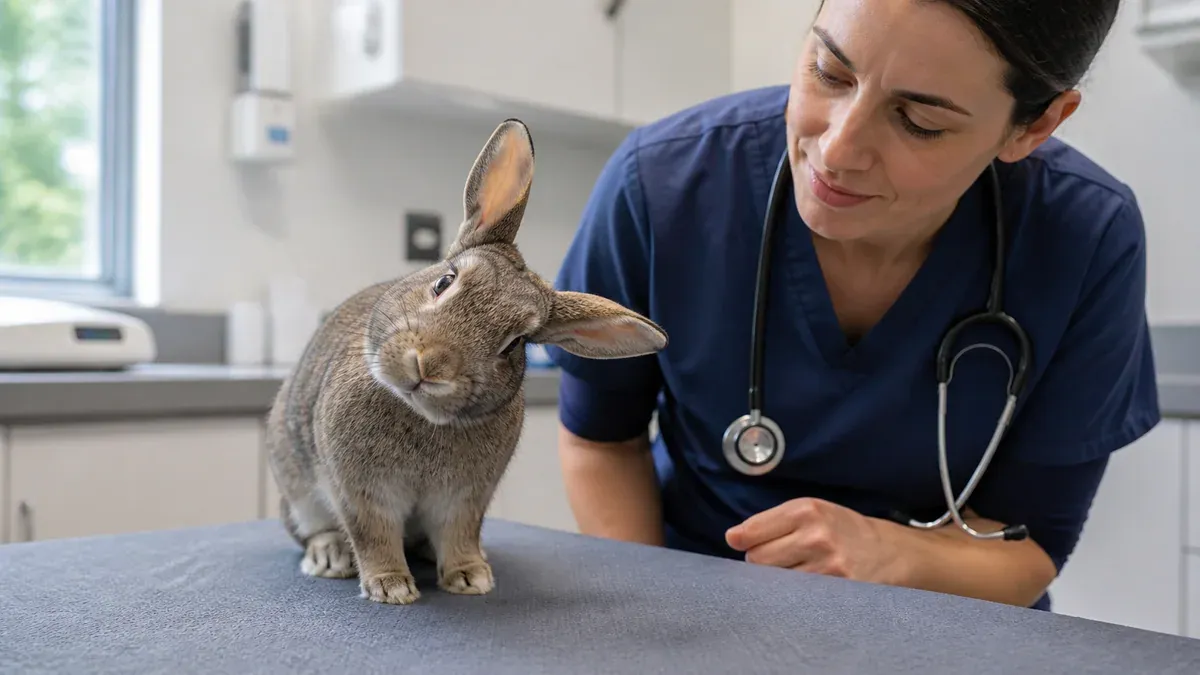
Veterinary warning — A head tilt, loss of balance or rolling in a rabbit calls for a prompt visit to a rabbit-savvy vet. E. cuniculi is treated only on prescription, and other serious conditions can cause the same signs.
E. cuniculi (Encephalitozoon cuniculi) is a microscopic parasite that is very common in pet rabbits, often present without causing any symptoms. It only becomes a problem when it “wakes up” and attacks the nervous system, kidneys or eyes — typically causing a head tilt, loss of balance or urinary problems. This guide explains how to spot those signs, what the vet does, and what to expect from treatment.
What is E. cuniculi?
Encephalitozoon cuniculi is an intracellular parasite (a microsporidian, related to fungi) that infects many pet rabbits. It settles mainly in the brain, kidneys and the lens of the eye, where it can stay silent for months or years.
It spreads mostly through spores shed in the urine of an infected rabbit: another rabbit ingests them while eating or grooming. A pregnant doe can also pass the parasite to her kits before birth, which explains some early eye problems.
The key point to grasp: being a carrier does not mean being ill. A large share of pet rabbits harbour the parasite without ever showing signs. The disease usually appears when the immune defences drop — for example during major stress, another illness, or with age — a useful reminder of the core needs set out in the rabbit species profile.
Signs to watch for
E. cuniculi can show up in three main forms, sometimes combined.
| Form | Common signs |
|---|---|
| Neurological | Head tilt (torticollis), loss of balance, rolling, tremors, hind-limb weakness or paralysis, urinary incontinence, sometimes seizures |
| Renal | Increased drinking and urination, gradual weight loss, drop in condition (signs of chronic kidney damage) |
| Ocular | A whitish area in the lens, eye inflammation (uveitis), sometimes cataract, often in a rabbit infected before birth |
The neurological form is the most dramatic: a previously normal rabbit suddenly starts tilting its head to one side, staggering or toppling over. When general condition is clearly affected, it helps to know how to recognise signs of pain or distress in a rabbit so you can judge urgency and describe the situation precisely to the vet.
Head tilt: don’t assume it must be E. cuniculi
This is the most common trap. A head tilt (torticollis) is not the same as E. cuniculi: a middle or inner ear infection, neglected ear mites or trauma produce the same sign, with different treatments. The full sorting of causes, what to do in the first hours and how to nurse a tilting rabbit are covered in my rabbit has a head tilt.
Only a rabbit-savvy vet can tell them apart, by examining the ears, assessing the neurological signs and, if needed, running further tests. That is why you should never start treatment “just in case” without a diagnosis.
How the vet reaches a diagnosis
A diagnosis of E. cuniculi is often a presumptive diagnosis, because no single simple test proves active disease on its own.
- The clinical exam assesses the neurological signs, the state of the ears and eyes, and general condition.
- A blood test can look for antibodies (serology). It mainly shows that the rabbit has been exposed to the parasite: many healthy rabbits are seropositive, so a positive result alone does not prove the symptoms come from E. cuniculi.
- Other tests (kidney bloods, imaging, ear examination) mostly serve to rule out other causes of head tilt.
The vet therefore reasons from a set of findings rather than from one test.
Treatment
Treatment for E. cuniculi is always prescribed and monitored by a vet. It relies mainly on an antiparasitic, fenbendazole, given as a prolonged course (often on the order of several weeks). The exact dose and duration are set by the veterinary prescription and should never be improvised.
Alongside this core treatment, supportive care is added according to the signs:
- anti-inflammatory to limit nerve inflammation,
- comfort measures for a rabbit that keeps toppling: a padded, floor-level space free of hazards,
- feeding support if the rabbit can no longer eat on its own, because a rabbit that stops eating quickly risks a gut shutdown,
- treatment of any associated infection (antibiotics) if a bacterial ear infection is also present.
A rabbit with a marked head tilt should be set up in a safe environment where it cannot injure itself when toppling, and helped to drink and eat until it regains its balance: those home care steps are detailed in my rabbit has a head tilt.
Outlook: what to expect
The outlook is variable and depends heavily on the initial severity and how quickly treatment starts:
- early treatment clearly improves the chances of recovery;
- many rabbits recover partially or fully, but a slight residual head tilt may remain for life without harming quality of life;
- severe forms, with continuous rolling and an inability to steady themselves, carry a more guarded outlook.
The main thing is not to judge too soon: a rabbit that looks badly affected in the first few days can stabilise and return to a normal life with time and good follow-up.
Reducing the risk day to day
There is no vaccine against E. cuniculi. Prevention rests on simple habits:
- reduce stress, the main trigger of an active form (abrupt changes, transport, conflictual pairings);
- good litter hygiene, since spores are shed in urine;
- an observation period when a new rabbit arrives, especially before any pairing.
The risk of transmission to humans stays low and mainly concerns immunocompromised people: washing your hands after cleaning the litter box and avoiding inhaling dried urine dust is usually enough.
When to seek emergency care
See a rabbit-savvy vet without delay if your rabbit:
- suddenly tilts its head, staggers or topples over,
- can no longer stand or rolls over repeatedly,
- stops eating or drinking,
- shows paralysis or weakness of the hindquarters.
The earlier treatment starts, the better the chances of recovery. For other common problems, browse all our rabbit health guides.
Veterinary sources and caution notes
This article aims to help you recognise possible signs; it does not replace an examination by a rabbit-savvy vet. With a head tilt, rolling or loss of balance, contact a veterinary clinic promptly.
Sources used to frame the recommendations:
- Merck Veterinary Manual — Parasitic diseases of rabbits
- House Rabbit Society — E. cuniculi
- RSPCA — Rabbit health and welfare
- VCA Hospitals — Infectious diseases in rabbits
Frequently asked questions
Will a rabbit carrying E. cuniculi always get sick?
No. A large proportion of pet rabbits carry the parasite without ever showing symptoms. The disease mainly flares up when the immune system is weakened (stress, another illness, old age). A carrier that stays symptom-free can live a completely normal life.
Is my rabbit's head tilt always caused by E. cuniculi?
No, which is exactly why a veterinary exam is essential. A head tilt can also come from an inner-ear infection (often bacterial) or from ear mites. Treatment differs by cause, so you should never assume it is E. cuniculi without veterinary advice.
Can E. cuniculi be passed to humans?
The risk exists but is low for a healthy person. It mainly concerns immunocompromised people. Simple hygiene — washing your hands after cleaning the litter box and avoiding inhaling dried urine dust — is usually enough to limit it.
Can my rabbit fully recover?
It depends on severity and how quickly treatment starts. Many rabbits recover partially or fully with early treatment, but a residual head tilt can persist. Cases with continuous rolling carry a more guarded outlook.