Ear mites in rabbits: signs, treatment and prevention
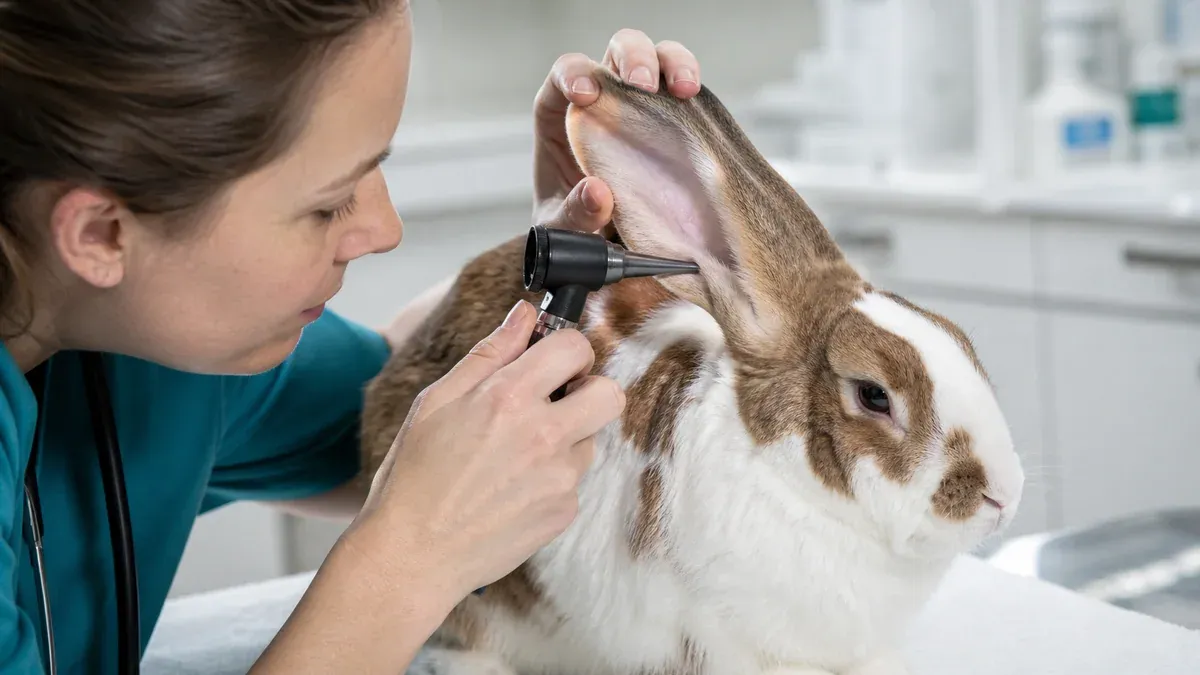
Veterinary warning — Ear mites should never be treated at home alone. Never try to remove the crusts yourself: it is painful for the rabbit and can worsen the infection. An appropriate antiparasitic treatment must be prescribed by a rabbit-savvy vet.
A rabbit that shakes its head, scratches persistently at its ears, or has thick brown crusts inside the ear canal is most likely dealing with ear mites — a common, well-documented parasitic condition in rabbits. This guide explains what causes it, how to recognise it, and why it always calls for veterinary care.
What are rabbit ear mites?
Ear mites (also called ear mange) are a parasitic infestation caused by Psoroptes cuniculi, one of the most common external parasites affecting rabbits worldwide. This tiny mite lives on the skin surface inside the ear canal, feeding on lymph and skin debris. Its presence triggers significant local inflammation, producing the characteristic crusts sometimes called an “ear canker.”
Unlike a passing irritation, ear mites do not resolve on their own: left untreated, the infestation worsens and the crusts progressively thicken.
Signs to watch for
| Sign | What it suggests |
|---|---|
| Persistent scratching at the ears or head | Itching caused by the mites |
| Frequent head shaking | Discomfort inside the ear canal |
| Thick, brown, clumped crusts | Inflammatory reaction in the outer ear canal |
| Warm, tender ears to the touch | Local inflammation, sometimes secondary infection |
| Reduced appetite, weight loss | Chronic discomfort from an advanced infestation |
| Head tilt or loss of balance | Rare but serious sign of inner-ear involvement — seek care immediately |
In advanced cases, crusts can spread beyond the ear flap to the head, neck, or even the legs if the rabbit scratches with its claws.
Don’t confuse this with fur loss over the back accompanied by heavy dandruff, which points instead to a different skin mite (Cheyletiella) or a simple moult: our guide on rabbit moulting: normal or a problem helps tell coat renewal from a skin problem. Body scratching with tiny black specks at the base of the fur points instead to fleas in rabbits. The full sorting table, area of the body by area of the body, is gathered in my rabbit keeps scratching. And when head shaking dominates rather than scratching, the sorting is done by what comes with it in my rabbit keeps shaking its head.
A head tilt does not always point to ear mites, though: it can also stem from an E. cuniculi infection, a parasite that affects the nervous system, or from a deep ear infection. Telling these causes apart is exactly the vet’s job, and what you can do while waiting for the appointment is set out in my rabbit has a head tilt.
Why you should never remove the crusts yourself
Ear mite crusts are firmly attached to the underlying skin. Forcing them off a conscious rabbit is extremely painful and can cause bleeding or a secondary bacterial infection. The right approach is to treat the underlying cause — the mites themselves — so the crusts detach naturally and gently as the skin heals under veterinary treatment.
A rabbit showing marked pain alongside these signs may also have other sources of discomfort: see our guide on signs of pain in rabbits to assess the full clinical picture.
How the vet makes the diagnosis
A rabbit-savvy vet usually identifies ear mites through a visual exam of the ear canal, sometimes supported by a microscopic look at a sample to confirm the mites’ presence. This sampling also helps rule out other causes of swelling or discomfort around the ear, such as an abscess, which presents differently (a firm lump under the skin rather than crusts inside the canal).
How ear mites are treated
Treatment relies on an antiparasitic prescribed by the vet. The product, dose, route, and number of administrations depend on the rabbit’s weight, condition, and the severity of the infestation. Several administrations may be needed to cover the parasite’s life cycle, so follow the prescription schedule. Crusts should never be pulled off; they fall away gradually as the underlying skin heals.
If a secondary bacterial infection is present (marked inflammation, discharge), the vet may add a course of antibiotics.
Contagion and prevention
Psoroptes cuniculi spreads through direct contact between rabbits. A few habits reduce the risk:
- Check a new rabbit’s ears closely before any close cohabitation, especially when introducing a second rabbit (see our article on rabbits living alone or in pairs for introduction precautions).
- Inspect your rabbit’s ears regularly during petting or grooming sessions to catch early crusting or unusual scratching.
- Avoid unsupervised contact with rabbits of unknown origin (shows, stray rabbits).
When to seek emergency care
See a vet promptly if the rabbit:
- has extensive or bleeding crusts,
- tilts its head or loses balance,
- stops eating normally,
- shows marked pain alongside the scratching.
Veterinary sources and caution notes
The sources below are provided as veterinary or institutional reference points to frame the topic cautiously: this article can help you recognise possible signs, but it does not replace an examination by a rabbit-savvy veterinarian. If you are unsure, or if your rabbit shows pain, lethargy, refusal to eat, or rapidly worsening signs, contact a veterinary clinic without delay.
Sources used to frame the recommendations:
- Merck Veterinary Manual — Parasitic diseases of rabbits
- Merck Veterinary Manual — Skin disorders of rabbits
- RSPCA — Rabbit health and welfare
Frequently asked questions
Can I remove the crusts from my rabbit's ear myself?
No, especially not on a conscious rabbit. These brown crusts are firmly attached to the skin, and forcing them off is very painful and can cause bleeding in the ear canal. Once veterinary treatment starts, the crusts gradually slough off on their own as the mites die and the skin heals.
Are ear mites contagious between rabbits?
Yes, Psoroptes cuniculi spreads easily through direct contact between rabbits. A newly adopted rabbit, or one that has been in contact with other rabbits (shows, boarding, shelters), should be checked closely before any close cohabitation.
Can a cat or dog parasite treatment cure my rabbit?
Never use one without veterinary approval. Some antiparasitics formulated for cats and dogs are poorly dosed or unsuitable for rabbits. The vet selects a product, dose, route, and schedule suited to the rabbit's weight and condition.
How long does ear mite treatment take in rabbits?
Duration depends on the prescribed product, severity, and veterinary recheck. Several administrations may be needed to cover the parasite's life cycle. Do not alter the schedule or pull the crusts off yourself.