Rabbit abscess: signs, causes and treatment
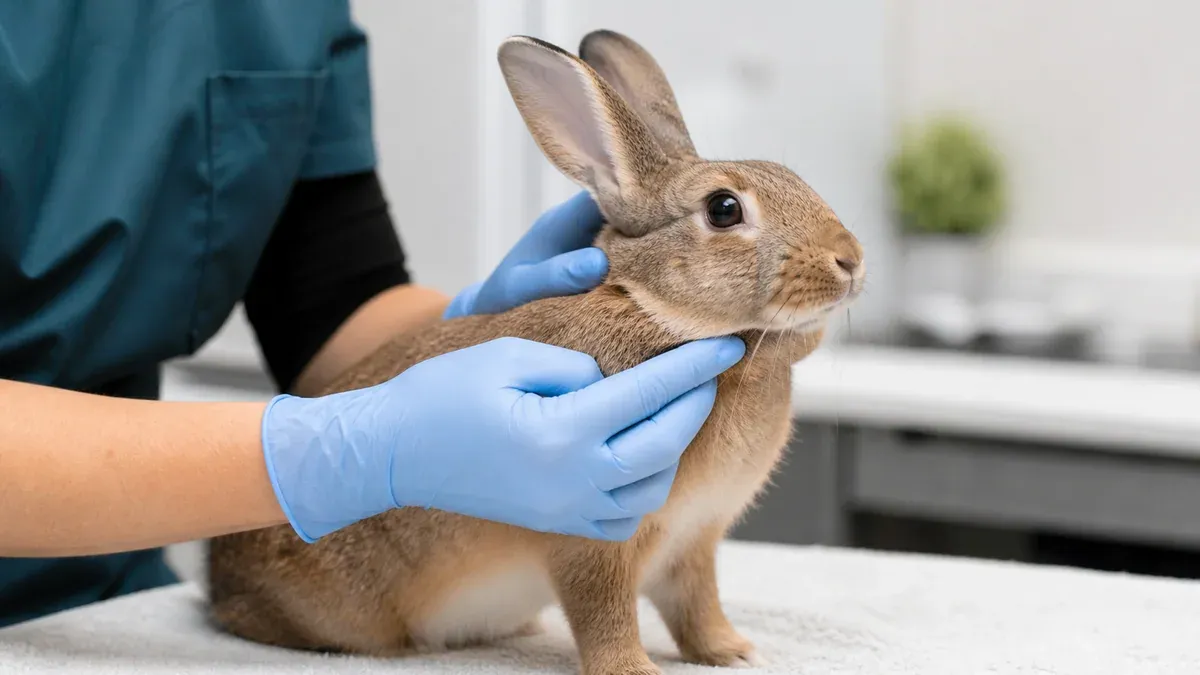
Veterinary warning — A rabbit abscess should not be treated at home without veterinary guidance. Do not attempt to drain or lance a lump yourself: rabbit pus is thick and non-liquid, and an uncontrolled incision worsens the infection. Consult a rabbit-savvy vet.
A swelling that appears under a rabbit’s jaw or anywhere on its body is a legitimate concern. Abscesses are among the most persistent complications in rabbit medicine, and the reason is rooted in the species’ physiology: rabbit pus is not liquid like that of dogs or cats, but thick and caseous, making spontaneous drainage unreliable. This guide covers the signs to recognise, the likely origins and when to seek care.
What is a rabbit abscess?
An abscess is an accumulation of pus resulting from the immune response against a localised bacterial infection. In most mammals, this pus is liquid and may sometimes drain spontaneously. In rabbits, the pus is caseous (cheese-like in consistency), often enclosed in a thick capsule. It rarely resolves on its own and usually requires veterinary care.
This characteristic makes rabbit abscesses difficult to treat and prone to recurrence. A simple needle aspiration or standard surgical drainage is rarely sufficient — the entire capsule must be removed and the underlying cause addressed.
Main types and locations
Dental abscesses
Dental abscesses are the most common type. They develop around tooth roots, particularly when malocclusion causes overgrowth or spurs that irritate surrounding tissue. Bacteria colonise the damaged root area and form an abscess progressively.
Typical locations:
- Under the lower jaw — linked to incisors or the first lower premolars
- Around the eye — upper molar roots are close to the tear ducts and orbit
- Along the cheek — retrobulbar or zygomatic abscess
Skin abscesses
An abscess can form under the skin following a wound: a bite from a companion rabbit, a scratch, a cut from enclosure materials or a foreign body (a straw fragment or wood splinter that penetrates the skin). These present as firm, rounded masses under the skin.
Internal abscesses
Less common but more serious: abscesses can develop in internal organs, often linked to systemic bacterial infection (including Pasteurella). They are harder to detect and carry a more guarded prognosis.
Do not confuse an abscess with thick crusts inside the ear canal, which point instead to ear mites, a parasitic infestation that is treated very differently.
Signs to watch for
| Sign | What it may indicate |
|---|---|
| Firm lump under the jaw or on the body | Skin or dental abscess forming |
| Swelling around an eye or persistent watery discharge | Upper molar abscess |
| Reduced appetite, refusing hay | Pain when chewing — likely dental abscess |
| Progressive weight loss | Chronic pain linked to the abscess |
| Drooling, damp fur under the chin | Oral discomfort — see also rabbit drooling |
| Skin fistula (small weeping opening) | Abscess that has ruptured spontaneously — requires prompt vet attention |
A rabbit eating little or nothing can develop GI stasis within hours. If a dental abscess coincides with a feeding stop, treat it as an immediate emergency.
Diagnosis and treatment
What the vet will do
The vet palpates the mass, may perform fine-needle aspiration to confirm the caseous content, and often prescribes X-rays to locate any involved tooth root.
The treatment
Standard treatment for a rabbit abscess combines:
- Surgical curettage — complete removal of the capsule and caseous pus, plus debridement of surrounding infected tissue
- Targeted antibiotic therapy — prescribed by the vet based on bacterial culture, for a defined duration
- Tooth extraction if the involved tooth is unrecoverable
- Post-operative care — wound cleaning, sometimes with antibiotic-impregnated packing of the cavity
Simple drainage (as used for dog abscesses) is insufficient: caseous pus does not flow, and the capsule will recur if not completely removed.
Recurrence risk
Rabbit abscesses recur frequently, especially when dental in origin. Recurrence happens when:
- a portion of the capsule is left behind after surgery
- the root cause (fractured tooth, foreign body, malocclusion) is not resolved
- the antibiotic course is stopped too early
Some rabbits need two or three procedures before lasting resolution. Regular veterinary follow-up after treatment is essential.
What not to do
Do not lance or compress the mass at home. Caseous pus will not come out, and an uncontrolled opening worsens the infection and risks spreading it.
Do not wait for the abscess to resolve on its own. In rabbits, that outcome is very unlikely: the abscess is more likely to grow, rupture or extend the infection without appropriate treatment.
Do not give antibiotics without a prescription. Some common antibiotics (oral amoxicillin, penicillin) are toxic to rabbits. Only a vet can prescribe the right molecule and route of administration.
Sources
- MSD Veterinary Manual — Bacterial and Mycotic Diseases of Rabbits — confirms the thick consistency of the pus: a simple drain generally cannot empty these abscesses, and thick-walled abscesses should be excised en bloc where possible. The same source also describes facial abscesses successfully treated with drainage and antibiotics. The technique depends on the abscess and the treating vet.
The choice of drug and route is a matter for the vet: the same source notes that a culture and sensitivity test should precede treatment. This article has not been reviewed by a veterinarian.
Frequently asked questions
Can a rabbit abscess resolve on its own?
You should not rely on that. Unlike dogs and cats, rabbits produce thick, caseous (cheese-like) pus that drains poorly. Without veterinary treatment, the abscess may grow, rupture or spread. Rabbit abscesses need prompt veterinary assessment and often surgical management.
How do I tell an abscess from a lump?
An abscess typically presents as a firm, well-defined mass under the skin, sometimes warm to the touch and mildly painful when pressed. A swollen lymph node or tumour can look identical — only a vet can distinguish them by fine-needle aspiration or biopsy.
My rabbit has a swelling under its jaw — is it urgent?
Yes. A swelling under a rabbit's jaw is a relative veterinary emergency. The most common cause is a tooth-root abscess. If your rabbit has also stopped eating or is producing very few droppings, it is an immediate emergency — GI stasis can develop within hours.
Do rabbit abscesses come back after treatment?
Often. The caseous pus is difficult to remove completely even surgically, and recurrence happens when the root cause (infected tooth root, foreign body) is not fully resolved. Some rabbits need several procedures or long-term monitoring.