Can you bathe a rabbit? What to do instead
Veterinary warning — This article covers hygiene handling and the situations that call for a consultation. It does not replace a clinical examination. A persistently soiled rear end, a wound, red skin or visible maggots need a rabbit-savvy vet — as an emergency in the last case.
No, a rabbit is not washed the way a dog is: a full bath puts it at real risk, and it is almost never necessary. A healthy rabbit grooms itself several times a day and keeps a clean coat with no help at all.
So the question to ask is not “how do I wash my rabbit” but “why is it dirty”. A soiled patch that keeps coming back is a symptom: it means the animal can no longer groom properly, or that something is keeping its coat permanently wet.
Why a full bath puts a rabbit in danger
Four mechanisms stack up, and none of them depends on how gently you handle the animal:
- Panic and struggling. Rabbits are a prey species, held in water against their will. Their hind muscle mass is powerful relative to their spine: one violent kick in a basin or a sink can cause a vertebral fracture or dislocation.
- Hypothermia. A rabbit’s undercoat is dense and holds water for a long time. A soaked animal keeps losing heat well after the bath is over, even in a room that feels warm to you.
- Damage to the skin barrier. Soapy water strips the protective film from very thin skin, which encourages moist dermatitis in the folds (groin, perineum, under the chin).
- The stress itself. Acute stress alone can be enough to tip a fragile rabbit’s gut into slowdown — the mechanism described in GI stasis in rabbits, where stress is a recognised trigger.
These risks are not theoretical and experience does not cancel them. Hence the simple rule: no full bath, no immersion, never the head under water.
A dirty bottom is a symptom, not a hygiene failure
A sound adult rabbit does not have a dirty rear end. When it does, the cause is almost always on this list:
| What you see | What the vet should rule out | Where the details are |
|---|---|---|
| Soft sticky clumps under the tail | Uneaten caecotrophs, a ration too rich | Soft droppings in rabbits |
| A round rabbit that can no longer reach its bottom | Excess weight | My rabbit is getting fat |
| An older rabbit grooming less, dull coat over the back | Joint pain | Senior rabbit health |
| Wet chin and dewlap, changed appetite | Dental disease, drooling | My rabbit is drooling |
| Yellowed fur and sore skin between the hind legs | Urine sitting on the skin, urinary problem or unsuitable tray | Red urine in rabbits |
Cleaning without addressing the cause gives you the same picture a week later. The priority is therefore the consultation, not the cleaning — except in the emergency described below.
The warm-weather emergency: flystrike
A soiled, damp coat, especially on the rear end, attracts flies. They lay on the skin and larvae can appear very fast: the veterinary sources listed at the end of this article describe a picture that can develop within hours, with severe damage hidden under fur that still looks intact.
Call a clinic immediately, without waiting, if you see: maggots in the fur or on the skin, small clusters of white eggs like grains of semolina, raw skin under a soiled area, or a subdued rabbit with a dirty bottom in warm weather.
In that specific situation, do not bathe the rabbit and do not try to rinse the area: wet fur is harder for the veterinary team to clip and clear completely of eggs and larvae. The only useful step is to call the vet immediately. The rest of the signs that call for an immediate phone call are gathered in rabbit emergency warning signs.
In summer, check your rabbit’s rear end at least twice a day: that is the frequency advised by the Rabbit Welfare Association & Fund (RWAF). Step the vigilance up for a rabbit that is overweight, elderly, long-haired or living outdoors.
The only cases where spot cleaning is justified
Home cleaning is limited to three situations, and always stays local:
- Fresh, limited soiling: a few stuck caecotrophs, a recent urine mark, a bit of soil. Removing what comes away on its own is useful and carries no risk.
- A rabbit recovering from surgery that lies on a soiled side: the area is cleaned according to the instructions given by the clinic, set out case by case in caring for a rabbit after spaying and caring for a rabbit after neutering.
- An explicit veterinary instruction, for instance daily cleaning of an area of urine scald with the product named at the consultation.
Outside those three cases, brushing replaces washing. It removes dead coat, limits mats and cuts down the amount of fur swallowed: the method and the rhythm through the year are covered in rabbit moulting and my rabbit is swallowing fur.
How to clean a soiled area without bathing the rabbit
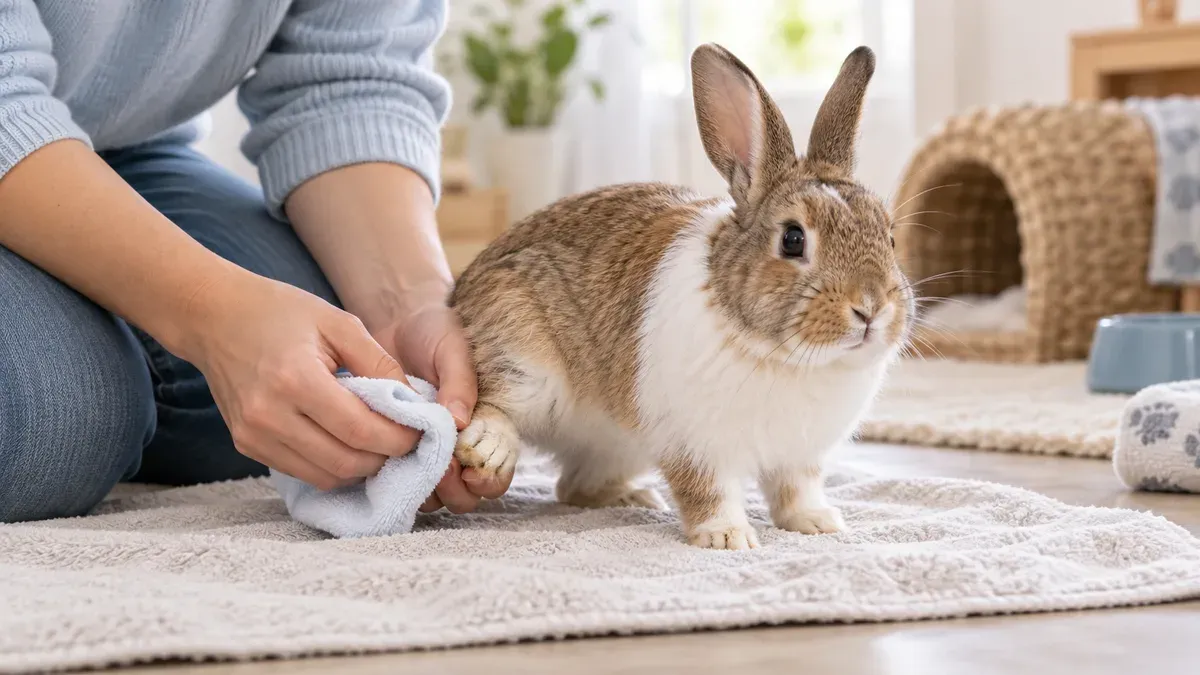
If cleaning is justified, the method comes down to six points:
- Set everything out before you pick the rabbit up: two dry towels, a bowl of warm water, a flannel or gauze pads. A rabbit held while you hunt for supplies struggles more.
- Work on the floor or on a low table covered with a non-slip mat, never at the edge of a worktop. Almost all handling accidents come from a fall or a jump.
- Wet only the soiled area, such as the rear end or chin. The rest of the body must stay dry.
- Plain warm water. No soap, no shampoo, no scented wipes, unless a product has been prescribed. Dab and soften stuck clumps rather than pulling on the fur: the skin tears before the mat gives way.
- Dry right down to the skin. Blot with a towel, then part the fur with your fingers to check that no dampness remains against the skin. A hairdryer is only ever used cold, at a distance, and only if the rabbit tolerates it without freezing.
- Keep the rabbit warm and free of draughts until the coat is completely dry, including at skin level.
A session lasts a few minutes. If the rabbit struggles, stop: put it down, let it settle and book an appointment. A rabbit that fights is far more likely to injure itself than to get any cleaner.
What must never be used on a rabbit
- Human shampoo, even “mild” or baby formulas: washing with or without shampoo strips the coat’s natural oils. Only use a product recommended by your vet when a skin condition requires washing.
- Dog or cat shampoos and parasite products. Several common actives are dangerous in rabbits, fipronil above all: the detail is in fleas in rabbits.
- A drying powder or “dry shampoo” for small pets, applied on your own initiative: the rabbit inhales it and swallows it while grooming.
- Scissors or clippers to cut away soiled fur: the skin, which is very thin, cuts before the fur does.
- A bath “to cool the rabbit down” in summer. Against heat, the safe measures are of a different nature — they are gathered in how to keep a rabbit cool in summer and heatstroke in rabbits.
Stopping the area from getting soiled again
Three levers matter more than the cleaning itself:
- The ration, because soft caecotrophs most often come from too many pellets or too much sugar: the amounts are in how many pellets to feed a rabbit, and unlimited hay remains the foundation, as how much hay a rabbit needs sets out.
- The litter tray, whose size and depth decide how much contact there is with urine: see the best litter tray for rabbits and how to clean a rabbit litter box.
- Weight and mobility, because a rabbit that can no longer reach its own rear end will not soil itself any less after one more clean-up.
Going further
The next step is simple: lift the tail gently and look at the skin around the anus. If the area is soiled or damp, ask your vet for advice so the cause can be found before the coat starts to break down. To place how urgent an isolated sign is, the full sorting is in when to see an exotic vet for your rabbit. Our other guides are gathered in the rabbit health section and in the rabbit species profile.
Sources and veterinary references
These pages directly cover bathing, flystrike and fipronil toxicity in rabbits. They replace neither a clinical examination nor prescribed treatment.
- Merck Veterinary Manual — Skin disorders of rabbits
- Rabbit Welfare Association & Fund — Bathing rabbits
- Rabbit Welfare Association & Fund — Flystrike in rabbits
Frequently asked questions
My rabbit smells: would a bath fix it?
No, and it would hide the cause. A healthy rabbit has almost no body odour: what smells is either the environment (litter tray, urine soaked into a rug) or a part of the body that stays damp — urine on the rear end, saliva under the chin, discharge from an eye. A body smell that persists after the tray has been cleaned is a reason to see a vet, not to run a bath.
Can I use a dry shampoo or a grooming powder on a rabbit?
Not on your own initiative. Drying powders sold for small pets can irritate the skin, are inhaled and swallowed during grooming, and fix none of the causes of soiling. Ask your vet before putting anything on a rabbit's skin, including products sold in pet shops as species-specific.
Does an outdoor rabbit need washing after rain?
No. A rabbit with access to a dry shelter dries itself. What matters is that it can get out of the wet and that its bedding does not stay damp: a coat that stays wet down at skin level invites dermatitis and, in warm weather, flies.
Should I trim the soiled fur around the anus?
That belongs in the consulting room, not at home. Rabbit skin is thin and tears easily under scissors or clippers, especially on an animal that struggles. A vet clips the area, examines the skin underneath and looks for the cause of the soiling at the same time.