Red urine in rabbits: porphyrins or haematuria?
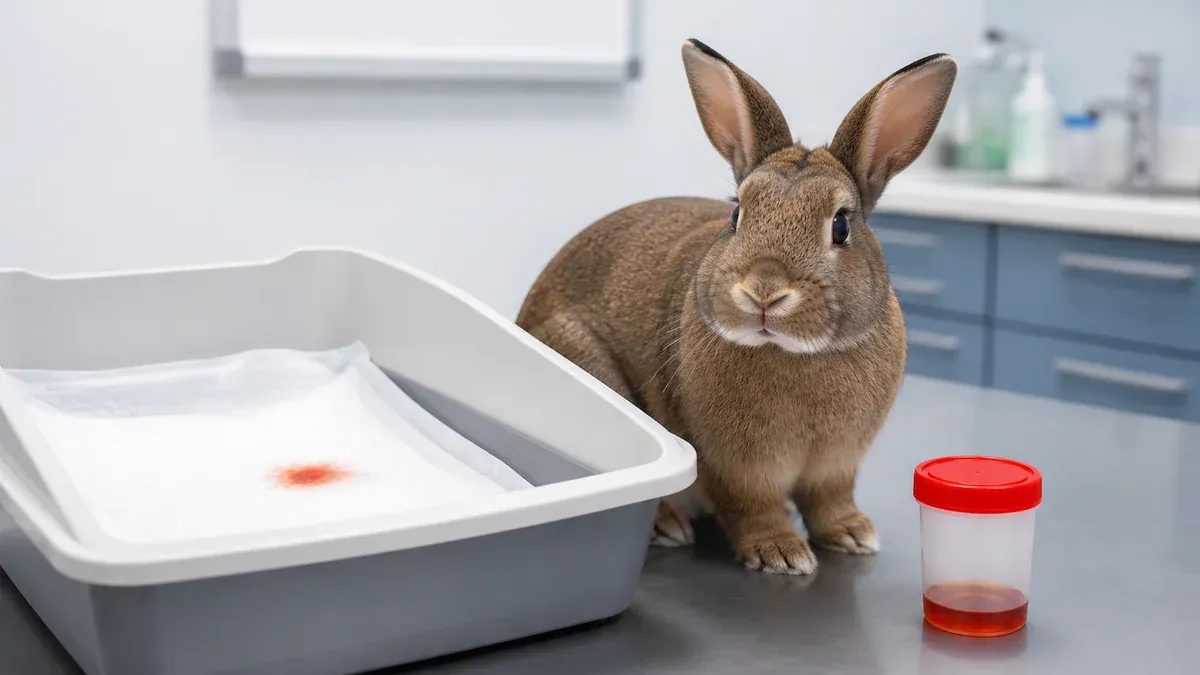
Veterinary warning: If your rabbit’s urine is red and is accompanied by other symptoms — lethargy, visible straining to urinate, hunched posture, pain, or refusal to eat — consult a vet promptly. Likewise, if red or orange urine persists for more than 2–3 days after you remove pigment-rich foods from the diet, do not wait. This article is for informational purposes only and does not replace a veterinary examination.
Two very different causes behind the same colour
Discovering red or orange urine in a rabbit’s litter tray is a common source of alarm. In many cases the explanation is benign: the rabbit may have eaten foods rich in natural pigments called porphyrins, and the colouration may fade within a few days. However, urine colour alone is not enough to rule out blood, so behaviour, appetite, urination comfort and recurrence matter.
However, the same visual appearance can also signal haematuria — the presence of actual blood in the urine. Haematuria has a range of causes, some of them serious, and requires veterinary attention. The challenge is that the two conditions can look almost identical to the naked eye. Understanding the difference matters.
Porphyrins: the most common cause and entirely harmless
Porphyrins are nitrogen-containing organic compounds that arise naturally during the breakdown of red blood cells. All mammals excrete some level of porphyrins in their urine; rabbits are simply particularly efficient at doing so, especially when their diet includes certain trigger foods.
What causes a porphyrin surge?
Concentration rises markedly when a rabbit eats foods high in plant pigments or porphyrin precursors. The most commonly implicated items are:
- Root vegetables: beetroot (by far the most potent trigger), carrots in large quantities
- Brassicas: red cabbage
- Leafy greens: dandelion leaves, plantain, some varieties of spinach
- Supplements: commercial vitamin preparations or mineral blocks that contain coloured additives
A single generous serving of beetroot can turn a rabbit’s urine a vivid orange-red within a few hours. This is not a sign of disease.
What porphyrin-tinted urine looks like
The colour is typically a uniform, deep orange to brick-red. It is distributed evenly throughout the urine with no visible streaks or solid material. Most importantly, the rabbit itself shows no signs of discomfort: it is alert, eating normally, moving freely and producing normal droppings in its usual quantity.
Porphyrin discolouration resolves on its own within 2–3 days once the triggering food is removed from the diet. No medication or dietary supplement is required.
One important technical note: porphyrins do not react with the blood detection field on a urine dipstick. If a dipstick test is run and the blood field remains negative, you are almost certainly looking at porphyrins rather than haematuria.
Haematuria: when urine actually contains blood
True haematuria tends to present differently from porphyrin colouration, though the distinction is not always clear at a glance. The urine may appear pink rather than orange-red, or it may contain visible streaks, clots, or sediment. The colour can vary significantly depending on how much blood is present and how dilute the urine is.
Critically, haematuria is rarely the only symptom. A rabbit with a urinary problem will often show one or more of the following signs alongside the abnormal urine colour:
- Straining during urination, sitting in the litter tray for prolonged periods with little output
- Hunched or tense posture; reluctance to move
- Signs of pain: teeth grinding (bruxism), grinding sounds, sensitivity when the belly is touched
- Lethargy, reduced grooming
- Reduced appetite or complete refusal to eat
If any of these accompany the colour change, a veterinary consultation should not be postponed.
Main causes of haematuria in rabbits
Urinary tract infection
Bacterial infection of the bladder or urethra causes inflammation of the urinary tract lining, which bleeds into the urine. In rabbits, urinary tract infections are often associated with calcium sludge — a thick, chalky deposit that accumulates in the bladder and creates an environment favourable to bacteria. Does are more frequently affected than bucks due to anatomical differences.
Bladder sludge or urinary stones
Rabbits metabolise dietary calcium very differently from most mammals: they absorb it with little regulation and clear a far larger share through the kidneys than other mammals — as much as 60%, against 2–5% in most vertebrates. When calcium intake is chronically excessive — most commonly in rabbits fed large quantities of alfalfa-based pellets — calcium carbonate precipitates in the urine, forming a gritty sludge. Over time this can consolidate into bladder stones (uroliths). Both sludge and stones irritate the bladder wall and can cause bleeding.
Uterine adenocarcinoma
Uterine disease, including adenocarcinoma, is an important concern in middle-aged and older unspayed does. One possible sign is blood around urination, which may be mistaken for a urinary tract problem. If you have an unspayed female over three years old and notice suspected haematuria, this possibility should be discussed with a vet. Spaying is a major preventive option.
Kidney disease
Kidney disorders, including nephritis or structural abnormalities, can result in blood passing into the urine. These conditions are less common than the causes above but should be considered, particularly in older rabbits.
Trauma
A fall, an impact, or rough handling can cause internal bruising or rupture of blood vessels within the urinary tract, resulting in temporary haematuria. Context usually makes this cause obvious.
How to tell them apart at home
You will not always be able to reach a definitive conclusion without veterinary equipment, but the following approach gives you useful information:
Observe behaviour first. A rabbit with pigment-tinted urine often behaves normally: it eats hay, moves around, and produces the usual number of droppings. A rabbit with haematuria may show discomfort or altered behaviour, but not always. If your rabbit seems entirely well, pigments are more likely, yet persistent or recurrent red urine still deserves veterinary advice.
Review the diet over the last 24–48 hours. Did the rabbit eat beetroot, a large portion of carrots, red cabbage, or a new supplement? If yes, remove that food, offer plain hay and water, and monitor over the following 2–3 days. If the colour disappears during that window, porphyrins were the cause.
Use a urine dipstick. These are available from pharmacies and some pet shops. Dip the strip in a fresh urine sample (collect it from a clean litter tray). Porphyrins do not activate the haemoglobin detection pad; if that field remains negative, blood is not present. A positive blood result requires a vet visit.
Home observation has limits. Only a vet can perform a full urine analysis, abdominal palpation, ultrasound, and bloodwork. When in doubt, consult.
Summary table
| Feature | Porphyrins | Haematuria |
|---|---|---|
| Colour | Uniform orange-red or brick-red | Pink, red streaks, clots possible |
| Other urinary symptoms | None | Straining, reduced output, sediment |
| Rabbit behaviour | Normal: alert, eating, active | Lethargic, hunched, pain signs |
| Evolution | Clears in 2–3 days after diet change | Persists; may worsen without treatment |
| Dipstick blood field | Negative | Positive |
| Urgency | None if no other symptoms | Veterinary consultation required |
When to see a vet urgently
Certain situations require a same-day or emergency consultation regardless of your preliminary assessment:
- Visible blood clots or pink mucus in the urine
- The rabbit is unable to urinate or produces only a few drops despite repeated attempts
- The abdomen appears swollen or is painful to touch
- Complete prostration: the rabbit will not move, is unresponsive to normal stimuli
- Complete food refusal alongside the colour change; do not wait for an hourly threshold (see also our guide on a rabbit not eating)
- A kit under three months old with any abnormal urine colour
- An unspayed female of any age with persistent haematuria
In all these cases, do not attempt to manage the situation at home.
How to prevent urinary problems
Several straightforward measures substantially reduce the likelihood of urinary problems in rabbits:
Maintain a low-calcium diet. Unlimited grass hay (timothy, orchard, meadow) should form 70–80 percent of the diet. Pellets should be limited to a small daily portion — no more than one tablespoon per kilogram of body weight — and should be adult formulations, not alfalfa-heavy junior pellets for long-term adult feeding.
Avoid excess alfalfa. Alfalfa hay and alfalfa-based pellets are high in calcium and appropriate for young, growing rabbits under six months. They are not suited to adult rabbits as a dietary staple.
Ensure adequate water intake. Fresh water available at all times encourages dilute urine, which reduces the risk of calcium sludge and crystal formation. Some rabbits drink more readily from a bowl than a bottle; offer both if needed. A sustained rise in intake, on the other hand, is not a good sign and should be measured then explained — see my rabbit is drinking a lot.
Spay female rabbits. Routine spaying eliminates the risk of uterine adenocarcinoma entirely and removes one of the most serious causes of haematuria in does. The procedure is typically performed between four and six months of age. See our detailed guide to spaying female rabbits for full information on timing, risks, and aftercare.
Schedule annual health checks for does over two years old. Even spayed females benefit from regular examinations, and for unspayed or late-spayed does, annual check-ups allow early detection of urinary or reproductive abnormalities before they become emergencies.
For more guidance on rabbit care, health, and nutrition, visit our complete rabbit section.
Sources
- MSD Veterinary Manual — Noninfectious Diseases of Rabbits — establishes two points used here: renal calcium elimination reaches 60% in rabbits against 2–5% in other vertebrates, which often gives the urine a cloudy appearance that is normal; and a dipstick “can quickly exclude normal pigment causes of red urine”, which is the decisive sorting step between pigment and blood. The same source puts the age at which uterine adenocarcinoma becomes a strong hypothesis in an intact doe at over 3 years.
Only a vet can confirm the presence of blood, look for its origin and decide on tests. This article has not been reviewed by a veterinarian.
Frequently asked questions
My rabbit has red urine — should I go to the vet?
Not always. A uniform orange-red colour with no other symptoms is usually dietary porphyrins and does not require a visit. But pink urine with visible blood streaks, combined with lethargy, straining, pain or reduced appetite, warrants a prompt consultation.
What are porphyrins in rabbit urine?
Porphyrins are natural pigments found in the urine of many mammals. In rabbits, certain foods (beetroot, carrots, red cabbage, vitamin supplements) raise porphyrin concentration and turn urine a vivid orange-red. This is benign and reverses within 2–3 days once the trigger food is removed.
How do I tell porphyrins from blood in rabbit urine?
The most reliable test is a urine dipstick: porphyrins do not trigger the 'blood' field, whereas haematuria does. Visually, porphyrins produce a uniform orange-red, while blood may cause pink tones, streaks, or clots. Rabbit behaviour is also telling: a porphyrin-tinted rabbit acts perfectly normal, while one with haematuria may show discomfort.
Are unspayed females at higher risk of haematuria?
Yes. Uterine adenocarcinoma, very common in unspayed does over 3 years old, frequently presents as blood in the urine. This is one of the main reasons spaying is strongly recommended for female pet rabbits.