Senior rabbit health: what to watch from five years old
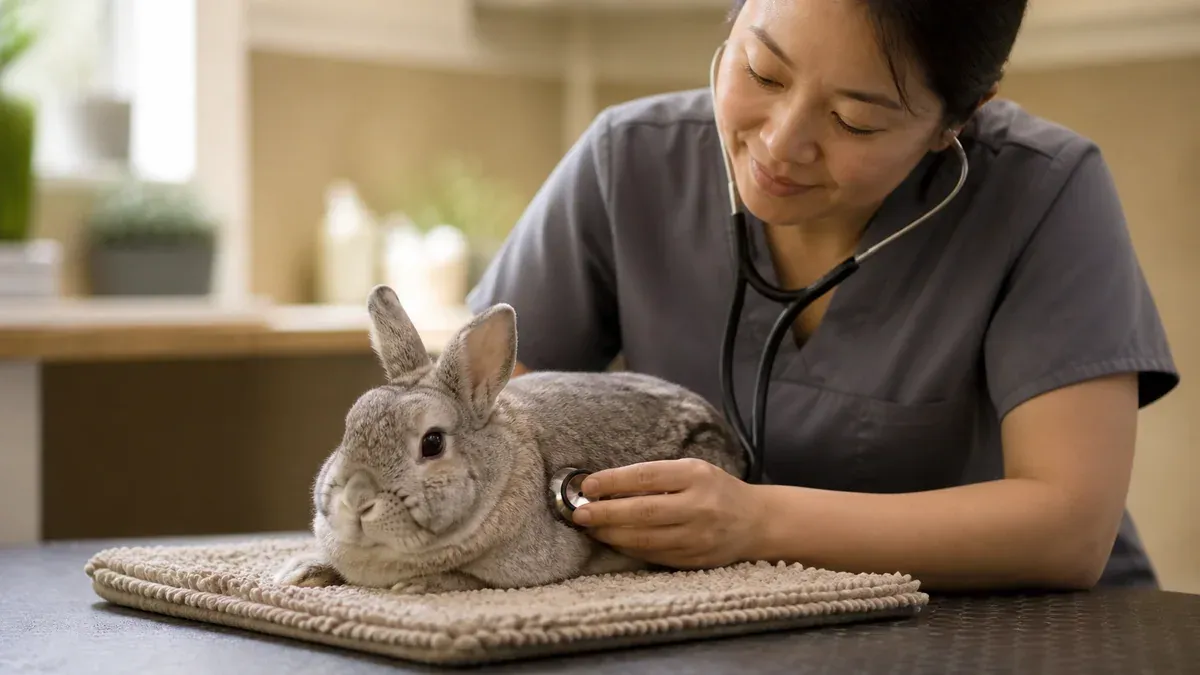
Veterinary warning — In older rabbits, many signs blamed on “old age” are in fact treatable conditions: joint pain, dental disease, kidney problems. This article helps you monitor a senior rabbit at home; it does not replace an examination by a rabbit-savvy vet.
A rabbit is usually treated as senior from around five to six years old, within a life expectancy that most often runs from eight to twelve years. Past that point four things deserve closer attention: weight, teeth and appetite, mobility and a clean rear end. The guiding rule fits in one sentence: old age explains nothing on its own. A change that settles in on an older rabbit can almost always be identified and eased.
What genuinely changes in an ageing rabbit
Ageing in rabbits is quiet. It almost never announces itself with a complaint — it shows up in small details of posture, grooming and routine. Three shifts dominate:
- Joints stiffen. Arthritis is common in rabbits over five or six. It does not produce a dog-like limp; it narrows the range of movement. When a mobility problem sets in over hours or days, age is not a sufficient explanation — the triage is in my rabbit is limping.
- Teeth carry a lifetime of wear. Molars grow continuously, and a long-standing wear problem tends to surface in the senior years.
- Organs filter less well. Kidney and urinary problems are among the leading reasons older rabbits are seen by a vet.
None of this is a reason to wait. These are precisely the changes where early detection pays off most.
Six things to monitor at home
1. Weight, measured and written down
This is the earliest indicator and the simplest. A monthly weigh-in on a kitchen scale, always under the same conditions, with the figure recorded somewhere (how to weigh a rabbit at home). It is the trend across three weigh-ins that speaks, not a single number. A steady decline in an older rabbit often points to dental, kidney or pain-related disease: never put it down to age without an examination, as covered in my rabbit is losing weight.
2. Teeth and the way it eats
Watch how it eats, not just how much. A senior rabbit that sorts through its hay, leaves the coarser strands, chews on one side, drops pieces or is slightly damp under the chin is telling you its mouth is uncomfortable. These signs often appear weeks before any weight loss. See rabbit dental malocclusion for how the condition progresses.
3. Mobility and pressure points
The jump test says the most: a rabbit that used to hop onto its hide or into its tray without thinking and now hesitates, tries twice or gives up is probably in pain. Also look at how it sits, at the underside of the feet (a red or hairless pressure area heralds sore hocks) and at nail length, which grows longer when the animal moves less. A rabbit in pain does not cry out: it freezes, hunches and moves less, as explained in how to tell if a rabbit is in pain.
4. Rear end and grooming
An arthritic or overweight senior can no longer reach its anus and stops eating its caecotrophs: they build up, stick to the perineum and soil the coat. That needs dealing with quickly for two reasons: it reveals pain or excess weight, and a soiled rear end attracts flies in warm weather, with a serious risk of flystrike. A coat turning dull or matted over the back and flanks tells the same story — the rabbit can no longer groom everywhere.
5. Drinking and urine
Keep an eye on the bowl and the litter tray. A clear, lasting rise in water intake, larger volumes of urine, a soaked tray — or conversely small, frequent attempts to pass urine — all deserve advice: in older rabbits these point towards the kidneys or the urinary tract. The two-to-three-day measuring method is described in my rabbit is drinking a lot.
6. Eyes and eyesight
A whitish haze in the eye, hesitation at a familiar obstacle, bumping into objects that have been moved: sight sometimes fades in older rabbits. A rabbit that sees less copes remarkably well as long as its landmarks stay put — bowl, hay, tray and hide in the same place.
Sorting table: what you see, what it points to
| What you see in an older rabbit | Likely lead | What to do |
|---|---|---|
| Weight loss over two or three weigh-ins | Teeth, kidneys, chronic pain | Consultation, without waiting for another sign |
| Reluctance to jump, hunched posture | Joint pain | Consultation; pain relief often transforms daily life |
| Caecotrophs stuck to the rear end | Pain, excess weight, over-rich ration | Consultation plus a review of the ration |
| Marked rise in drinking and urine | Kidney or urinary lead | Consultation with testing |
| Drooling, hay sorting, one-sided chewing | Dental disease | Dental consultation |
| Stops eating, droppings stop | Digestive emergency | Same day, no delay |
Adapting the home without turning it upside down
The useful adjustments are simple and cheap:
- A litter tray with one low side, so nothing has to be climbed over.
- Non-slip flooring (mats, cork tiles): bare tiles make a stiff rabbit skid and deepen its reluctance to move.
- Gentle ramps instead of jumps up to platforms — or simply removing levels that have become risky.
- Everything within reach: hay, water and hide on one level, with no obstacle in between.
- Deep, dry bedding in resting areas, which spares painful pressure points.
Above all: do not cut out run time. An older rabbit needs daily movement to keep its gut, muscles and joints working; the sensible move is to adapt duration and floor area to what it can handle rather than shortening sessions as a precaution (see how many hours of exercise does a rabbit need).
The ration: what changes, what does not
What does not change: unlimited hay, for life, and fresh water always available. What may change, with your vet: the pellet amount, adjusted to the body condition of a less active animal, and the texture on offer if the teeth are fragile (fresh grass, tender greens and softer hay are often better accepted). A thin senior rabbit is a case for examination, not for an enriched ration decided on your own.
How often to see the vet
At home: a monthly weigh-in, plus a weekly look at feet, eyes and rear end while brushing.
At the practice: a check-up at least once a year, which many rabbit-savvy vets suggest moving to twice a year past this age — the exact rhythm is set with them, based on the animal’s history. Vaccination stays recommended for life: myxomatosis and RHD do not spare older rabbits (see the rabbit vaccination schedule).
Mistakes to avoid
- Blaming a change on age without having the animal examined: nothing delays useful diagnoses more.
- Giving human painkillers (paracetamol, ibuprofen, aspirin): dangerous in rabbits. Every drug and every dose is a veterinary prescription.
- “Resting” the rabbit by shrinking its space: immobility worsens arthritis, weight gain and gut stasis.
- Stacking up joint supplements bought on your own before a diagnosis has been made.
- Putting off a consultation because “nothing can be done at that age”: pain management, dental care and kidney monitoring all remain effective in seniors.
Going further
Logical next step: write down your rabbit’s weight today, then again on the same date next month. That simple record spots trouble earlier than any visual impression. To place a specific sign, browse our rabbit health guides and the rabbit species page, and to judge urgency, see when to see an exotic vet for your rabbit.
Veterinary sources and caution notes
The sources below serve as veterinary or institutional reference points to frame the topic cautiously: this article helps you monitor an ageing rabbit, but only a rabbit-savvy vet can diagnose and prescribe treatment suited to a senior animal.
The links below were rechecked on 2026-08-05; no dosage is given because every drug choice and dose belongs with the veterinarian.
Sources used to frame the recommendations:
- RSPCA — Rabbit health and welfare
- Merck Veterinary Manual — Noninfectious diseases of rabbits
- VCA Hospitals — Rabbits: problems and diseases
- VCA Hospitals — Dental disease in rabbits
Frequently asked questions
At what age is a rabbit considered senior?
There is no official birthday for it. In practice rabbits are treated as senior from around five to six years old, with a well-cared-for pet rabbit generally living between eight and twelve years. Larger breeds often age earlier than dwarf breeds, so it is the animal's condition rather than the number that should set the level of monitoring.
My old rabbit sleeps more and moves less — is that normal?
A gradual slowdown is ordinary; a clear change over a few days is not. The useful benchmark: a healthy senior rabbit still moves around, eats its hay, stands up on its hind legs and eats its caecotrophs. If it hesitates to jump, stays in one position or gets a dirty rear end, that points to pain or a gut problem worth examining, not to age alone.
Should an older rabbit be switched to senior pellets?
Not automatically. Unlimited hay remains the base of the ration at every age, and an older rabbit in good body condition does not need a different range. Any change of pellets should be decided with your vet, based on weight, dental condition and test results — not on the word 'senior' printed on a bag.
Can a senior rabbit still be vaccinated and anaesthetised?
Yes to vaccination, which stays recommended for life because myxomatosis and RHD do not spare older animals. For surgery, age alone is not a contraindication: what matters is general, cardiac and kidney condition. A pre-anaesthetic assessment lets your vet weigh the risk case by case.