How to weigh a rabbit at home
Veterinary note — Weighing your rabbit is monitoring, not diagnosis. Scales tell you that a weight has changed, never why. Any variation that confirms itself, and above all any weight loss alongside a change in appetite, droppings or behaviour, belongs with a rabbit-savvy vet.
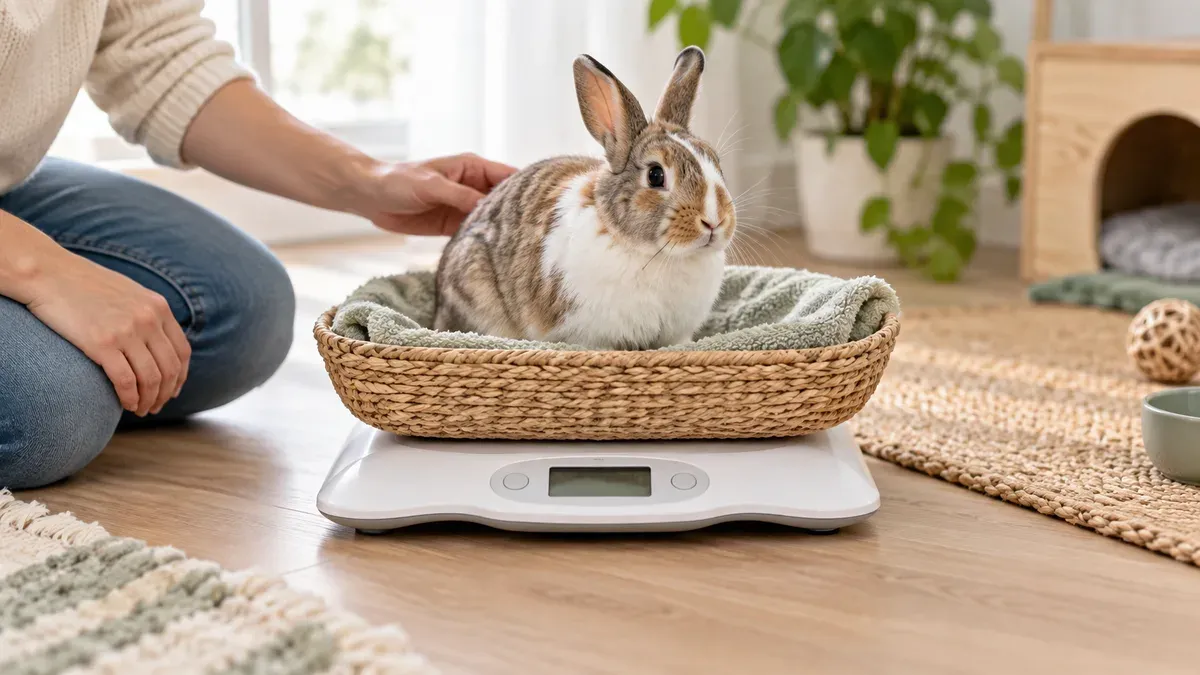
You weigh a rabbit at home on kitchen scales that read in grams, with a capacity greater than the combined weight of rabbit and container, by placing the animal in a basket or carrier that has been tared empty first. Write the figure down immediately, with the date: it is the record, not the scales, that spots a problem.
One rule makes the measurement useful: always weigh in the same conditions — same scales, same container, same time of day. A healthy adult rabbit holds a stable weight, and it is the trend across several readings that reveals dental, kidney or digestive disease before anything shows to the eye, as set out in my rabbit is losing weight.
Kit that works, and kit that does not
- Kitchen scales, reading in grams, with a capacity greater than the combined weight of rabbit and container. Pet rabbits weigh from 1 to 7 kg depending on size (see the rabbit species page), so scales capped at 3 kg will max out with an adult lop once the container is included.
- A stable container: a low wicker basket, a rigid tray, a carrier. What matters is that the rabbit can stand in it without slipping and without launching itself out in one jump.
- A towel or non-slip mat in the bottom. A rabbit whose feet skid tenses up, shifts around, and the reading never settles.
- A notebook or a note on your phone. A weight you do not write down is a weight lost: nobody remembers the exact figure six weeks later.
What does not work: bathroom scales, whose 100–200 g steps hide early loss; mechanical scales, cruder still; and holding the rabbit in your arms over the platform, which adds your own micro-movements to the measurement error.
The method, step by step
- Put the scales on a hard, flat surface. A worktop, never a rug or a cushion: a soft base distorts the reading.
- Place the empty container on the platform and tare it (the “tare” or “zero” button). The display must read 0 before the rabbit is involved at all.
- Lift the rabbit into the container, supporting the chest and the hindquarters, never scruffing it by the neck and never lifting it by the ears.
- Wait a few seconds for the reading to settle, one hand beside the container without pressing on it. A strand of hay or a leaf of greens keeps the rabbit busy while you read.
- Write down the figure and the date straight away, then put the rabbit back on the floor. The whole session should take under a minute.
If the rabbit jumps out before the reading settles, do not try three times in a row: come back to it later in the day. A missed weigh-in costs nothing; a fall from a kitchen worktop does.
If your rabbit will not sit still
This is where most owners give up, and it is fixable:
- Use the carrier, door closed, tared empty. The rabbit is contained rather than restrained, and the number settles on its own. It is one more reason to make the carrier a normal piece of furniture, as described in how to get a rabbit used to its carrier.
- Pick your moment: after a run-around session, when the rabbit is calm, rather than during the dawn or dusk activity peak.
- Weigh at floor level, with the scales on the ground, for a rabbit that panics up high. The precision is identical and a fall becomes impossible.
- Never wrestle. A rabbit struggling above the ground can injure itself badly by kicking out. If the session turns into a rodeo, stop: the scales are not an emergency.
A rabbit that tolerates no handling at all is usually telling you something other than “difficult character” — the step-by-step confidence-building method is in how to tame a fearful rabbit.
How often should you weigh a rabbit?
There is no universal schedule: ask your vet how often this particular rabbit should be weighed. The table lists situations to discuss, not a clinical prescription.
| Situation | Benchmark rhythm | What you are watching |
|---|---|---|
| Healthy adult rabbit | Frequency agreed with the vet | Stability over time |
| Senior rabbit | Frequency agreed with the vet | Any steady decline, however small |
| Suspected weight loss | As directed by the practice | Whether the trend confirms itself |
| Vet-supervised weight loss | As directed by the practice | Progress expected by the vet |
| Convalescence or ongoing treatment | As instructed by the practice | Recovery, or continuing loss |
| Growing baby rabbit | As directed by the practice | Growth over time |
Very frequent weighing can mainly highlight normal fluctuations. Close monitoring of an older rabbit sits inside a wider set of checks, covered in senior rabbit health.
Reading the chart: what actually matters
A single weight means almost nothing. Three principles make the record usable:
- There is no universal normal weight. Between a netherland dwarf and a giant breed the gap is a factor of five or more. The right weight for a rabbit is its own — the one it holds as an adult when body condition is correct.
- The trend is the signal, over two or three readings. A drop that repeats itself matters even when it is small; a single lower figure does not.
- Scales do not replace your hands. Run your fingers along the ribs, the pelvis and the spine at every weigh-in: a rabbit whose ribs are becoming sharp is losing condition even if the figure barely moves, and a rabbit whose ribs you have to press to feel is overweight. The hands-on assessment is described in my rabbit is getting fat.
Small differences between readings are expected: gut contents, bladder and time of day are enough to produce them. That is exactly why you weigh in identical conditions, and why you judge on repetition.
When the scales mean phoning the vet
- A drop confirmed over two or three readings, with no deliberate change of diet: book an appointment without waiting for a second symptom.
- Weight loss in a rabbit that has stopped eating: this is an emergency. Do not wait for an hourly threshold before calling (my rabbit is not eating).
- A steady rise, which calls for a review of the diet and living space with the vet rather than an improvised restriction.
- A stable weight but ribs that are becoming prominent: muscle loss can be offset by fat gain and mask a problem.
- Rapid loss in a rabbit on a diet: that is never a success, it is a sign of falling appetite.
To judge how urgent an associated sign is, use when to see an exotic vet for your rabbit.
Mistakes that ruin a weigh-in
- Switching scales mid-monitoring: two devices do not give exactly the same figure, and the comparison loses its meaning.
- Weighing at wildly different times of day, or straight after a large serving of greens.
- Forgetting to tare, then subtracting the basket’s weight from memory.
- Rounding, or not writing it down. “About 2 kg” detects nothing at all.
- Trusting the look of the animal: fur hides weight loss for a long time, especially in dense-coated breeds and during moulting.
Weight is used elsewhere too
The figure in your notebook is not just a monitoring tool. It is asked for at every consultation, it drives dose calculations — every veterinary prescription is worked out on the animal’s weight, which makes a recent figure genuinely useful the day treatment starts (how to give a rabbit medication) — and it is one of the details to give over the phone in an emergency, alongside what is in your rabbit first aid kit.
Where to go next
Logical next step: weigh your rabbit today, write down the figure and the date, then set a reminder for the same date next month. Two minutes a month is all it takes to build the one piece of health data you can produce at home without medical equipment. To interpret a change, start from my rabbit is losing weight or my rabbit is getting fat, and browse our rabbit health guides.
Sources and veterinary references
The sources below frame the subject cautiously: this article describes a home monitoring method, and does not allow you to set a target weight or to interpret a variation on your own.
- RSPCA — Rabbit health and welfare
- VCA Hospitals — Rabbits: problems and diseases
- Merck Veterinary Manual — Disorders and diseases of rabbits
Frequently asked questions
Can I weigh a rabbit on bathroom scales?
It is the least reliable option. Bathroom scales usually display in steps of 100 to 200 g, and at that resolution early weight loss stays invisible for weeks. The fallback trick is to weigh yourself, then weigh yourself holding the rabbit, but the difference is far too crude to build a chart from. Kitchen scales cost very little and completely change the quality of the monitoring.
Should a rabbit be weighed on an empty stomach?
No, and never starve one for the occasion: in rabbits, a few hours without food is enough to start slowing the gut down. You cancel out the effect of a meal a different way, by always weighing at the same point in the day, for instance before the evening feed. What makes two readings comparable is identical conditions, not an empty stomach.
My rabbit will not fit in a basket. What else works?
Use the carrier itself, door shut, placed on the scales and tared empty before the rabbit goes in. For a large rabbit whose carrier overhangs the platform, flat-topped kitchen scales plus a low, wide rigid tray will do, as long as the whole thing is stable. If nothing works, have the rabbit weighed at the practice during visits rather than improvising something unsafe.
My rabbit is a few dozen grams different from last time. Should I worry?
Not on its own. Gut contents, a full or empty bladder and the time of day all move the number, including in a perfectly healthy rabbit. What matters is the direction the chart takes over two or three readings taken in the same conditions. A one-off variation is worth noting; a trend that confirms itself is worth a vet appointment.