How to get a rabbit used to its carrier: a four-step plan
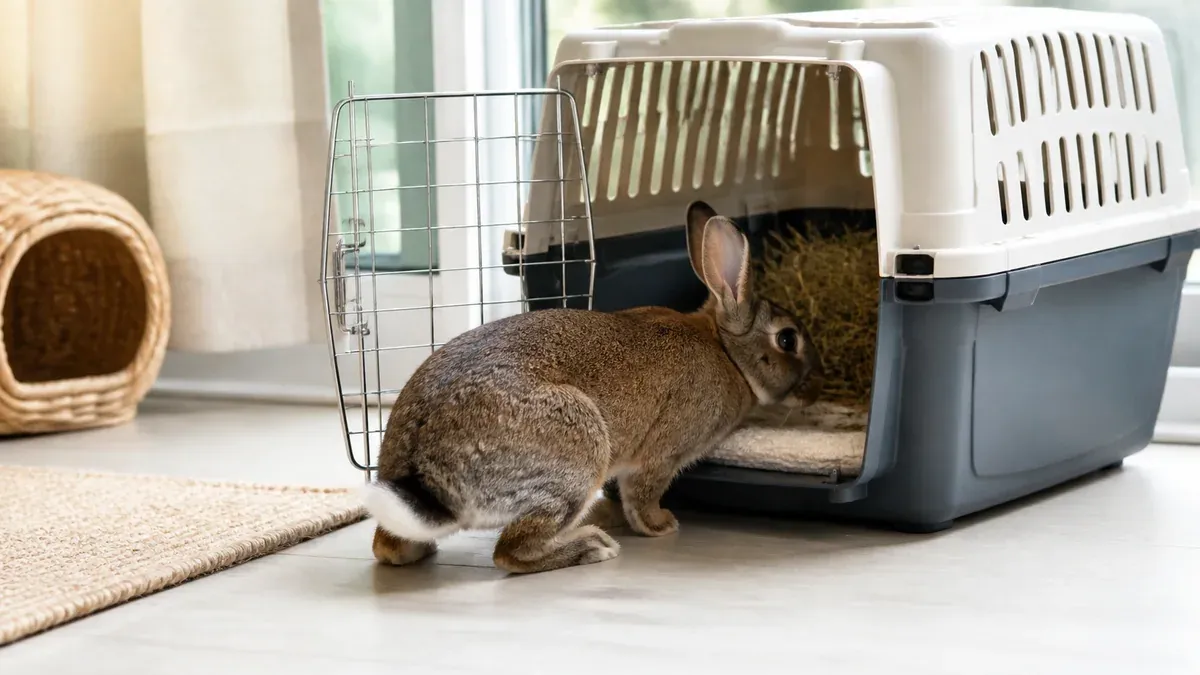
A rabbit gets used to its carrier through one rule and four steps: the carrier stays open permanently in its living space, turned into a hiding place with hay inside, and training moves forward in short sessions — walking in, door closed for a few seconds, carrier lifted, then a drive that goes nowhere. The principle that changes everything: you never grab the rabbit to put it in, you arrange things so it walks in by itself.
The reason is simple. For most rabbits the carrier carries one association: it comes out of the cupboard, the rabbit gets caught, and the day ends at the vet. The stress does not come from the box, it comes from that sequence. Breaking the association takes two to three weeks, and makes every future vet visit or journey far easier.
Setting the carrier up before you start
Three practical details make everything else easier:
- A carrier that opens from the top, as well as at the front. This is the single most useful feature: on the day you genuinely have to leave, lowering a rabbit in from above is far less stressful than pushing it backwards through a door.
- The door removed, or fixed open, for the whole familiarisation phase, so it can never swing shut on its own.
- A non-slip base: a towel, a rubber mat or a piece of bath mat. A rabbit that skids on bare plastic associates the object with losing its footing, and stops going in.
Add a handful of hay from day one. The carrier should smell of hay, not disinfectant.
The four steps
Allow three to four days per step, with very short sessions — five minutes is plenty — and one absolute rule: move on only when the previous step is solid, with no hesitation. If the rabbit freezes, backs off or thumps, drop back a step.
Step 1 — The carrier becomes furniture
Put the open carrier in the living space, somewhere the rabbit passes regularly, and leave it there. No handling, no prompting. Add hay, a little of its usual bedding, maybe a cardboard box alongside so it blends into the scenery.
This step is done when the rabbit walks past without noticing it, goes in of its own accord or lies down inside.
Step 2 — Meals happen inside
Serve the evening greens or the pellet ration inside the carrier. At first put the bowl at the entrance; move it back a few centimetres each session until it sits at the far end.
Do not lean over the carrier while it eats: sit at a distance and let it get on with it. The step is done when the rabbit goes all the way in, without hesitating, and eats calmly.
Step 3 — The door, then patience
Put the door back on. While the rabbit eats inside, close it for two or three seconds, then open it before the rabbit tries to leave. This is the delicate part: increase in very small increments — a few seconds, then ten, then a minute, then two.
The stop signal is unmistakable: as soon as it scratches at the door or turns around looking for the exit, you have gone too fast. Open up without fuss and go shorter next time.
Step 4 — Movement
It is movement, not confinement, that worries rabbits most. Progress in this order:
- Lift the carrier a few centimetres, set it down, open it.
- Carry it at hip height over a few metres, always two-handed, level, held against your body.
- Walk a circuit of the flat or the garden.
- Put it in the parked car, engine off, for two minutes, then come back in.
- Drive once around the block with no destination, and return home.
That last step is the one everyone skips, and it pays off most: it teaches the rabbit that a car journey does not necessarily end in a consultation. For securing the carrier in the car, temperature and rest stops, see how to transport a rabbit by car.
Departure day: what changes
- Leave the carrier where it is the night before, without moving it or deep-cleaning it: the familiar smell does half the work.
- Add fresh hay and a few greens at the far end just before leaving.
- Do not grab the rabbit. Let it walk in for the food, then close the door calmly.
- If you do have to lift it, always support the hindquarters: a rabbit that feels unsupported struggles and can injure its own back. That is also why many rabbits dislike being handled, as covered in my rabbit doesn’t like being picked up.
- Partly cover the carrier with a light cloth, without blocking ventilation.
And if you have to leave right now?
A rabbit that has stopped eating or is bleeding cannot wait three weeks for training. In that case:
- Use the top opening if the carrier has one, and lower the rabbit in from above with one confident movement, one hand under the chest, the other under the hindquarters.
- Failing that, tip the carrier upright, door facing up, and lower the rabbit in rather than pushing it in backwards.
- Wrap it in a towel if it struggles: this protects its back and your forearms, and shortens the restraint.
- Do not cancel the trip because it refuses to go in. A delayed consultation always costs more than a well-managed moment of stress.
An emergency does not wipe out the work you have done. Simply restart training a few days later, one step lower.
The mistakes that stall training
- Putting the carrier away between trips: the number one reason this fails. An object that only appears on vet days stays an alarm signal.
- Pushing the rabbit in backwards through the front door: it braces, digs in and records the restraint.
- Rushing step 3 by shutting the door for several minutes on the first attempt.
- Using a sugary treat as bait: it adds nothing over the usual greens and unbalances the ration.
- Cleaning the carrier with a scented product before leaving: the familiar smell is precisely what reassures.
- Shutting the rabbit in “so it gets used to it”: prolonged restraint builds a fear, it does not extinguish one.
How long it takes, and how to keep it
A confident rabbit works through the four steps in two to three weeks. A nervous rabbit, or one with a bad journey behind it, may need more than twice that — the method stays the same, only the size of the increments changes. In principle it is the same approach as in how to tame a fearful rabbit: never any restraint, always the animal’s own initiative.
To keep the training alive, leave the carrier out all year and serve a meal in it once or twice a month. It is the best possible preparation before a long journey or a trip away with your rabbit.
Going further
Logical next step: get the carrier out of the cupboard today, take the door off and drop a handful of hay inside. The first three days ask nothing more than that. For the rest of the setup and travel questions, browse our rabbit housing guides and the rabbit species page.
Frequently asked questions
Can you use a soft carrier bag for a rabbit?
For a walk or a trip on public transport, a well-ventilated soft bag can work for a rabbit already used to it, provided it holds its shape and cannot collapse onto the animal. For car travel a hard carrier is clearly safer: it protects during braking and can be strapped in properly. A soft bag is trained for with exactly the same gradual method.
Should two bonded rabbits travel in the same carrier?
Yes in most cases, as long as the carrier is big enough for them to sit side by side. Bonded rabbits reassure each other, and splitting a pair for a journey or a vet visit adds stress for nothing. It also avoids rejection on the way home, when one of them comes back smelling of the clinic.
Should the carrier stay out all the time, even with no trip planned?
That is the heart of the method. A carrier kept in a cupboard eleven months a year becomes an unfamiliar, threatening object every time it appears. Left open in the living space with hay inside, it turns into one hiding place among others — and on departure day the rabbit walks in without thinking.
My rabbit already had a traumatic vet trip — can it still be retrained?
Yes, but you have to start lower and move slower. Change the carrier if you can, or alter its appearance noticeably, go back to the stage where it simply sits open in the room, and only progress after several days with no avoidance. Plan in weeks rather than days.