Rabbit first aid kit: what to keep at home
Veterinary warning — A first aid kit is never a way to treat a rabbit at home. It exists to stabilise a situation, record what you are seeing and buy back the minutes of the journey. Any medication, dose or treatment length is a matter for a rabbit-savvy vet.
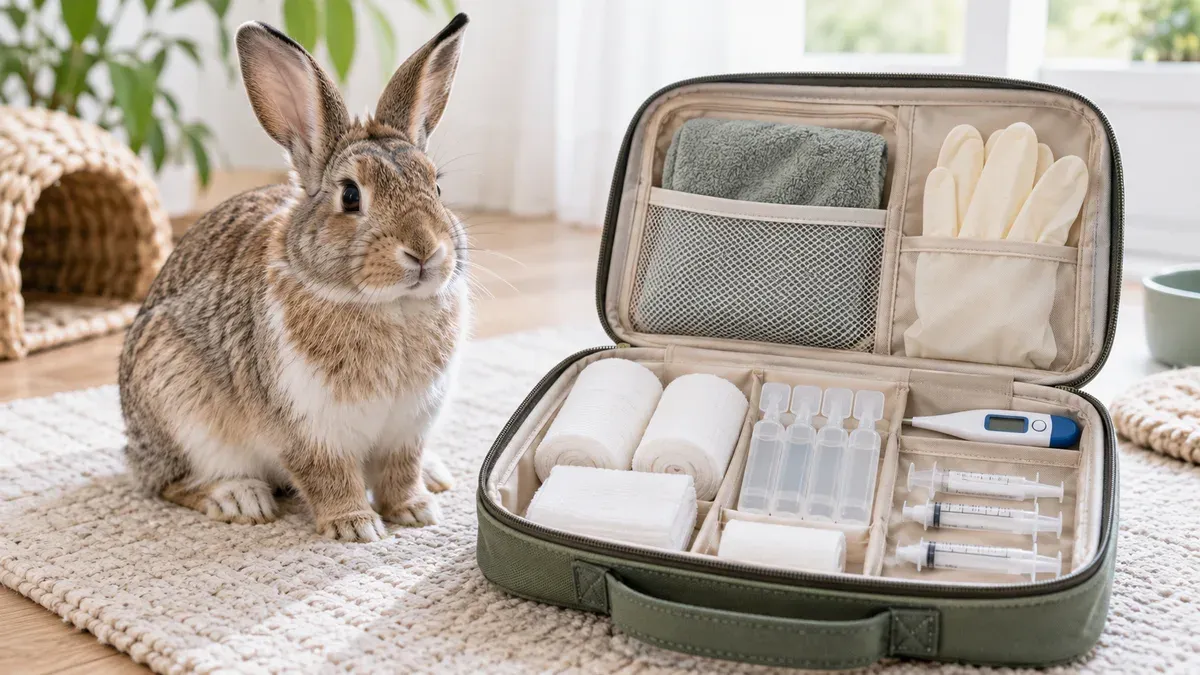
A good rabbit first aid kit holds something to measure with, something to travel in, something to press on a small wound, and something to call with — nothing more. In practice: kitchen scales accurate to the gram, a carrier ready to go, sterile gauze, single-dose saline vials, needle-free syringes reserved for your vet’s instructions, and your exotics vet’s number plus the out-of-hours line written on the lid.
What is missing matters just as much: no human medicines, no leftover prescriptions, no alcohol-based antiseptics. In this species the commonest emergency is not a visible injury anyway, but a rabbit that stops eating and whose gut shuts down — a situation where the only right move is to call, not to open a box (rabbit GI stasis).
What a kit can do — and what it never will
Three real uses:
- Buying time: pressing on a bleed, stopping a nail cut too short, rinsing a soiled eye while you organise the journey.
- Recording: a weight noted down, the time of the last meal, a photo of the litter tray. These are the first things the clinic will ask for.
- Leaving fast: a carrier already fitted out saves the ten minutes spent hunting for a towel and a non-slip mat at the exact moment you should already be driving.
One use to rule out from the start: treating the rabbit yourself. A rabbit that is unwell deteriorates quickly and quietly, and time spent trying a home remedy is almost always time taken from the real treatment.
The core list
| Item | What it is actually for | What it does not replace |
|---|---|---|
| Kitchen scales (1 g) + small tub | Weekly weighing, spotting a loss before it shows | An exam for a rabbit that is losing weight |
| Needle-free syringes (1, 5 and 10 ml) | Giving prescribed medication (the technique is set out here), fluids on instruction | Deciding to syringe-feed on your own |
| Styptic powder or pencil | Stopping the bleed from a nail cut too short | Stitches, or care for a deep wound |
| Sterile gauze + self-adhesive bandage | Pressing on a bleed for the length of the journey | A dressing left in place for days |
| Single-dose saline vials | Rinsing an eye, clearing debris around a wound | Eye drops, which are prescription medicine |
| Clean cotton towel + disposable gloves | Gentle containment, protecting the car | Forceful restraint, which injures |
| Carrier ready, non-slip mat, hay | Leaving in two minutes, travelling without sliding | A journey thought through in advance |
| Unopened recovery food powder | Restarting food intake when the clinic says so | A consultation when the rabbit stops eating |
| Notebook or phone note | Weight, times, droppings, symptoms | Memory, which distorts everything under stress |
| Numbers: exotics vet, out-of-hours, pet taxi | Calling without searching | Finding a rabbit-savvy vet before the emergency |
Styptic powder deserves a special mention: it is the one item on this list you will probably use one day, because a nail cut a millimetre too short bleeds a lot and looks alarming. How to avoid getting there is covered in how to trim a rabbit’s nails.
What must never be in it
This is the most useful part of the article, because these items turn up in a great many home-made kits:
- Human medicines — paracetamol, ibuprofen, aspirin — which must never be given without a veterinary prescription; no home dose can be inferred from this article.
- Leftover prescriptions: an antibiotic from a past episode, a painkiller for another animal, a tube opened a year ago. A dose worked out for a different weight and a different problem is not a stopgap, it is an extra risk.
- Alcohol-based antiseptics, hydrogen peroxide, iodine tincture: painful and harsh on tissue. On a rabbit, anything put on the skin ends up swallowed at the next grooming session.
- Cotton wool, which leaves fibres in a wound. Sterile gauze exists for that reason.
- Essential oils, whether applied or diffused: see are air fresheners dangerous for rabbits.
- Hairball remedies — paraffin oil, pineapple juice, laxatives — which delay the consultation without treating the cause. What genuinely protects a rabbit mid-moult is set out in rabbit swallowing fur.
- A cone bought in advance: a rigid collar stops a rabbit reaching its hay and eating its caecotrophs. Whether one is needed, and which type, is the clinic’s decision.
Four situations, four add-ons
The core kit covers everyday life. Depending on your rabbit and the season, add a module:
- Heatwave. Two frozen water bottles wrapped in cloth, a ceramic tile or cool mat, a mister to dampen the ears with cool, not ice-cold water. No cold baths, no ice packs laid on the body: the exact approach is set out in rabbit heatstroke.
- Coming home from surgery. Spare low-dust bedding, clean syringes, and the prescribed medication in its original packaging. The day-by-day picture is covered for does in caring for a rabbit after spaying and for bucks in caring for a rabbit after neutering.
- Older rabbit. Scales left out rather than stored away, an extra non-slip mat, and a notebook with the weight written down every week (senior rabbit health).
- Travel. A stripped-back version: the usual hay, syringes, gauze, saline vials, health record, and an exotics clinic identified near your destination before you set off (travelling with a rabbit).
The three things worth more than the equipment
A complete kit is useless if these three points are unresolved:
- A rabbit-savvy vet identified before you need one, with their hours and the weekend out-of-hours arrangement. The time to look is not Sunday at 10 pm: how to choose, and how to grade urgency, is covered in when to see an exotic vet for your rabbit.
- A travel plan: who drives, how long the journey takes, what you do if you have no car. A rabbit transported badly arrives in worse shape than it left (how to transport a rabbit by car).
- Your own rabbit’s normal: its usual weight, a day’s worth of droppings, its meal times, its baseline behaviour. It is the gap from that baseline the vet will work with, far more than a general description.
The reflex that matters most
Nothing in the kit changes the central rule: in rabbits, not eating is an emergency in itself. Do not wait for an hourly threshold; call promptly for an unusual reduction and urgently for complete refusal, even if the rabbit seems calm (my rabbit is not eating: what to do).
Pain signals are just as quiet in this species: a hunched posture, flattened ears, slow tooth grinding, unusual stillness. They are set out in how to tell if a rabbit is in pain, and no kit treats them — they get phoned in. Sorting what can wait for an appointment from what means calling within the hour is covered in rabbit emergency signs.
Keeping the kit usable
- One dedicated box, closed, stored next to the carrier — not spread across three drawers.
- A check every six months: expiry dates on saline vials and recovery food, syringes still moving freely, phone numbers still current.
- Restock immediately after each use, while the gap is still obvious.
- The health record in the same place, with vaccination dates (rabbit vaccination schedule) and the history of past treatments.
In summary
- A kit is for measuring, travelling, pressing and calling — not for treating.
- The core: scales, needle-free syringes, gauze, saline, styptic powder, a ready carrier, written phone numbers.
- No human medicines, no leftover prescriptions, no alcohol-based antiseptics.
- Recovery food is given on the vet’s instruction, never on your own initiative.
- More than 8 hours without eating: same-day consultation, whatever the box contains.
Logical next step: put the box together this weekend, write your rabbit’s current weight on the lid, and save your exotics clinic’s out-of-hours number in your phone now. To place a symptom and judge how urgent it is, browse our rabbit health guides and the rabbit species page.
Veterinary sources and reference points
The sources below are used as veterinary or institutional reference points to frame this topic carefully: this article helps you prepare equipment and react quickly, and in no way allows you to treat a rabbit at home.
No dosage is given here: any drug, dose or treatment length is a matter for veterinary prescription.
Sources used to frame these recommendations:
- RSPCA — Rabbit health and welfare
- VCA Hospitals — Gastrointestinal stasis in rabbits
- VCA Hospitals — Rabbits: problems and diseases
- Merck Veterinary Manual — Digestive disorders of rabbits
- PDSA — Heatstroke in rabbits
Frequently asked questions
Can I keep a painkiller in the kit for night-time emergencies?
No. A human painkiller must never be given to a rabbit without a prescription: paracetamol, ibuprofen and aspirin therefore do not belong in a home kit, and leftovers from an old prescription match neither the current problem nor the rabbit's current weight. Drug, dose and duration are the vet's call alone. Write the out-of-hours number on the lid instead.
Do I need a thermometer in the kit?
Only if your vet has asked you to take temperatures and shown you how. In rabbits, a rectal reading means restraining an already stressed animal, and the risk of injury and panic often outweighs the value of the number. Precise observation — eating, drinking, droppings, posture — tells the clinic far more over the phone.
Should I keep recovery food in advance?
An unopened sachet is worth having, as long as you accept it is not something to start on your own. A rabbit that has stopped eating needs a vet's eyes or at least a phone call first: syringe-feeding an animal in pain, dehydrated or with an obstruction can make things worse. The sachet is for when the clinic says to begin, not before.
What should I pack for a weekend away with a rabbit?
The travel version fits in a pouch: the usual hay and pellets in sufficient quantity, a bowl, syringes, sterile gauze, single-dose saline vials, the health record, any current medication in its original packaging, and the contact details of an exotics clinic near where you are staying, looked up before you leave. Everything else can wait.