Caring for a rabbit after spaying: the first days at home
Veterinary warning — The days after a spay are when a rabbit can deteriorate fastest and most quietly. This article explains what to watch at home; it replaces neither your clinic’s discharge instructions nor a phone call to your rabbit-savvy vet at the first doubt.
After a spay, a rabbit should ideally be awake, alert and already eating when discharged by the clinic. At home, she should be kept warm and quiet, given pain relief exactly as prescribed, and have her wound checked once a day. The single most important point: in rabbits, the real post-operative danger is not the incision, it is the gut stopping. A rabbit refusing all food or no longer passing droppings warrants an immediate call to the clinic, even fresh out of surgery.
This article starts the moment you get home. If you are still weighing up the decision, the right age and the surgical options, that ground is covered in should you spay a female rabbit. And if it is a male who has just been operated on, what you watch is different — a scrotal wound in contact with the bedding, fertility that lingers: see caring for a rabbit after neutering.
The first 24 hours: what actually matters
Coming home comes down to four things, in this order.
- Warmth and quiet. Settle her in a comfortably warm room, out of draughts, away from children and other pets, with the lights down. Follow any specific warming instructions from the clinic.
- Hay and water straight away. Put fresh hay within immediate reach and water in whatever container she normally uses. This is not the day to change hay type or pellet brand.
- Eating again. Check that she continues eating from the time she gets home. The first reassuring sign is usually a few strands nibbled, not a cleared bowl.
- Droppings. Look at the tray. Smaller and fewer droppings for 24 hours is common; none at all is not.
If she refuses all food on coming home, call the clinic rather than waiting for an hourly threshold. Her discharge instructions take priority: post-operative gut stasis is a genuine risk in rabbits and is far easier to treat early (see rabbit GI stasis).
Do not leave her alone for long stretches during those first 24 hours. A rabbit hunched in a corner, grinding her teeth or refusing to move is not “sleeping off the anaesthetic” — she is in pain or something is going wrong.
How the first days usually go
| When | What to expect | What warrants a call |
|---|---|---|
| Coming home (day 0) | Awake and alert; may hide but continues to nibble | Refuses all food, passes no droppings or is profoundly dull |
| Day 1 | Eating hay, droppings smaller but present | No droppings at all, tight abdomen, prostration |
| Days 2 to 3 | Appetite close to normal, droppings back to size | Appetite that drops again after picking up |
| Days 4 to 7 | Curious again, moving normally | Wound red, swollen, weeping or open |
| End of week one to week two | Skin healing on track, veterinary check-up | Pain, determined licking, late-onset dullness |
The exact date of the check-up and whether stitches need removing depend on the technique used: your vet sets that timetable, not a general rule.
Checking the wound without touching it
One quick look a day is enough, in daylight, without handling the area. The rule is simple: look, do not clean, do not apply anything. No cream, no antiseptic, no spray without an explicit instruction from your vet — whatever you put there ends up swallowed at the next groom.
| What you see | What it means |
|---|---|
| Thin pink line, dry, slightly raised in the first days | Ordinary healing |
| Small bruise around the incision | Common, not alarming on its own |
| Spreading redness, heat, increasing swelling | Have it looked at |
| Weeping, discharge, smell | Have it looked at without delay |
| Open wound, stitches pulled out, visible tissue | Emergency, call immediately |
Watch for what does not show on the skin, too: in rabbits a complication often begins as a change in behaviour — stillness, refusing hay, teeth grinding — before any local sign appears.
Pain: the most underestimated part
A rabbit does not complain. She hunches, half-closes her eyes, holds her ears flat, grinds her teeth, declines to move. Those quiet signals are set out in how to tell if a rabbit is in pain, and they matter as much after surgery as at any other time.
Three safety rules, no exceptions:
- Finish the prescribed pain relief, even if she seems fine. Stopping early is a classic cause of the appetite dipping again on day two or three: pain stops eating, and stopping eating stops the gut.
- Never give human medicines — paracetamol, ibuprofen, aspirin — or leftovers from another animal’s treatment. Drug choice, dose and duration are veterinary prescriptions, full stop.
- Do not adjust doses yourself, whether she looks too sleepy or not comfortable enough: that is a call to the practice, not a home adjustment.
If this is your first time giving a syringed treatment, the hold and the exact technique are described in how to give a rabbit medication.
Setting up the space for recovery
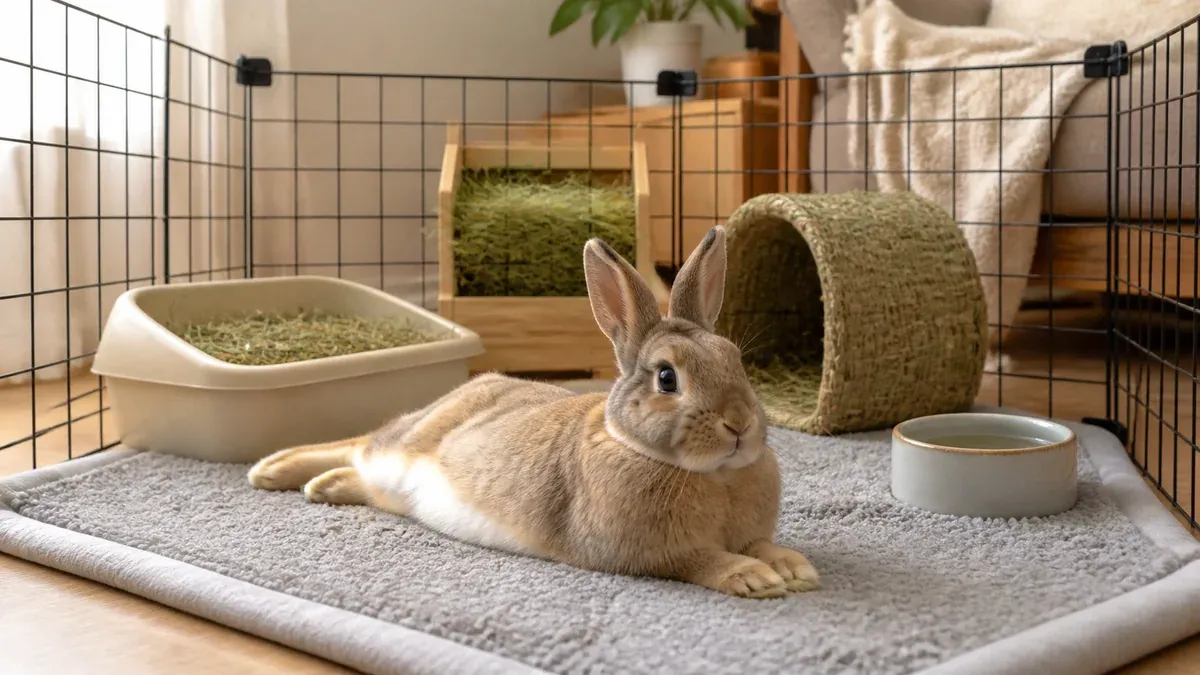
The aim is not to immobilise her — it is to remove the movements that pull on the incision while keeping the gut working.
- Take away height for now: platforms, levels, jumps onto the sofa. The rest of the floor space stays available.
- Switch to low-dust bedding, paper or cellulose, while the wound heals: dust and fine shavings stick readily to a fresh incision.
- Clean the tray more often than usual during this period, to keep the area clean without ever touching the wound itself.
- Keep the floor non-slip: bare tiles make an unsteady rabbit skid.
- Do not cut out movement altogether. Gentle pottering keeps the gut going; it is jumping and dashing about you want to avoid, not walking.
Bowls, hay and water should all be on one level and within immediate reach, so nothing stands between her and food.
What about her companion?
If she lives with another rabbit, separating them is not a neutral act: a few days apart is sometimes enough to break a bond built over months. The usual compromise is to keep them in sight and smell of each other, in two adjoining spaces, and reunite them as soon as your vet agrees. If the companion grooms the wound or mounts her, separation becomes necessary — decide that with the clinic rather than by guesswork.
What not to do
- Fasting her, before or after: a rabbit’s gut must never stop, and the pre-op fasting rule for cats and dogs does not apply.
- Waiting until tomorrow because “she has just had surgery” when she has not eaten for hours.
- Confining her to a tiny cage for a week: complete immobility encourages stasis and sore pressure points.
- Changing her food for a recovery formula bought on your own initiative.
- Bathing or wetting the area, or trying to lift a scab.
- Restarting full run sessions too soon, before the check-up gives the go-ahead.
When to call urgently
Call without waiting, including evenings and weekends, if you see:
- no droppings for several hours, or a tight, painful abdomen;
- a complete refusal to eat, without waiting for an arbitrary time threshold, as covered in my rabbit is not eating;
- fast breathing, cold extremities, a rabbit lying flat and unresponsive;
- an open, weeping or clearly swollen wound;
- dullness that appears after a phase of improvement.
Going further
Logical next step: write down the time of her first meal and roughly how many droppings you find each day for three days. That small record is what catches a relapse before it becomes an emergency. To place a specific sign and judge urgency, browse our rabbit health guides, the rabbit species page and when to see an exotic vet.
Veterinary sources and caution notes
The sources below serve as veterinary or institutional reference points to frame the topic cautiously: this article helps you monitor recovery at home, but only the vet who performed the surgery can adapt the instructions, the treatment and the check-up schedule.
No dosage appears here: every drug choice, dose and treatment length belongs with the veterinarian.
Sources used to frame the recommendations:
- RSPCA — Rabbit health and welfare
- Rabbit Welfare Association & Fund — Neutering: castration and spaying
- ASPCA — Caring for your rabbit after surgery (PDF)
- VCA Hospitals — Gastrointestinal stasis in rabbits
- VCA Hospitals — Rabbits: problems and diseases
- Merck Veterinary Manual — Digestive disorders of rabbits
Frequently asked questions
Does a rabbit need a cone or collar after being spayed?
Not as a matter of course, and it is your vet's call. A rigid collar is badly tolerated by rabbits: it stops them picking up hay and eating their caecotrophs, both essential to keeping the gut moving. Many rabbit-savvy vets prefer close monitoring of the wound, adding a soft protection only if the rabbit really works at the site.
My rabbit is licking her incision — is that a problem?
An occasional lick in passing is ordinary. Persistent attention is not: a rabbit that keeps returning to the wound, pulls at stitches or strips the fur around it is usually telling you the area hurts or itches. Call the practice rather than improvising a dressing or a product, which will simply be swallowed at the next grooming session.
My rabbit is still territorial after her spay — is that normal?
Yes, in the first few weeks. Hormones already circulating do not vanish on the day of surgery: marking, mounting or tray guarding can linger before fading. Hormonal behaviour that has not shifted at all after several months is worth raising with your vet at the check-up.
Should I feed extra pellets to help her recover?
No. The priority is getting hay and water going again, not adding calories. A bigger pellet ration fills the stomach and pulls her away from hay, which is the opposite of what a fragile gut needs. Offer her favourite greens and two or three different hays instead to trigger appetite.