How to give a rabbit medication at home
Veterinary warning — This article explains a technique, never a prescription. No drug, dose or treatment length can be inferred from it: those belong to the rabbit-savvy vet treating your animal. Never give a human medicine, and never reuse a prescription written for another pet.
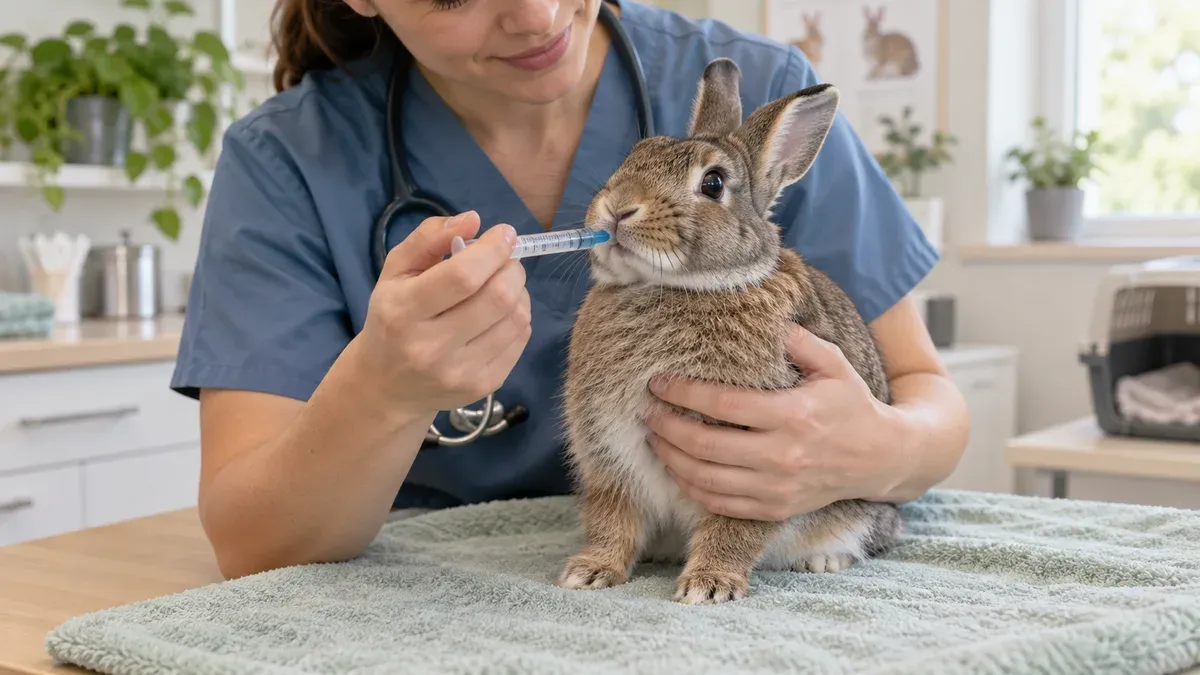
Liquid medication is given to a rabbit with a needle-free syringe, slipped in at the side of the mouth into the toothless gap behind the incisors, in small amounts, with the rabbit on the floor and steadied against you — never lifted, never scruffed. Rabbits cannot vomit, so give it time to swallow between pushes and never empty the syringe in one go.
Everything else comes down to three rules: never change a prescription on your own, never stop because “she seems better”, and call the clinic as soon as your rabbit consistently refuses treatment or stops eating. Do not wait for an hourly threshold: an unusual reduction warrants a prompt call and complete refusal is an emergency, treatment or no treatment (my rabbit is not eating).
Three questions to ask before you leave the clinic
They prevent half the problems that show up at home:
- Which formulation and which route? Oral liquid, tablet, eye drops, ear drops, spot-on pipette, injection — the technique changes completely, and some products designed for dogs or cats are not suitable for rabbits at all.
- What do I do about a missed or spat-out dose? The answer depends on the drug. Asked at the appointment it takes ten seconds; asked on a Sunday night it becomes an emergency phone call.
- Which effects should make me ring back? Reduced appetite, softer or fewer droppings, dullness: knowing which are expected and which are not stops you abandoning a useful treatment out of misplaced caution.
Ask for a demonstration while you are there. Watching the vet or nurse do it once beats every written description, this one included.
Handling: what works, what causes injury
A rabbit struggling above ground level can injure itself badly — the hind end is powerful and the spine is fragile. Hence four principles:
- On the floor, always. Sit down, rabbit between your legs or braced against your thigh, its hindquarters against a wall or cushion so it cannot reverse away.
- Never by the scruff. Lifting a rabbit by the back of the neck, even “like a cat”, is painful and unsafe in this species.
- Wrapped if needed. A towel laid diagonally, the body swaddled, head and nose free: the burrito wrap limits scratching and stress. It must never compress the chest.
- Two people where possible. One holds, one gives the dose. The whole thing then takes seconds instead of a minute of wrestling.
A rabbit already used to being handled tolerates all of this far better. If yours panics the moment you approach, work on handling calmly outside treatment times rather than discovering the problem on the evening of the first dose.
Formulation by formulation
| Formulation | The technique | The common mistake |
|---|---|---|
| Oral liquid | Needle-free syringe at the side of the mouth, behind the incisors, in small successive amounts | Squirting fast towards the throat, risking aspiration |
| Tablet | Never crush or split without the vet’s approval; ask whether a liquid version exists | Crushing a modified-release tablet, which changes the whole treatment profile |
| Eye drops | One hand steadies the head, the other eases the lower lid down; the bottle never touches the eye | Aiming straight at the cornea, so the eye shuts and the dose is wasted |
| Ear drops | Apply at the entrance of the canal, then massage the base of the ear for a few seconds | Pushing the nozzle into the canal or cleaning with a cotton bud |
| Spot-on pipette | Part the fur at the base of the skull, apply to skin, prevent grooming until dry | Using a dog or cat antiparasitic that is not validated in rabbits |
| Injection at home | Only after a hands-on demonstration, with the equipment supplied | Improvising from a video found online |
Spot-ons deserve particular care: several over-the-counter parasite products are potentially toxic in rabbits, fipronil-based ones first among them. The detail is in fleas in rabbits.
Oral liquid, step by step
It is the most common formulation, and the one where technique genuinely changes the outcome.
- Set up before you pick the rabbit up: dose drawn, syringe wiped, towel ready, suspension shaken if the label says so. A rabbit held still while you hunt for the bottle has already lost patience.
- Get down on the floor, rabbit braced against you, hindquarters blocked.
- Slide the syringe in from the side, into the toothless gap between incisors and molars, tip angled towards the cheek rather than the throat.
- Push in small amounts, letting the rabbit swallow between each. Rabbits cannot vomit: aspiration is prevented, not corrected.
- Let go as soon as the dose is in, then offer something it likes straight away — a sprig of greens, a fresh handful of hay. The session ends on an acceptable note.
- Write down the time on a note taped to the box. With twice-daily dosing and more than one person in the house, a double dose happens more easily than you would think.
Rinse the syringe with clean water after each use, follow the storage instructions (some preparations are refrigerated, others are not), and keep the bottle in its original packaging with the prescription.
When your rabbit refuses: sort the cause first
Refusal is not stubbornness, and what to do depends on why:
- A technique problem — the rabbit twists away and half the dose runs down its chin. Rework the hold, change position, get a second pair of hands. This is the most common case and the easiest to fix.
- A taste problem — it takes the syringe, then shakes its head and drools afterwards. Report it: many treatments come in different flavours or can be reformulated.
- A rabbit that is getting worse — it used to accept the dose and no longer does, eats less, sits hunched. That is no longer an administration problem but a clinical sign: call the same day. Pain signals in this species are subtle, and they are listed in how to tell if a rabbit is in pain.
Either way, a missed dose gets reported, not quietly made up.
What you must never do
- Give a human medicine — paracetamol, ibuprofen and aspirin above all — even “just once”, even at a reduced amount.
- Reuse leftover prescriptions, your rabbit’s or another pet’s. Some antibiotics that are routine in dogs and cats, oral penicillins in particular, severely disrupt a rabbit’s gut flora; choosing the drug is a veterinary act in itself.
- Stop as soon as things improve. A course abandoned because “the rabbit is fine now” invites a relapse and, with an antibiotic, encourages resistance. The length is set by the prescription, not by how the animal looks.
- Double up a missed dose to catch up.
- Force a panicking rabbit: beyond the fracture risk, every failed session makes the next one harder.
- Improvise an injection or home pain relief based on a forum thread.
After the dose: what to watch
The first few days of a new treatment deserve close attention, tracked in three simple ways:
- What it eats, and above all whether it is still touching its hay.
- Its droppings: rough number and appearance. Smaller, fewer or softer droppings get reported to the clinic rather than saved for the follow-up appointment.
- Its behaviour: a rabbit sitting hunched in a corner, grinding its teeth slowly or refusing to move does not wait for the follow-up appointment.
These observations are worth as much as the treatment itself — they are what lets the vet adjust. To judge when a sign becomes urgent, use when to see an exotic vet for your rabbit.
The post-surgery case
This is when most owners give medication at home for the first time. Two extra reflexes apply: finish the prescribed pain relief to the end rather than stopping the moment the animal looks comfortable, and treat the return of appetite as the real indicator of the day. The full timeline is in caring for a rabbit after spaying.
Going further
Logical next step: set up a care corner today — clean syringes, a towel, a dosing log taped to the box — and check the out-of-hours number is written on it. To round out the equipment, see what belongs in a rabbit first aid kit, and to place a symptom, browse our rabbit health guides and the rabbit species page.
Veterinary sources and reference points
The sources below are used as veterinary reference points to frame this topic carefully: this article describes how a treatment is administered, and does not allow you to choose a medicine, a dose or a duration.
No dosage is given here: any drug, dose or treatment length is a matter for veterinary prescription.
Sources used to frame these recommendations:
- RSPCA — Rabbit health and welfare
- VCA Hospitals — Rabbits: problems and diseases
- Merck Veterinary Manual — Digestive disorders of rabbits
- Merck Veterinary Manual — Disorders and diseases of rabbits
Frequently asked questions
Can I mix the medicine into banana purée or recovery food?
Only if your vet clears it for that specific treatment. Two catches: some drugs are absorbed differently alongside food, and a sick rabbit often eats less, so the dose ends up in the bin with the refused portion. Where it is allowed, mix the dose into a very small amount eaten in front of you — never stir it through the day's ration and hope for the best.
What should I do if my rabbit spits part of the dose out?
Do not top it up yourself: there is no way to judge how much went down, and doubling a dose is a real risk. Note the time and roughly how much was lost, then ask the clinic what to do — they know whether that dose should be repeated, and it depends on the drug. Repeated spitting usually points to technique, to the taste of the product, or to a rabbit whose condition is slipping.
Should the treatment be given before or after a meal?
The prescription decides, and it varies by drug. With no instruction, consistency matters most: the same slots every day, written on a note taped to the box. One thing is constant in rabbits — a treatment must never cost the animal a meal, because stopping eating is more dangerous than a late dose.
My rabbit struggles so hard I'm afraid of hurting it. What now?
Stop, put it down on the floor and ring the clinic. A panicking rabbit can fracture its own spine kicking out, and that is not a theoretical caution. Vets can often switch formulation, flavour or dosing rhythm, or show you the handling in person. A missed dose can be sorted out; a spinal fracture cannot.