How many hours of exercise does a rabbit need every day?
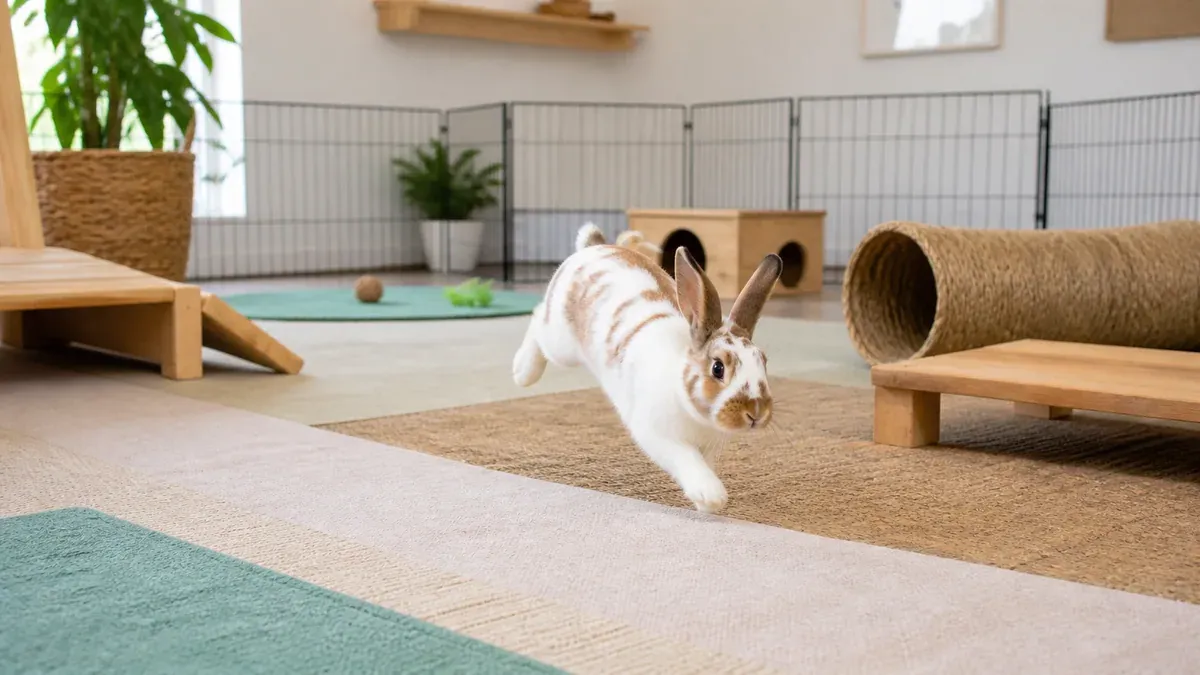
A rabbit needs at least 3 hours out of its base pen every day, and more whenever possible, with permanent access to a wider area as the ideal. That time is not a luxury: it maintains muscle, bone, gut motility and behavioural balance. The most effective approach is not chasing a number but placing those sessions at the right time of day, in a space where the rabbit can actually get up to speed.
How many hours out of the pen at minimum?
Allow 3 hours a day at minimum, and more if your routine allows: that is the floor set by the PDSA. Those hours are spent in an exercise area clearly larger than the night pen, where the rabbit can run, jump and dig. Free, permanent access to that area remains the best setup.
The matching floor areas by body size are set out in what size enclosure for a rabbit.
That floor comes with two limits worth knowing:
- It does not replace the base space. Four hours of freedom do not offset twenty hours in a cramped cage: the rabbit must be able to stand up, stretch out and take a few hops even in its permanent space.
- It counts useful time, not open-door time. A pen door opening onto an 80 cm corridor the rabbit never uses is not run time.
Where the home allows it, free access to a rabbit-proofed room for much of the day remains the ideal — an arrangement covered in can a rabbit live cage-free full time.
Why those hours genuinely matter
A rabbit that moves little accumulates concrete problems, not just boredom:
- Muscle and bone: inactivity causes muscle wastage and weakens the skeleton, especially in a rabbit that has never had a real running area.
- Gut motility: movement supports digestive activity. A sedentary rabbit is at greater risk of a slowdown in gut transit.
- Weight: too little exercise is a classic cause of weight gain, alongside excess pellets.
- Behaviour: bar chewing, compulsive digging, restlessness before meals and constant demands are often symptoms of run time that is too short or too unpredictable.
- Joints: in an ageing rabbit, immobility speeds up stiffening. It is one of the first things to watch in a senior rabbit.
What matters as much as the duration
Consistency
Rabbits anticipate schedules remarkably well. Two daily sessions at the same times beat one long improvised session every other day: consistency lowers anticipatory restlessness, and the rabbit stops demanding attention constantly once it knows when its turn comes.
Time of day
Rabbits are crepuscular: they are naturally most active early in the morning and towards the end of the day. A session timed to those peaks is used far better than one in mid-afternoon, which is usually spent asleep.
Floor area and surface
A clear room where the rabbit can build up speed in a straight line beats a cluttered maze. Avoid bare tiles and varnished wood, on which rabbits skid and hesitate to launch: a rug or cork tiles are enough to unlock sprints and binkies.
What is in the space
An empty room attracts nothing. A tunnel, a cardboard box with holes cut in it, a digging area and hay spread across several spots turn a passive session into an active one — see how to keep a bored rabbit busy.
Organising the day when you work
The pattern that works best in a busy household:
| Time | Indicative duration | What happens |
|---|---|---|
| Morning, before leaving | 1 h to 1 h 30 | Natural activity peak, running and exploring |
| Daytime | — | Base pen, unlimited hay, self-directed activities |
| Late afternoon or evening | 2 h to 3 h | Second peak, interaction, enrichment session |
Two slots are enough to clear the 3-hour floor. If your schedule blocks it on some days, that is not a disaster: what counts is the weekly average, not daily perfection.
Adjusting run time for age and circumstances
The 3-hour floor applies to a healthy adult. Three cases call for changing the format rather than the duration:
- Young or newly adopted rabbit: it may refuse to come out for the first few days. Leave the door open onto a small, quiet area and let it come out on its own, without carrying it; widen the space once it explores without freezing (see why does my rabbit hide all the time).
- Older or arthritic rabbit: ask your vet to adapt the duration and intensity to your rabbit’s mobility and pain. Offer sessions on fully non-slip flooring, with no steps or ledges to climb, and never force the rabbit to move.
- Rabbit after surgery or when unwell: how much exercise, and what kind, is then down to your vet, who may ask for strict rest while it heals. Do not go back to the usual sessions without their go-ahead.
If you cannot manage those hours
Three solutions, in order of effectiveness:
- Enlarge the base space rather than stretching the sessions. A pen of several square metres changes a rabbit’s life more than one extra hour of freedom.
- Open up a rabbit-proofed room for free access while you are out, once proofing is complete (cables, plants, products, furniture).
- Adopt a companion, if your situation allows: two bonded rabbits keep each other active and cope far better with long stretches without people.
What does not work: compensating with food, or assuming the rabbit “rests anyway” — an under-stimulated rabbit does sleep more, but that sleep is not a sign of wellbeing.
Signs that run time is too short
- It chews the bars or rattles the pen door at fixed times (see why does my rabbit chew the bars).
- It digs frantically in one corner of the pen, always the same spot.
- It bolts out of the pen the moment it opens, then runs laps for several minutes.
- It gains weight although the ration has not changed.
- It becomes listless, with no interest in what is offered.
One of those signs on its own proves nothing; two or three together justify lengthening and regularising the sessions before looking any further.
When it is no longer about run time
A rabbit that used to move normally and suddenly refuses to come out, stays hunched or moves stiffly is not short of exercise: it is probably in pain. Do not try to get it moving: contact a vet promptly and check it against how to tell if a rabbit is in pain. If it stops eating or stops passing droppings, contact a vet straight away: that is an emergency.
Common mistakes
- Opening the pen while the rabbit is chewing: you reward the behaviour and it will stick.
- Counting a session in an unproofed room: you spend it calling the rabbit back and cut it short out of caution.
- Running a rabbit on a slippery floor: it will not launch itself, however long the session lasts.
- Cutting run time for an old or overweight rabbit: those are precisely the rabbits that need it most, with adapted areas and non-slip flooring.
Going further
Logical next step: honestly time your rabbit’s real freedom over three days. The gap with your initial estimate is usually instructive. To prepare the room before extending sessions, see how to rabbit-proof a room. And if the hard part is not getting your rabbit out but getting him back in, the routine to build is in my rabbit won’t go back in its pen. All our guides are gathered in rabbit housing and on the rabbit species page.
Welfare sources and benchmarks
These benchmarks rely on sources that explicitly cover the 3-hour daily exercise floor, the morning and late-afternoon activity peaks, and the need for several hours out of the enclosure.
- PDSA — How should I exercise my rabbit?
- RSPCA — Rabbit health and welfare
- RSPCA — Caring for senior rabbits
- House Rabbit Society — Living with a house rabbit
- House Rabbit Society — How to care for a pet rabbit
Frequently asked questions
Can a very large pen replace daily run time?
Only partly, and only if the space is genuinely large. A pen of several square metres, laid out with distinct zones and non-slip flooring, reduces the need for counted sessions. But a rabbit that never leaves its pen loses sensory novelty and the chance to run in a straight line: a generous base space plus regular access to a wider area remains the better setup.
Do I have to supervise my rabbit for the whole session?
Not necessarily, provided the area is genuinely rabbit-proofed: cables protected, toxic plants out of reach, cleaning products shut away, no access to skirting boards or fragile furniture. Until proofing is finished, direct supervision is essential — a short supervised session beats a long one in an unprepared room.
My rabbit just lies down during its session — is it wasted?
No. Rabbits do not run continuously: they alternate exploring, resting and short bursts of speed. If yours leaves the pen willingly, settles relaxed in the room and moves about now and then, the session is doing its job. What should prompt questions is a rabbit that refuses to come out or stays frozen in the same spot every time.
Does time in the garden count as exercise?
Yes, provided the area is enclosed and safe: buried mesh or a mesh floor against digging, a roof against predators and cats, shade, water, and no toxic plants or treated lawn. Supervise your rabbit throughout every outdoor session, even in a covered, predator-proofed area. Keep it for mild days and never leave a rabbit outside in full sun without shelter: heat puts it in danger quickly.