Why does my rabbit hide all the time? How to tell what it means
Veterinary note — This article helps you tell ordinary withdrawal from a sign of pain or illness. It does not replace a clinical examination. A rabbit that hides and eats less, produces fewer droppings or sits still and hunched needs to be seen promptly by a rabbit-savvy vet.
A rabbit that hides is doing nothing unusual: in a prey species, taking cover is the default resting behaviour, and rabbits spend much of the day out of sight. The real question is not “why is it hiding?” but “since when, and in what condition?”. Withdrawal that has been there since adoption is a matter of trust and setup; withdrawal that appeared within a few days in a rabbit that used to come out is a medical hypothesis first.
Before interpreting anything, gather three concrete facts: has the hay been eaten, are there normal numbers of droppings spread outside the hide, and does the rabbit move around at dusk? Those three pieces of evidence beat any impression formed mid-afternoon, exactly when a healthy rabbit is asleep.
Hiding is normal — here is what is not
A healthy rabbit alternates between resting under cover and periods of activity, mostly at dawn and dusk. It uses its hide to sleep, to digest, to keep watch, and it comes out by itself once the room is quiet.
Three things are not normal:
- It never comes out at all, not even at night, not even to eat.
- It used to come out and no longer does: the change is recent and clear-cut.
- It stays hidden without sleeping: hunched, motionless, eyes open, never relaxing or stretching out.
The last point is the most misleading. A relaxed rabbit flops, stretches, lets its back legs trail behind it. A rabbit that stays tense at the back of its hide for hours is not resting: it is on alert, or in pain. Posture-by-posture decoding is set out in how to read rabbit body language.
Sorting it out: since when, and in what condition?
| What you observe | Most likely reading | What to do |
|---|---|---|
| Hidden by day, active and eating at dusk | Normal species rhythm | Nothing, just watch at the right hours |
| Hidden constantly since adoption (under 3 weeks) | Settling-in phase | Give it time, cut noise and demands |
| Always been hidden, eats normally, comes out at night | Low confidence or an unreassuring room | Change the setup, then work on trust |
| Rarely hid before, has been hiding for a few days | Pain, illness, or fear tied to a specific event | Check hay and droppings, call the vet if either drops |
| Hidden and eating less, fewer droppings, hunched posture | Medical signal | Same-day veterinary contact |
| Hides only around certain people, or another animal | A learned association with a threat | Change the conditions of contact, not the rabbit |
Rows four and five govern everything else: while a medical doubt remains, behaviour work waits. Trying to tame a rabbit that hurts achieves nothing but frustration on both sides.
The first question is medical, not behavioural
A rabbit in pain withdraws before it shows anything else: that is the concealment mechanism common to prey species, described in how to tell if a rabbit is in pain. Faced with recent withdrawal, run this check in a few minutes:
- The hay: how much has actually been eaten since yesterday, not how much was offered.
- The droppings: number, size and regularity. Smaller or scarcer droppings count as much as none at all.
- The posture: hunched rabbit, feet tucked under the body, eyes half closed.
- Tooth grinding: slow and heavy, it signals pain, and should not be confused with the soft purring of contentment.
- Breathing and head position, if either looks unusual.
A single abnormal item is enough to move from the behavioural to the medical register. If the rabbit has stopped eating, go straight to rabbit not eating: what to do; to place the level of urgency, the full triage is in when to see an exotic vet for your rabbit.
What in the room keeps a rabbit hidden
Once health is ruled out, the environment explains most lasting withdrawal. The commonest causes are physical, and all of them are fixable:
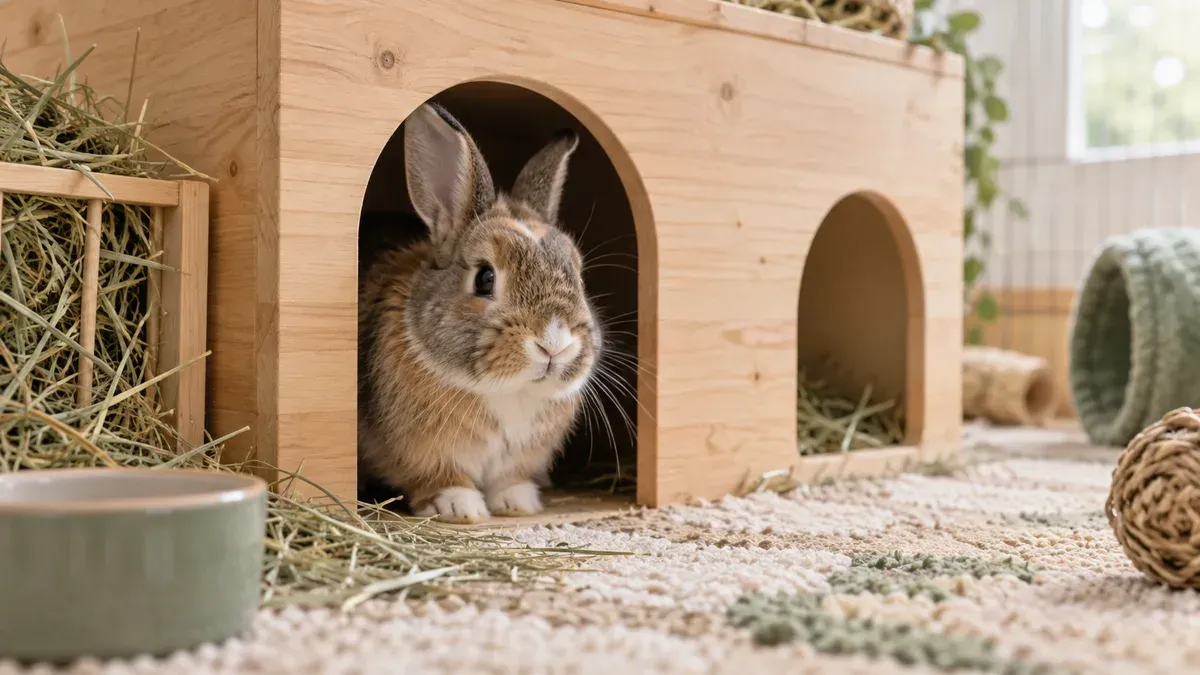
- A hide with a single opening. From the rabbit’s point of view, a shelter with no second exit is a trap: it will go in, but it hesitates to come out when someone approaches. Two openings change how it gets used.
- Open space with no staging posts. A large empty room forces the rabbit to cross exposed ground. A couple of tunnels, a cardboard box open at both ends and a low piece of furniture are enough to create a protected route.
- A slippery floor. A rabbit that skids does not venture out: polished boards and tiles are genuine deterrents, as explained in the best floor surface for rabbits.
- Noise and traffic. A loud television, the vacuum cleaner, constant coming and going, children on the move: the living area needs a quiet corner away from the through route.
- A perceived predator. A cat or dog watching, even without aggression, is enough to keep a rabbit on alert. It needs a zone where it is not being looked at.
- A recent change: a house move, new furniture, a new pet, building work. Settling back down takes several days, and the procedure for a move is set out in moving house with a rabbit.
The aim is never to remove hiding places, but to multiply them and make the trip between them reassuring. The principles of a usable space are covered in how to set up an indoor pen for a rabbit and how to rabbit-proof a room.
The rabbit that has just arrived
A newly adopted rabbit almost always hides for the first few days, and that is the expected behaviour. What matters is the trend, not the speed:
- Days 1 to 3: night-time outings only, normal eating, limited exploring.
- Week 1: longer outings, droppings spread over a wider area, curiosity about objects.
- Weeks 2 and 3: time spent outside the hide even while you are in the room, at a distance.
If nothing has progressed after three weeks in a stable home, or if the rabbit has been eating little from the start, have it examined before continuing any trust work. Once health is clear, the step-by-step method — presence without contact, hand on the floor, food as a mediator — is set out in how to tame a fearful rabbit and does not need reinventing here.
What not to do
- Pulling the rabbit out of its hide, or grabbing it as it takes cover: the fastest way to turn a refuge into a conflict zone.
- Removing or blocking the hide to “make” it come out. It will retreat under the furniture instead, out of reach and out of sight.
- Waking it during the day to check it is fine: watch at dusk, when it is meant to be active.
- Bringing in a stream of visitors during the first weeks.
- Chasing it to pick it up. Reluctance to be carried is instinctive, as my rabbit doesn’t like being picked up explains.
One exception: if you need to catch the rabbit for travel or treatment, do not do it deep inside its shelter. Move the operation to an open area, or let it walk into its carrier by itself.
Checking whether it comes out while you are away
Three objective clues are enough, and all three can be read in the morning without disturbing the animal:
- Where the droppings are: concentrated inside the hide, they point to a rabbit that does not leave it; spread around the room or in the tray, they prove the opposite.
- The hay rack: a noticeably emptier rack in the morning is the best evidence of night activity.
- Objects moved: a pushed bowl, a rucked-up mat, a tunnel in a new place.
If all three look good, your rabbit is probably fine and simply lives on hours that are not yours. If they look bad, you have objective information to give the vet, which beats an impression. To judge more broadly whether its life meets its needs, the seven-day review in how to tell if a rabbit is happy takes over from here.
When to see a vet
- Same day: the rabbit stays hidden and eats less, passes fewer droppings, grinds its teeth slowly or sits hunched.
- Straight away: no droppings, a tense abdomen, laboured breathing, a rabbit sitting withdrawn — the full criteria are in rabbit emergency warning signs.
- Book an appointment: withdrawal that settles in over several weeks with no other sign, or a rabbit that has hidden since a specific event and never returned to its previous behaviour.
Where to go next
A concrete next step: tomorrow morning, before feeding, note three things — hay eaten, roughly how many droppings, and where they are. Two mornings are enough to tell a discreet rabbit from a rabbit that no longer comes out. Only then work on the environment and on trust with how to tame a fearful rabbit, and give it reasons to come out with how to keep a bored rabbit busy. Our other guides are gathered in the rabbit behaviour section and in the rabbit species profile.
Sources and references
- RSPCA — Rabbit health and welfare
- PDSA — How should I exercise my rabbit?
- VCA Hospitals — Rabbits, diseases and problems
Frequently asked questions
Should I take away the hiding place if my rabbit never leaves it?
Never. A rabbit denied a refuge does not become more sociable: it simply retreats somewhere else, usually somewhere less reachable and less safe, such as under a piece of furniture. The hide is not the cause of the withdrawal, it is the consequence. The right move is to add a second one, closer to where the family lives, so that coming out gradually costs less.
My rabbit only comes out at night. Is that a problem?
No. Rabbits are most active at dawn and dusk, and a good share of their activity happens while the house sleeps. Many owners believe their rabbit stays hidden permanently when they are simply watching at the wrong hours. Droppings spread around the room and hay eaten overnight settle the question far better than daytime observation.
How long does a newly adopted rabbit take to come out of hiding?
Anywhere from a few days to two or three weeks, depending on its history. What should improve is the time spent outside the hide and the area explored, not necessarily contact with you. A rabbit that after three weeks in a stable home still does not come out even at night, and eats little, needs a veterinary check before any behaviour work.
My rabbit only hides when my children are around. What should I do?
That is useful information, not sulking: the rabbit associates their presence with noise, fast movement or attempts to pick it up. The rule that changes everything is that the hide stays off limits to everyone, children included, and that interaction happens at floor level with no chasing and no handling. Splitting the tasks by the child's age is covered in our dedicated guide.