False pregnancy in rabbits: how to recognise it and what to do
Veterinary note — This article describes a common hormonal behaviour and what to do at home. It cannot reliably distinguish a false pregnancy from a real one, or from a uterine or mammary condition. A doe that eats less, sits hunched and still, or has mammary glands that are hot, hard or painful must be examined by a rabbit-savvy vet.
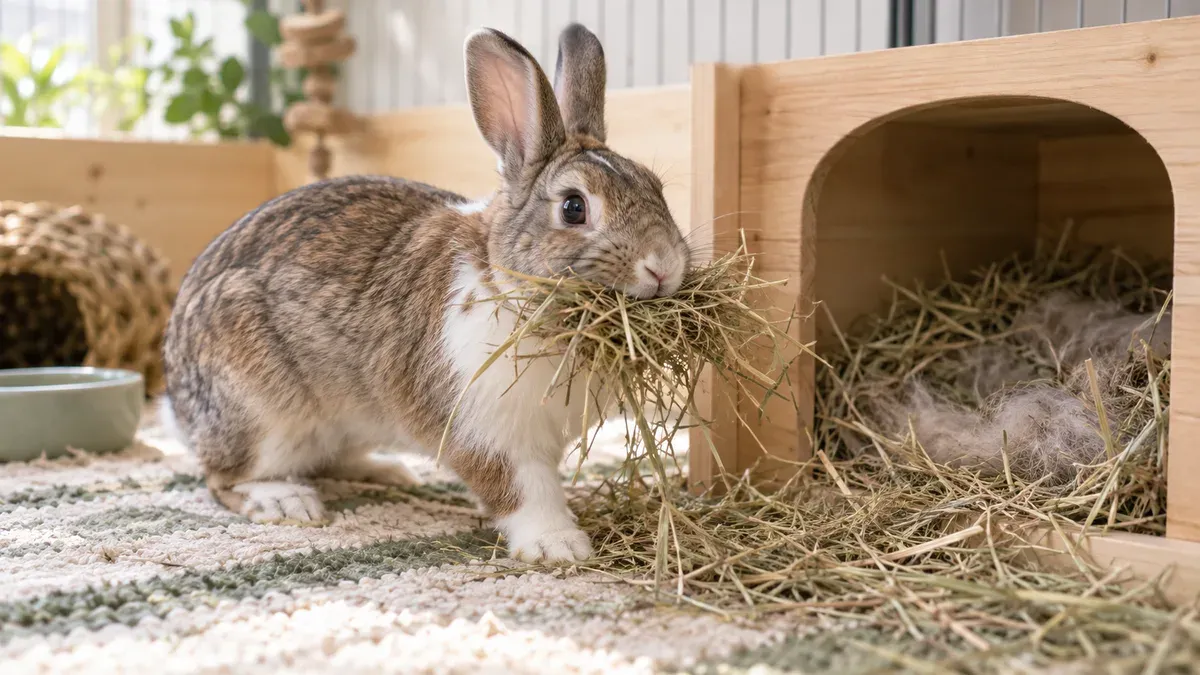
A doe that carries hay in her mouth, digs at the same corner and pulls tufts of fur from under her chin is showing signs compatible with false pregnancy, also called pseudopregnancy. But the same signs occur in real pregnancy: behaviour alone cannot distinguish them.
Two checks still come before everything else. Rule out a real pregnancy — contact with an intact male, however brief, however unlikely, changes the whole picture — and confirm she is still eating and still producing droppings. As long as those two hold, the episode is supported, not treated.
What a false pregnancy actually is
In rabbits, ovulation is induced notably by mating. When ovulation occurs without fertilisation, hormonal changes can trigger pseudopregnancy and nesting behaviour.
That explains an observation that throws many owners: a doe living alone, who has never met a buck, can have a false pregnancy. Mounting by another rabbit can be involved. The behaviour is therefore a hormonal signal, never proof that fertilisation occurred.
The episode concerns an unspayed doe, generally from sexual maturity onwards, reached between 4 and 6 months depending on the individual. It is also one of the reasons that come up most often in the decision to spay, set out in should you spay a female rabbit.
The signs that define it
| What you observe | What it looks like | What should worry you on top |
|---|---|---|
| Carrying hay or straw | She moves about with a mouthful, always towards the same corner | Nothing in itself: this is the most typical sign |
| Fur pulling | Tufts taken from the dewlap, belly and flanks, laid in the nest | Raw skin, a wound, or fur pulled somewhere other than the nest |
| Intense digging | One precise corner, scraped insistently, bedding pushed back | Broken claws, bleeding paws |
| Guarding the corner | Grunting, boxing, lunging when a hand comes near | Aggression that persists after the episode ends |
| More visible mammary glands | Prominent glands, sometimes a little milk | A gland that is hot, hard, red or painful: appointment |
| Reduced appetite | She eats less or leaves her hay | Call immediately; do not wait for an hourly threshold |
The nesting behaviour is the most readable of all: the doe picks an enclosed spot, piles hay into it, then lays the pulled fur over the top. The digging that goes with it belongs to the same hormonal register as the one described in why does my rabbit dig everywhere, except that here it is concentrated on a single area and paired with carrying material.
The grunting and boxing often surprise owners of a previously easy-going doe. They signal neither a change of character nor failed training: this is nest defence, occasional and contextual. The full reading of those signals is in why does my rabbit grunt and how to read rabbit body language.
Rule out a real pregnancy first
This is the only genuinely urgent question, and it is worth asking even when it seems absurd.
- Contact with an intact male, however brief, is enough. A shared run of a few minutes, a stay with a friend, a visit to someone who keeps a rabbit: it happens more often than people assume.
- The sexing may be wrong. A “male” sold as such may be a female, and the other way round. Sex is confirmed by a vet, as male or female rabbit and buying a rabbit from a pet shop both stress.
- A recently neutered male stays fertile for a while. Keeping them apart after surgery is not a formality: ask the vet who operated how long to allow.
- Never palpate the abdomen yourself to “check”. The manoeuvre is risky, for a genuinely pregnant doe and for the abdominal organs alike.
In practice: if contact with an intact male cannot be ruled out with certainty, have her examined. An unplanned litter creates far heavier problems than one precautionary appointment.
What to do during the episode
The aim is not to interrupt the behaviour, but to let it run without it creating a second problem.
- Leave the nest where it is. There is nothing to correct, and taking it apart restarts construction elsewhere.
- Keep hay and water fully accessible, including from the chosen corner: a doe guarding her nest moves around less willingly.
- Pick up the fur lying outside the nest. A doe pulling her own fur swallows some of it while grooming; the transit checks to run are in my rabbit is swallowing fur.
- Watch two things every day: how much hay has been eaten and how many droppings are in the tray. Those are the two indicators that turn an ordinary episode into a medical one.
- Cut handling down for a few days. Work at floor level rather than picking her up, as my rabbit doesn’t like being picked up explains.
- Do not put her with an intact male during the episode, for obvious reasons.
What not to do
- Dismantling the nest or removing the deposited fur: it does not shorten the episode and restarts the building.
- Telling her off for guarding the corner. Nest aggression is not disobedience; punishment adds stress and damages the relationship.
- Giving a “treatment” on your own initiative. No over-the-counter product belongs here, and a doe is not a bitch: canine protocols do not transfer.
- Introducing a companion during the episode. A doe defending a nest is in no condition to accept an introduction: postpone the process described in how to introduce two rabbits.
- Concluding that her character has changed. Wait until the episode is over before judging anything about the relationship.
- Expecting a settled pair to sort itself out. In two rabbits living together, a hormonal phase is a known trigger for conflict, covered in keeping two rabbits together without fighting.
When it becomes a reason to see the vet
A false pregnancy is not treated as such. Several situations, however, call for veterinary advice:
- A mammary gland that is hot, hard, red or painful, or any abnormal discharge: have it examined without delay.
- Reduced appetite or fewer droppings: call immediately; do not wait for an hourly threshold. The full criteria are in rabbit emergency warning signs.
- A doe sitting hunched and still, grinding her teeth slowly: those are pain signals, described in how to tell if a rabbit is in pain.
- Repeated episodes: several false nests close together are worth reporting, because they point to the underlying hormonal question.
- Lingering doubt about a real pregnancy. The three levels of urgency are sorted in when to see an exotic vet for your rabbit.
Preventing recurrence through spaying
A single false pregnancy is not on its own a reason for surgery. Repeated episodes, however, are one of the arguments regularly put forward in favour of spaying, alongside the risk of uterine disease in unspayed does and life with a companion rabbit.
The age and timing of the procedure are decided with a rabbit-savvy vet, based on size, development and general health: there is no universal date. The benefits, the procedure and the questions to ask are gathered in should you spay a female rabbit, and the recovery period in caring for a rabbit after spaying.
Where to go next
Today’s concrete step: write down the date the nesting started and, every evening, two numbers — how much hay was eaten and roughly how many droppings there are. If both hold steady, let it run its course. If they fall, call. To place the episode within your doe’s overall wellbeing, how to tell if a rabbit is happy gives the longer-term markers. Our other guides are gathered in the rabbit behaviour section and in the rabbit species profile.
Sources and veterinary references
The sources below frame the general points on rabbit reproduction, hormonal behaviour and neutering. They replace neither a clinical examination nor prescribed treatment.
- RSPCA — Rabbit health and welfare
- Rabbit Welfare Association & Fund — Neutering, castration and spaying
Frequently asked questions
Can a doe that has never met a buck have a false pregnancy?
Yes. Pseudopregnancy can occur without fertilisation, including after mounting. However, if contact with an intact or recently neutered male is possible, only a vet can rule out a real pregnancy.
Should I take the nest my doe has built apart?
Not during the episode. Dismantling the nest shortens nothing and pushes her to rebuild elsewhere, usually somewhere less accessible. Leave it where it is, keep hay and water available, and pick up only the tufts of fur lying outside the nest, to limit how much she swallows while grooming.
My doe grunts and lunges when I come near her corner. Is that permanent?
No. Nest defence is contextual and fades with the episode. It is not corrected by telling her off, which only adds stress. Cut handling down for a few days, work at floor level rather than picking her up, and resume your usual contact once the nesting behaviour has stopped.
How can I tell a real pregnancy from a false one?
You cannot settle it at home, and you should not palpate the abdomen yourself: the manoeuvre carries real risk. Two things guide the vet: whether contact with an intact male was possible at all, however brief and however unlikely it seems, and whether the sex was ever confirmed by a professional. If in doubt, have her examined.