How to tell if a rabbit is happy: a seven-day welfare check
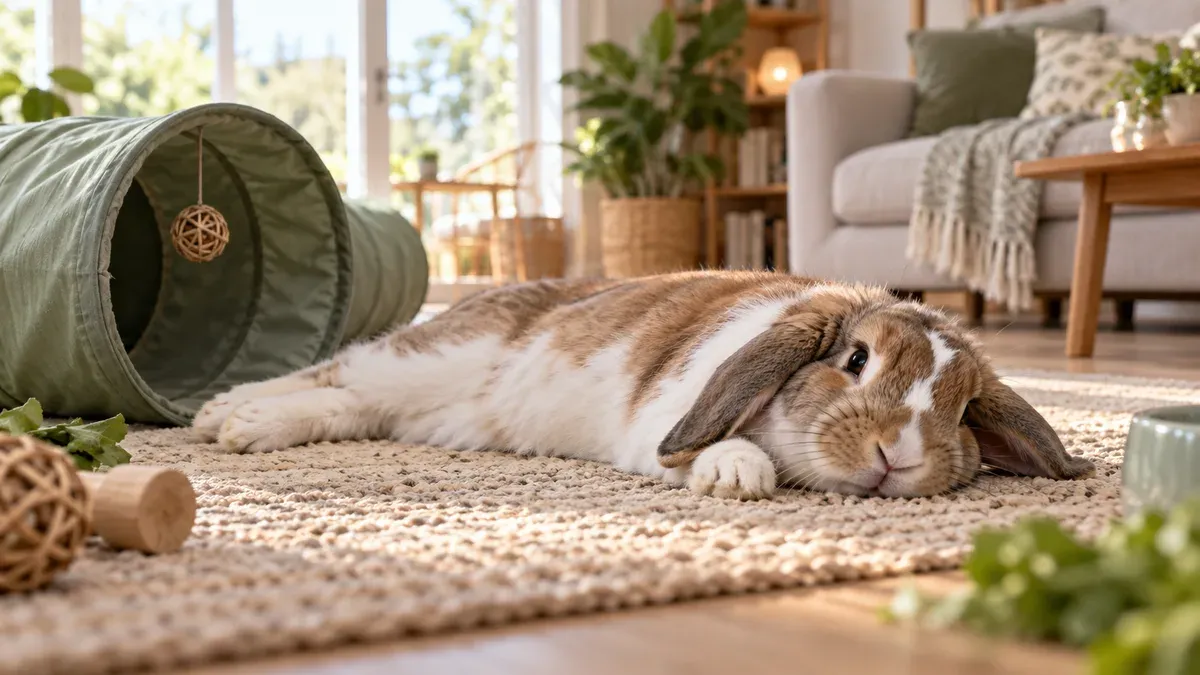
A happy rabbit is recognisable through six observable behaviours: it grazes hay throughout the day, it moves and leaps during its active hours, it lies stretched out flat away from its hiding place, it explores and rearranges things, it comes over to you unprompted, and it grooms itself thoroughly. Observe them together and track change over a week: no single sign proves on its own that a rabbit is doing well.
The most common mistake is reading rabbit welfare the way you would read a dog’s: a rabbit that tolerates being carried and stays quietly in its corner looks like a contented one. In a prey species, the reverse is usually true. Decoding a single signal — ears, posture, tooth grinding — belongs to how to read rabbit body language; the aim here is different: working out whether the life your rabbit actually leads meets its needs.
Six observable signs that a rabbit is doing well
| What you observe | What it confirms | What its absence points to |
|---|---|---|
| Grazes hay in short sessions all day | Sound digestion and a full day | Hay refused or an unbalanced diet, see why has my rabbit stopped eating hay |
| Runs, changes direction, throws in twisting leaps | Enough space and enough time out | Space too tight or exercise sessions too short |
| Lies on its side, legs extended, out in the open | It feels safe where it lives | An environment perceived as threatening, see how to tame a fearful rabbit |
| Explores, forages, shifts or tips things over | Enough stimulation | Under-stimulation, see how to keep a bored rabbit busy |
| Approaches you uninvited, follows you, asks for attention | An established relationship, no fear | A bond to rebuild, or handling experienced as a constraint |
| Grooms itself fully, clean coat, dry rear end | Physical comfort, retained flexibility | Pain, excess weight or a dental problem: veterinary advice |
No single row is enough on its own. It is their accumulation across several days that separates a rabbit that is thriving from a rabbit that is coping.
The “well-behaved rabbit” trap
A rabbit that does nothing is not a serene rabbit. In a prey species, stillness is first and foremost a survival strategy: not being noticed. The rabbit that hangs back in its pen, does not come out when the room gets busy and “never causes any trouble” is exactly the profile worth examining closely.
To observe curiosity, put a tape- and staple-free cardboard box, or a handful of hay in an unusual spot, into the pen at dusk, then step away. Note whether the rabbit sniffs, nibbles or moves it. No response proves anything on its own; if it persists alongside reduced appetite or droppings, contact a vet.
That is the boundary not to blur: boredom slows a rabbit down, pain switches it off. A hunched, unresponsive rabbit that is also eating less does not have an enrichment problem, it needs examining, as set out in how to tell if a rabbit is in pain.
The seven-day welfare check
A general impression is often wrong; a week of notes makes day-to-day comparison more objective. In a notebook or a phone note, record daily:
- Hay: is the rack or pile visibly gone down, morning and evening?
- Droppings: is the quantity and size steady from one day to the next?
- Activity at dawn and dusk: is the rabbit up and moving in both key windows?
- Time genuinely spent out of the pen, timed rather than estimated.
- Contact: how many times did it come to you of its own accord?
- Rest: does it stretch right out, or does it always stay in the “loaf” position, ready to bolt?
After seven days, the weakest line names the job to do. Check exercise time in particular: PDSA recommends at least three hours a day in a large, secure run, and more where possible, as detailed in how many hours of exercise does a rabbit need. Add a weekly weigh-in, which makes visible what the eye misses: the method is in how to weigh a rabbit at home.
Five needs no toy can replace
A thriving rabbit does not need expensive accessories, but these five things do not substitute for one another:
- Space and movement: a pen where it can stand up, stretch out and take a few hops, plus regular daily time outside it.
- Unlimited hay: simultaneously its main food, its longest daily occupation and what keeps its teeth worn down.
- Company: a compatible rabbit is the standard way to meet social needs; human interaction does not fully replace a rabbit companion. The question is settled in can a rabbit live alone.
- Things to chew, dig and forage in: a digging box, cardboard, plant material refreshed regularly.
- A predictable environment: the same routine times, a hiding place always available, no enforced handling.
When one of those five is missing, the others do not make up for it — which is why a rabbit surrounded by toys but shut in twenty-three hours a day is no better off than one without any.
What a happy rabbit is not
Four assumptions distort the picture:
- “It lets me carry it, so it must be happy.” Tolerating being picked up is rarely a sign of contentment, and often a freeze response, as explained in my rabbit doesn’t like being picked up.
- “It never destroys anything, so it must be content.” A rabbit that neither digs nor chews anywhere is a rabbit with nothing to do, or one that does not dare.
- “It is well covered, it loves its food.” Excess weight reduces grooming, mobility and caecotroph intake; the real consequences are listed in my rabbit is getting fat.
- “It lives alone but it seems fine.” The absence of complaint proves nothing: in rabbits, silence is the norm.
When a change of mood is not a welfare problem
Three situations change behaviour without the environment being at fault: sexual maturity, at around 4 to 6 months, which makes a rabbit more restless and more territorial; moulting, which temporarily reduces tolerance to being touched; and age, with a senior rabbit naturally quieter and needing a different kind of monitoring (senior rabbit health).
A rabbit that changes abruptly, on the other hand — stops approaching, hides constantly, stops grooming, refuses hay — is not raising a welfare question but a medical one, on the timescales described in when to see an exotic vet for your rabbit. Where withdrawal dominates the picture, the full triage between normal rhythm, medical cause and setup is in why does my rabbit hide all the time.
Where to go next
One concrete step for tonight: open a note on your phone and start the seven-day log. At the end of the week, fix the weakest line — one only — then run the check again. To work on stimulation, start from how to keep a bored rabbit busy; to interpret a specific signal you notice along the way, keep the body language guide to hand. Our other guides are gathered in the rabbit behaviour section and in the rabbit species profile.
Sources and references
- RSPCA — Rabbit health and welfare
- PDSA — How should I exercise my rabbit?
- University of Bristol — Pet rabbits and exercise
Frequently asked questions
My rabbit never binkies. Does that mean it is unhappy?
Not necessarily. Some adult rabbits, and most seniors, binky very rarely while being perfectly content. What counts is the overall picture: if your rabbit explores, eats its hay, stretches out flat and comes over to you, the absence of binkies means little. It is a recent disappearance of leaps in a rabbit that used to do them that deserves a closer look, starting with mobility and pain.
My rabbit stays completely still when I pick it up. Is that a good sign?
No, often the opposite. A rabbit that lies motionless in your arms is frequently frozen with fear rather than relaxed. A rabbit genuinely comfortable with handling shifts an ear, resettles, blinks. Total stillness in a prey species is a signal worth taking seriously, not a compliment.
Does a rabbit need a companion to be happy?
A compatible rabbit companion meets species-specific social needs. Human interaction remains valuable, but does not fully replace interaction with another rabbit. Before adding a second rabbit you also have to accept neutering, gradual introductions and doubled resources.