How to keep a bored rabbit busy: method and cheap ideas
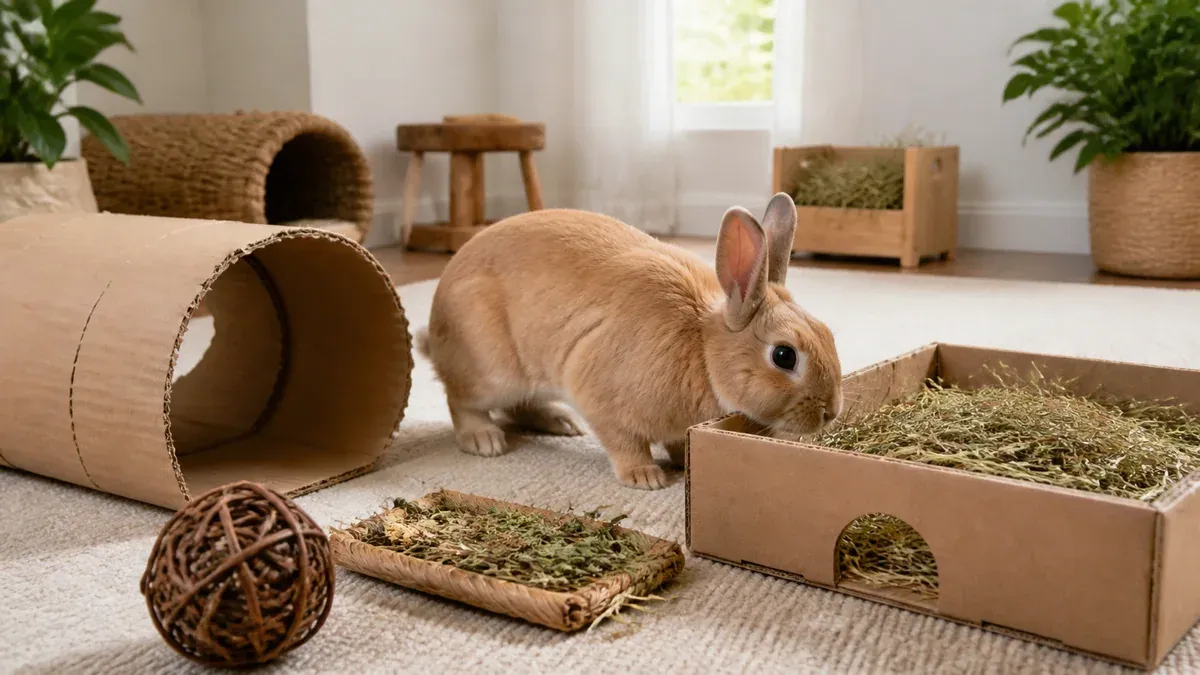
A bored rabbit needs four things to do: forage, chew, dig and explore. The most effective answer is not buying toys but arranging the space: hay spread across several spots, materials to chew, a digging box, cardboard to investigate — all of it refreshed weekly. One check comes first, though: boredom in rabbits very often comes down to a pen that is too small or run time that is too short, and no activity makes up for that.
Telling real boredom apart
Rabbits sleep a lot and rest during the day: that is their rhythm, not boredom. What separates an under-stimulated rabbit from one that is simply resting:
| What you see | Boredom likely | Other lead |
|---|---|---|
| Aimless repetitive behaviour (bar chewing, digging the same spot) | Yes, a classic signal | Frustration over space |
| Constant demands the moment you enter the room | Often | Learned habit, if you give in every time |
| Stillness during normal activity hours (dawn, dusk) | Possible | Pain: worth an examination |
| Targeted destruction (rugs, skirting boards, wallpaper) | Often | Digging instinct, hormones in an unneutered rabbit — see my rabbit destroys everything |
| Daytime sleep with normal morning and evening activity | No | Normal rabbit rhythm |
The one thing to watch: a listless rabbit that no longer reacts even at the hours it should be active, and eats less, needs veterinary advice first. Boredom slows a rabbit down; it does not switch it off.
To place boredom inside a wider picture — space, time out, company, rest, relationship — the seven-day log in how to tell if a rabbit is happy names the weakest point before you start adding activities.
The four needs to cover
1. Foraging for food
This is the most powerful lever and the cheapest. A wild rabbit spends much of its day searching and sorting plants. At home, anything that turns a served meal into a found one is time well spent:
- Spread the hay across three or four points rather than one pile — the amount itself stays unlimited (see how much hay does a rabbit need).
- Stuff a cardboard tube with hay, folded shut at both ends.
- Tuck the daily greens between the layers of a box or under a snuffle mat.
- Scatter the pellet ration instead of using a bowl, where the flooring allows it.
2. Chewing
Rabbits chew for life. Without suitable material, they fall back on whatever is available. Keep on offer at all times:
- untreated branches of apple, hazel or willow, dried and free of mouldy bark;
- plain cardboard and tubes, replaced as soon as they are shredded;
- unvarnished willow or rattan, and compressed hay.
Avoid: conifers (pine, fir, cedar), branches from stone-fruit trees, any treated, varnished or furniture-salvaged wood, and cardboard with ink or tape on it.
3. Digging
The burrowing instinct cannot be trained out, only channelled. A digging box — a large crate filled with torn kraft paper, hay and pieces of cardboard — gives an acceptable outlet and spares the living-room rug. For what a rabbit expresses by digging and the boundaries to set, see why does my rabbit dig everywhere.
4. Exploring
Novelty is often enough. An upturned box with two openings, a tunnel, a crate placed somewhere new, a low platform: the rabbit inspects, circles, climbs up and jumps down. Moving existing items around revives interest without buying anything.
The near-zero-cost enrichment kit
- Cardboard boxes of all sizes, with openings cut into them
- Toilet and kitchen roll tubes, stuffed with hay
- Kraft paper or unprinted newsprint, crumpled
- A digging crate filled with paper and hay
- A fabric or cardboard tunnel
- Safe branches, replaced regularly
- An old towel to push around and rearrange
Three or four of these at a time is plenty: putting everything out at once clutters the space and kills the novelty effect. One useful sign that the kit is too thin: a rabbit that keeps handling its bowl for want of anything else to move (why does my rabbit tip over its bowl). When buying does make sense — a rigid tunnel, a snuffle mat, compressed hay — the safe materials, the ones to rule out and the point at which an object comes away are set out in which toys should you choose for a rabbit.
Rotation: the rule that changes everything
An item that has been in place for two weeks becomes furniture. The most effective method is to keep a third of the material in reserve and rotate weekly: take out two ignored items, bring back two that were put away. The rabbit rediscovers an “old” object as if it were new.
Note what actually gets used while you are at it. Most rabbits have a clear dominant style — forager, chewer, digger or explorer — and a space tuned to that preference beats a complete but generic one.
What does not work (or carries a risk)
- Commercial treats as an activity: highly calorific, they feed boredom as much as the rabbit.
- Bell toys, dangling cords and soft plastic: little used, and swallowed fragments can cause trouble.
- Opening the pen while the rabbit chews the bars: that is a reward, and the behaviour sticks (see why does my rabbit chew the bars).
- A space crammed with objects: rabbits also need clear floor to run on.
- Leaving the TV or radio on “for company”: no effect on the need for activity, and a stressor if the volume is high.
When boredom is not the real cause
Three situations call for something other than enrichment:
- Space or run time is insufficient. This is the most common cause, and no toy compensates for it: start with how many hours of exercise does a rabbit need.
- The rabbit has been alone for a long time. Material enrichment does not replace a companion for a social animal — the question is worth taking seriously in can a rabbit live alone.
- Something hurts. A rabbit that abruptly loses interest in everything, eats less or sits hunched does not need a cardboard box: it needs a rabbit-savvy vet.
Going further
Logical next step: watch for a week what your rabbit genuinely uses, and clear away the rest. A space tuned to its preferences occupies it better than a cluttered one. To go further, browse our rabbit behaviour guides and the rabbit species page.
Frequently asked questions
How much time a day does keeping a rabbit occupied take?
About fifteen minutes, as long as they go into preparing the environment rather than entertaining the rabbit. Hiding hay in several places, refilling a digging box, swapping in a fresh cardboard box: the rabbit then keeps itself busy for hours. Direct attention matters too, but it does not replace a space worth exploring.
Do I need to buy rabbit toys from a pet shop?
Rarely. The most effective activities cost next to nothing: cardboard, paper tubes, unprinted kraft paper, a digging box, tunnels, safe untreated branches. The most useful shop-bought items are plain wood, willow or compressed hay; soft plastic toys with bells or dangling cords add little and carry a swallowing risk.
My rabbit ignores everything I offer — why?
Two causes dominate. Either the items have been out too long and lost their novelty, which a weekly rotation fixes. Or what you offer does not match what this rabbit enjoys: some never dig but love pushing things around, others ignore tunnels and spend their time chewing. Test one category at a time to find the preference.
Does a bored rabbit necessarily need a companion?
Not necessarily, but it is the most complete answer for a rabbit left alone for long stretches. Before adopting a second rabbit, check space, run time and enrichment first: a rabbit frustrated by a cramped pen will still be frustrated as a pair. Living together also requires gradual introductions and doubled resources.