Why does my rabbit tip over its bowl?
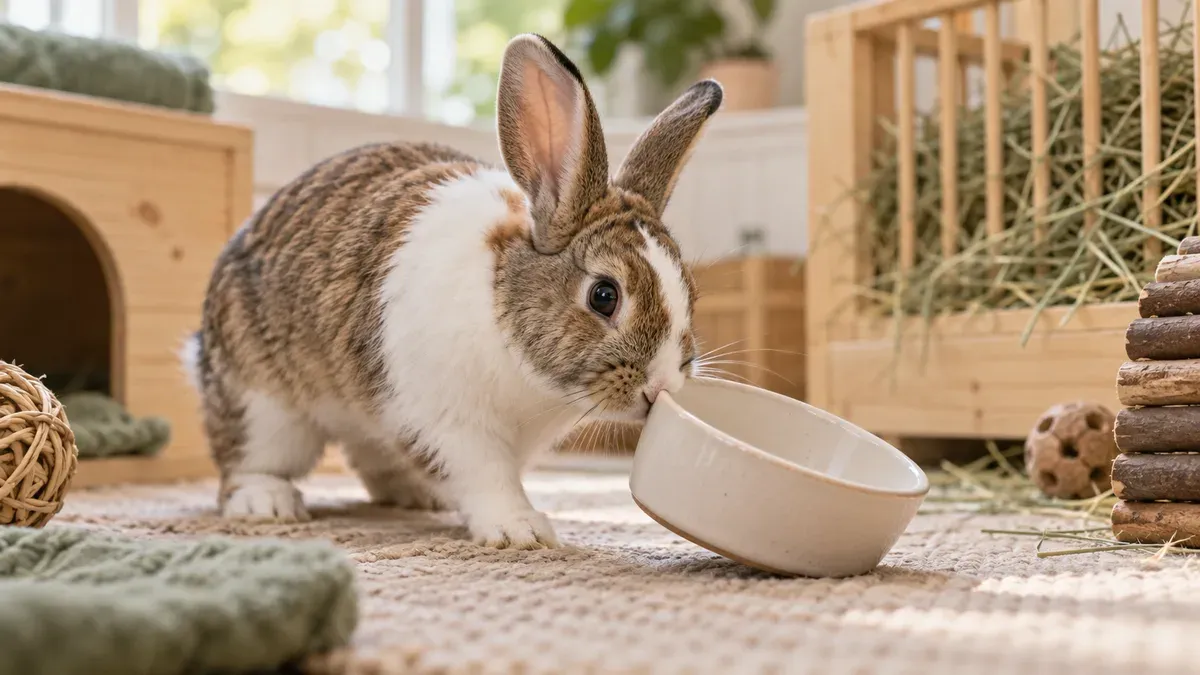
A rabbit that tips its bowl over is, in the vast majority of cases, doing exactly what instinct tells it to do: shift, lift and rummage through whatever sits in its territory. Three drivers cover most situations — an empty bowl it is asking about, a bowl light enough to move without effort, and a need to handle its environment that nothing else is satisfying.
Only one situation calls for a quick response: a water bowl tipped over routinely, leaving a rabbit with nothing to drink for hours. And only one scenario belongs with a vet: a rabbit that suddenly starts tipping its bowl when it never used to, while eating less.
Sorting by what gets tipped, and when
| What is tipped | Typical timing | Most likely driver | What to change |
|---|---|---|---|
| Empty pellet bowl | After the meal | Asking for more, playing with a light object | Heavier bowl, review the ration |
| Full pellet bowl | At feeding time | Excitement, selective feeding | Feed before opening the pen, single-component pellet |
| Water bowl | Any time | Unstable bowl, play, heat | Heavy ceramic plus a second water point |
| Bowl and litter together | Evening and night | Digging instinct with no outlet | A dedicated digging box |
| Everything loose, out of nowhere | New habit | Pain, hormones, recent change | Veterinary examination |
The action, from the rabbit’s point of view
Watch a rabbit do it: it slides its nose under the rim, lifts, then shoves with its head or a front paw. That is the very movement it uses to dig a burrow and move soil, described in why does my rabbit dig everywhere. A plastic bowl weighing a few dozen grams is, from that angle, an object perfectly designed to be flipped.
So the behaviour is not anger, not revenge and not a complaint aimed at you. It becomes a problem only through its consequences: spilled water, pellets scattered through the litter, noise at night.
The water bowl: the one case that cannot wait
A rabbit that tips its water bowl at 10 pm spends the night with nothing to drink. The risk is not theoretical: a rabbit fed mainly on dry hay and pellets depends entirely on its bowl for hydration, with requirements in the region of 50 to 100 ml per kilo per 24 hours according to the clinical sources set out in how much water does a rabbit drink. In hot weather that shortage compounds an already poor ability to regulate body temperature (heatstroke in rabbits).
Three measures are enough:
- A ceramic or stoneware bowl with a wide base, one the rabbit cannot lift with a flick of its nose.
- A second water point at the other end of the living space. If one goes over, the other stays.
- A visual check morning and evening, at the same time as the hay goes in. An empty bowl does not announce itself.
A sipper bottle can serve as a backup, never as the only source: the flow rate is often inadequate and the head-up drinking posture stays uncomfortable.
When it is the pellet bowl
Here the behaviour is telling you something about the ration itself.
- The bowl is emptied in minutes, then tipped. The rabbit is still looking: the pellet ration may be gone too quickly to occupy the day. Reference amounts, in grams per kilo of bodyweight, are in how much pellets to feed a rabbit — while hay itself stays available at all times.
- The rabbit sorts through it first, then tips. That is the signature of a seed mix, from which it picks out the fatty, sugary pieces and rejects the rest: the problem is the product, not the bowl (why seed mixes are bad for rabbits). A single uniform pellet removes the option of selective feeding.
- The bowl is a toy between meals. This is the most common signal in an under-occupied rabbit: the bowl is the only object in its space it can actually manipulate. Near-zero-cost alternatives are gathered in how to keep a bored rabbit busy.
One approach works particularly often: scatter part of the ration for foraging, through hay or in a dedicated box, rather than serving all of it in the bowl. The rabbit gets back the searching behaviour the bowl was standing in for.
The kit that solves most cases
- Material: ceramic, stoneware or weighted stainless steel. Light plastic goes over with one nudge.
- Shape: wide base and low rim, rather than a tall narrow container that topples.
- Diameter: around 12 to 15 cm (roughly 5 to 6 in) for a dwarf rabbit, more for a large breed, so that the whiskers do not rub against the sides.
- Placement: on the floor, on a flat non-slip area, away from the litter tray — a bowl placed too close ends up full of kicked-out litter.
- Support: a non-slip mat or tile under the bowl stops it sliding and dampens the noise.
If the rabbit persists with a heavy, well-placed bowl, the equipment angle is exhausted: this is no longer about the container, it is about a need for activity or a discomfort to identify.
When it stops being behaviour
Four situations fall outside behaviour and justify an examination:
- Sudden onset in a rabbit that never did it, with no change of bowl or position.
- The rabbit approaches, picks up a pellet, then drops it, or chews on one side only: dental pain heads the list, and it is covered in dental malocclusion in rabbits.
- The bowl is tipped and the rabbit is eating noticeably less. In this species, a marked reduction or stop in eating means contacting a vet immediately (my rabbit is not eating).
- The behaviour comes with a hunched, unresponsive rabbit or loud tooth grinding: the bowl stops mattering and the subject becomes rabbit emergency signs.
The hormonal explanation, often overlooked
In an unneutered rabbit, tipping bowls sometimes belongs to a wider pattern: marking, moving objects around, constantly reorganising the territory. These behaviours appear with sexual maturity, at around 4 to 6 months, and usually settle after neutering, as set out in should you neuter a male rabbit. In females, a nest-building episode brings the same urge to move everything.
What does not work
- Telling the rabbit off or banging on the pen. It does not link the telling-off to the action, it links your approach to something unpleasant.
- Putting the bowl back every time, in front of the rabbit. The back-and-forth becomes a highly rewarding game.
- Filling it fuller in the hope that a full bowl is heavier: it barely is, and the extra pellets unbalance the ration.
- Removing the water bowl overnight because it will only be tipped. That is the one genuinely dangerous response on this list.
Where to go next
Practical next step: swap the water bowl for a wide-based ceramic model, add a second water point, then watch for three days. If the behaviour persists despite a stable container, the subject is no longer equipment but occupation — start with how to keep a bored rabbit busy, and browse our rabbit behaviour guides and the rabbit species page.
Frequently asked questions
My rabbit only tips its bowl over at night. Why?
Because that is when it is awake. Rabbits are crepuscular: they are most active in the early morning and early night, exactly when the house goes quiet. A bowl being shoved around at those hours reflects the normal rhythm of the species rather than deliberate mischief. If the noise is the problem, a ceramic bowl on an absorbent mat cuts the racket considerably, and moving the living space away from the bedroom handles the rest.
Should I clip the bowl to the bars so it cannot be tipped?
Clip-on bowls do work, but they often force the rabbit to eat with its head raised in an unnatural posture, and they get dirty quickly. A heavy ceramic bowl on the floor usually gives better results without constraining posture. Keep the clip-on model for rabbits that persist despite a heavy bowl, or for pens where floor space is tight.
My rabbit tips the bowl the moment I fill it. Is that impatience?
It is common and there is nothing aggressive about it. Many rabbits associate your presence with food and start handling anything that moves around feeding time, out of sheer excitement. Feed before you open the pen rather than after, put the bowl down without any back-and-forth, and stop picking it up to reposition it: a repeated action quickly becomes an interaction game.
Can a tipped bowl be a sign of dental pain?
It can be, when the behaviour appears suddenly in a rabbit that never did it, especially if it approaches the bowl, picks up a pellet and then drops it. Dental pain often shows up as an appetite frustrated by the act of chewing itself. In that case it is not the bowl that needs changing, it is the rabbit that needs examining.