Which toys should you choose for a rabbit?
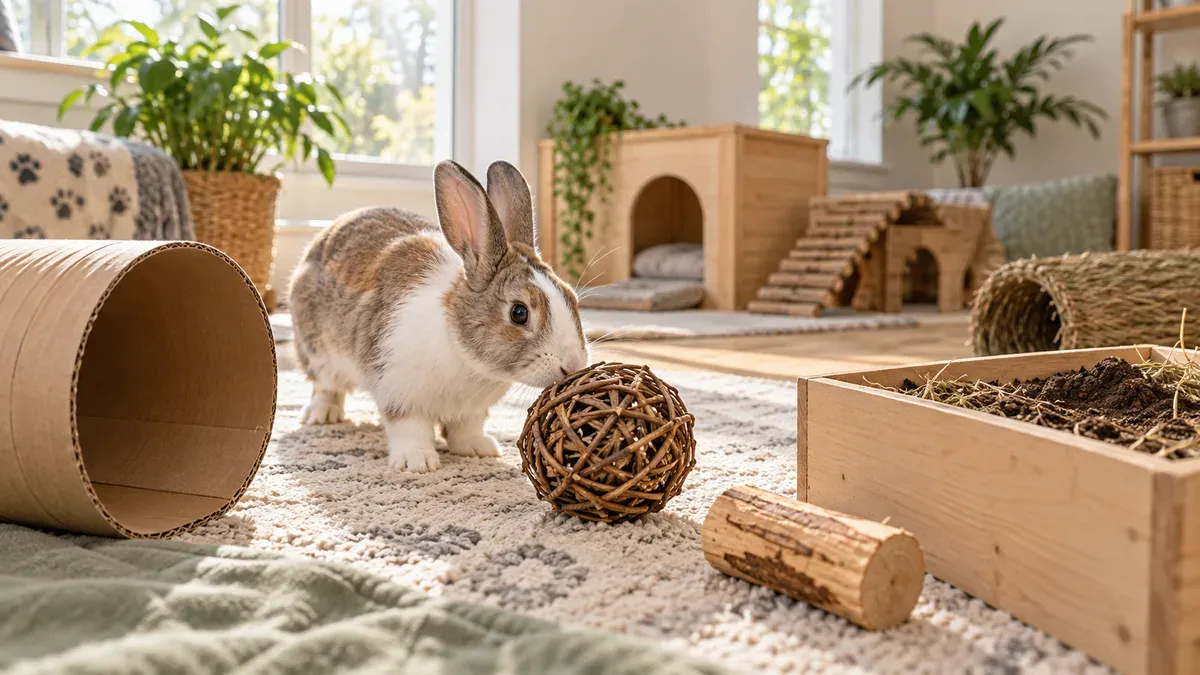
A good rabbit toy is not one the rabbit “likes”, it is an object that channels a behaviour the animal would perform anyway: foraging for food, chewing, digging, shoving, exploring. So the choice runs in that order — need first, material second, product last.
This page is about selecting an object and keeping it safe. The day-to-day enrichment method — how to spread things out, rotate them, avoid clutter — is covered in how to keep a bored rabbit busy, and the space it all has to fit into in how to set up an indoor pen for a rabbit.
Start from the need, not the shop aisle
Rabbits have a clear dominant habit, and an object that does not match it stays on the floor. Work out first what yours does spontaneously.
| What the rabbit does | The need behind it | What works | What disappoints |
|---|---|---|---|
| Roots through hay, sorts it, scatters it | Foraging | Hay spread across several points, a cardboard tube stuffed with hay, a snuffle mat | Pellet-dispensing gadgets, treat balls |
| Chews skirting boards, bars, furniture legs | Chewing | Safe untreated branches, plain cardboard, unvarnished willow or rattan, compressed hay | Coloured sticks bound with syrup, varnished wood |
| Digs at the carpet, scrapes in a corner | Digging | A rigid digging box, shredded kraft paper, a dedicated old rug | Digging objects too small or too light |
| Tips its bowl, moves everything | Shoving and moving | A willow ball, a wooden cup, a thick towel to drag | Objects too heavy, or fixed to the floor |
| Inspects, circles, climbs | Exploring | A rigid tunnel, a box with two openings, a low platform | An object always left in the same place |
If the rabbit chews the bars or wrecks the skirting boards, the object is only part of the answer: the causes are covered in why does my rabbit chew the bars and my rabbit destroys everything. Likewise, a rabbit digging at the carpet is expressing an instinct that can be channelled but not corrected (why does my rabbit dig everywhere), and a rabbit that plays with its bowl for want of anything else is telling you something (why does my rabbit tip over its bowl).
Materials: what passes and what does not
A rabbit does not play with an object, it eats it gradually. Material is therefore the first safety criterion, ahead of shape and ahead of brand.
| Material | Verdict | Why |
|---|---|---|
| Untreated plain wood (apple, hazel, willow) | Safe | Reduces to shavings and fibres, with no sharp edge |
| Willow, unvarnished rattan | Safe | Comes apart into strands that pass without notable risk |
| Cardboard with no ink or glue | Safe | Reduces to crumbs; replace often |
| Compressed hay, plant fibres | Safe | Edible by design |
| Thick non-fraying fabric | Conditional | Remove as soon as it pulls into threads |
| Hard, unchewable plastic | Conditional | Fine for a tunnel or a box, never as a chew item |
| Soft plastic, toys with bells | Rule out | Fragments and gets swallowed; the bell is a loose small object |
| String, twine, wool | Rule out | Swallowed threads form a foreign body that is hard to clear |
| Painted, varnished, stained or chipboard wood | Rule out | Glues and finishes are not meant to be eaten |
| Conifers (pine, fir, cedar), stone-fruit trees | Rule out | Species not advised for rabbits |
What the “rule out” column has in common is the swallowing of indigestible fragments. In an animal that cannot vomit, a swallowed foreign body rarely resolves on its own — which is also why gut transit deserves watching, as set out in GI stasis in rabbits and my rabbit is swallowing fur.
For branches you gather yourself, the rule is the same as for houseplants: check the species before offering it, and the list of what is toxic is in which houseplants are toxic to rabbits.
Five questions to ask before buying
- Which need does this object cover? If the answer is “it’s cute”, it will end up in a corner.
- What exactly is it made of? A “natural” label says nothing. Plain wood is recognisable by touch; varnish shows up in the light.
- What happens if the rabbit swallows a piece? An object that reduces to plant fibres is not the same problem as one that breaks into shards.
- What does it look like half-chewed? That is the state it will spend most of its life in. A sharp edge or an exposed staple disqualifies it.
- Is it the right size? An object meant to be shoved must be movable by the rabbit; a tunnel must allow a turn without getting stuck, or it will never be used again.
One common trap is worth naming: treat-dispensing objects. They do occupy, but they also feed, and commercial treats are calorie-dense for little nutritional return — the subject is covered in are rabbit treats useful. Hay, by contrast, can be handed out without counting: it is the only bait to use freely, in the proportions set out in how much hay a rabbit needs.
Testing a new toy
A new object is not presented, it is put down. The method that gives the most reliable answer comes down to four points.
- Put the object on the floor, somewhere the rabbit passes, without showing it or calling the rabbit over.
- Give the rabbit several opportunities to explore it, without blocking clear floor space. Rabbits often inspect at night and at first light.
- Watch what the rabbit does with it, not whether it approaches: sniffing does not count; chewing, digging, shoving or going inside do.
- Review it after several sessions. Used, it joins the rotation. Ignored, it is put away and retested in a few weeks, or swapped for another category.
This test avoids the most expensive mistake: piling up objects from one family because the first “seemed to go down well”. Three or four well-chosen objects in rotation occupy a rabbit better than a crowded pen — and a cluttered space takes away the clear run the rabbit needs, as the reference points in how many hours of exercise a rabbit needs make clear.
When to take a toy away
An enrichment object is a consumable. Remove it without hesitation when:
- it sheds hard fragments — plastic, paint, a staple, a spring;
- it leaves a sharp edge or a point once chewed;
- it reduces to threads or filaments the rabbit pulls at with its teeth;
- it is soiled with urine or droppings and cannot be washed;
- it turns mouldy: damp cardboard or a damp branch is thrown out, not dried out;
- the rabbit gets a foot, its head or an ear caught in it, even once.
Cardboard items are replaced at the rate they are destroyed, which is normal and part of their job. Plain wood items last months. Fabric can be washed, but goes for good as soon as it frays.
Adapting to size, age and situation
- A large rabbit needs heavier objects to stand up to it, and wider tunnels: a tunnel that is too narrow becomes a trap rather than a shelter.
- An older or arthritic rabbit makes little use of anything requiring rearing up or climbing. Favour floor level: a low digging box, hay spread around, objects to shove.
- A rabbit living alone spends more hours without stimulation, so rotation matters more. Objects still do not replace a companion for a social animal.
- An unneutered rabbit approaching sexual maturity may destroy more: objects channel the behaviour, they do not address the hormonal cause.
The rest of the kit — tray, hideaway, bowls, carrier — is ranked by real usefulness in what accessories are truly essential for a rabbit.
Where to go next
A concrete next step: for one week, note each evening what your rabbit actually used. You will end up with its dominant habit — forager, chewer, digger, shover or explorer — and that is what should drive the next purchase, not the shop aisle. Then take away whatever served no purpose: clear space beats full space. The rest of our guidance is gathered in the rabbit accessories section and on the rabbit species page.
Sources and references
Frequently asked questions
Do I need to buy toys, or is cardboard enough?
Plain cardboard, paper tubes and safe branches already cover most of the need, and they are what gets used day to day. Buying makes sense mainly for what is hard to improvise: a rigid tunnel that lasts, a washable snuffle mat, compressed hay. The criterion is the need covered, not the novelty of the product.
How can I tell whether a toy is safe for a rabbit?
Three questions settle it: what is it made of, what happens if the rabbit swallows a piece, and what is left of it half-chewed? Untreated plain wood, unvarnished willow, cardboard and compressed hay all pass. Soft plastic, bells, string and painted items do not.
My rabbit is ignoring the toy I just bought. What now?
Leave it on the floor under supervision and watch what the rabbit does with it. An object ignored after several opportunities probably does not match its dominant habit: some rabbits forage, some chew, some shove everything around. Put it away and test another category rather than accumulating.
Can I give branches gathered outdoors?
Yes, provided they come from a safe species — apple, hazel, willow — have not been treated, do not grow at a roadside, and are dried before being offered. Conifers, stone-fruit trees and any varnished, painted or reclaimed furniture wood should be ruled out.